











Trading charts laptops. Source: TechGaged / Shutterstock
21Shares Researcher Warns Token Launches Are Broken; Here’s Why
In Brief
- • Most crypto tokens now trade below their launch price.
- • Oversupply and poor incentives are driving weak performance.
- • The token launch model is increasingly being questioned.
Ad
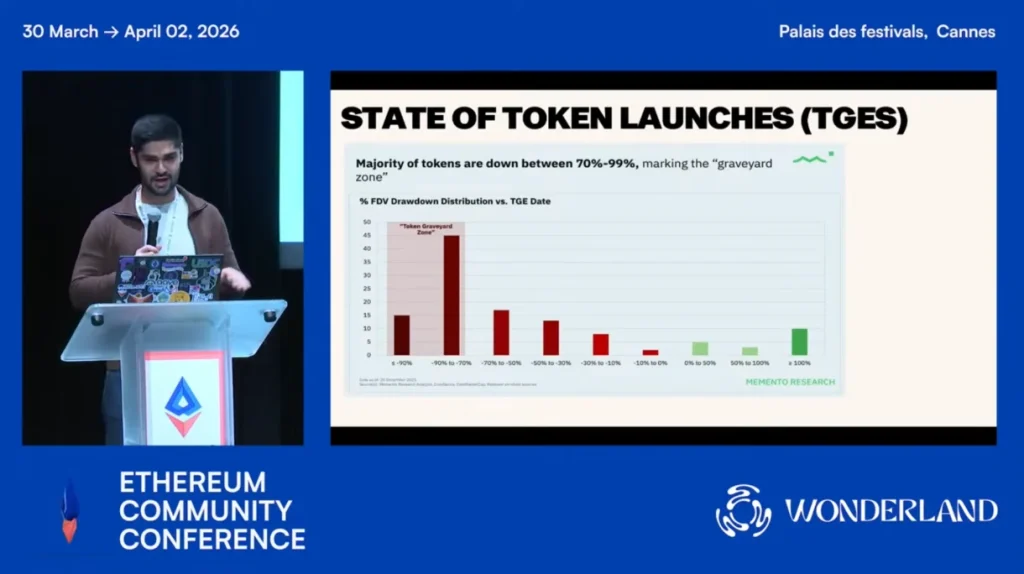
Around 85% of crypto tokens now trade below their launch price, according to research shared by 21Shares researcher Darius Moukhtarzade. In fact, many of them are down between 70% and 99% after their launches, and very few recover. The numbers point to a market where launching a token has become easier than sustaining one.
Too many tokens, not enough demand
As the researcher pointed out in a speech at the annual Ethereum Community Conference streamed on March 31, the market has been flooded, with tens of millions of tokens now existing across networks like Solana, Base and BNB Smart Chain. That explosion spreads both liquidity and attention thin.
“We have a different market than in the past. There’s way more tokens out there, which also means attention and capital is spread way more thin than we used to have it back in the day.”
Even strong projects struggle because capital rotates faster and users jump between narratives. AI has also pulled away from crypto, competing for the same developers and investment flows.
![Moukhtarzade's presentation at [EthCC].](https://techgaged.com/app/uploads/2026/04/image-2-1024x570.webp)
At the same time, many teams still follow the old launch model. High valuations combined with low circulating supply create immediate selling pressure.
“High FTV equals low float, and the main reasoning for this is that there’s higher dollar sell pressure if you launch at a higher FTV. (…) Projects that launch at an FTV of $100 million and below are three times more likely to have successful TG than projects that launch at the FTV of $500 million and more.”
Airdrops don’t help either, as most recipients sell quickly, and other early participants often do the same. That leaves new buyers absorbing supply right after launch.
Why the model is breaking
The deeper issue is incentive design. Most tokens reward selling instead of holding. Early investors want out, retail tries to front-run them, and teams unlock over time, turning the whole affair into a race.
“And then we have this race to the exit because the early investors want to sell before the public. The public wants to sell before the team. Everybody looks at the vesting schedules and the unlocks. It’s basically a race to the exit.”
Moukhtarzade argues this structure is reaching its limit. Projects now need real usage before launching. That means product-market fit, users who stay without incentives, and revenue that exists without a token attached.
The next phase may look different. Tokens tied to actual value, including revenue or equity-like structures, are starting to replace pure governance tokens.
“Design your token so people make money by holding your token and not by selling. Because if you look in the past, how do you make money with most tokens? Basically by selling it.”
All things considered, the market isn’t rejecting tokens per se, but it’s a bit unfriendly to the weaker ones. And right now, there are way too many of those.
How do you rate this article?
Subscribe to our YouTube channel for crypto market insights and educational videos.






Join our Socials
Briefly, clearly and without noise – get the most important crypto news and market insights first.





8
Also read
Similar stories you might like.

Altcoins
2 AI Tokens to Buy Right Now
Azeez | 2026-04-01

Bitcoin
CZ Explains Why Quantum Computing Won’t Kill Crypto
Ana | 2026-04-01
Blockchain
Swift Tests Blockchain System For Global Payments
Ana | 2026-03-31

Bitcoin
New U.S. Bill Backs Domestic Bitcoin Mining Industry
Ana | 2026-03-31
Industry
AI Tokens Split from Crypto; Up 6% While the Market Drops 21% in Q1
Jastra | 2026-03-31

Bitcoin
Quantum Breakthrough Sparks Fresh Fear for Bitcoin Security
Ana | 2026-03-31

Altcoins
Ripple CEO Says U.S. Can’t Survive “Gensler 2.0”
Rokas | 2026-03-31

Blockchain
Crypto Apps Exposed to Risk After Malicious Axios Versions Go Live
Rokas | 2026-03-31

Market
How Accurate Are Robert Kiyosaki’s Predictions?
Sead | 2026-04-01

Industry
Trump Backs Bitcoin, Stablecoins In New Pro-Crypto Push
Ana | 2026-03-30