













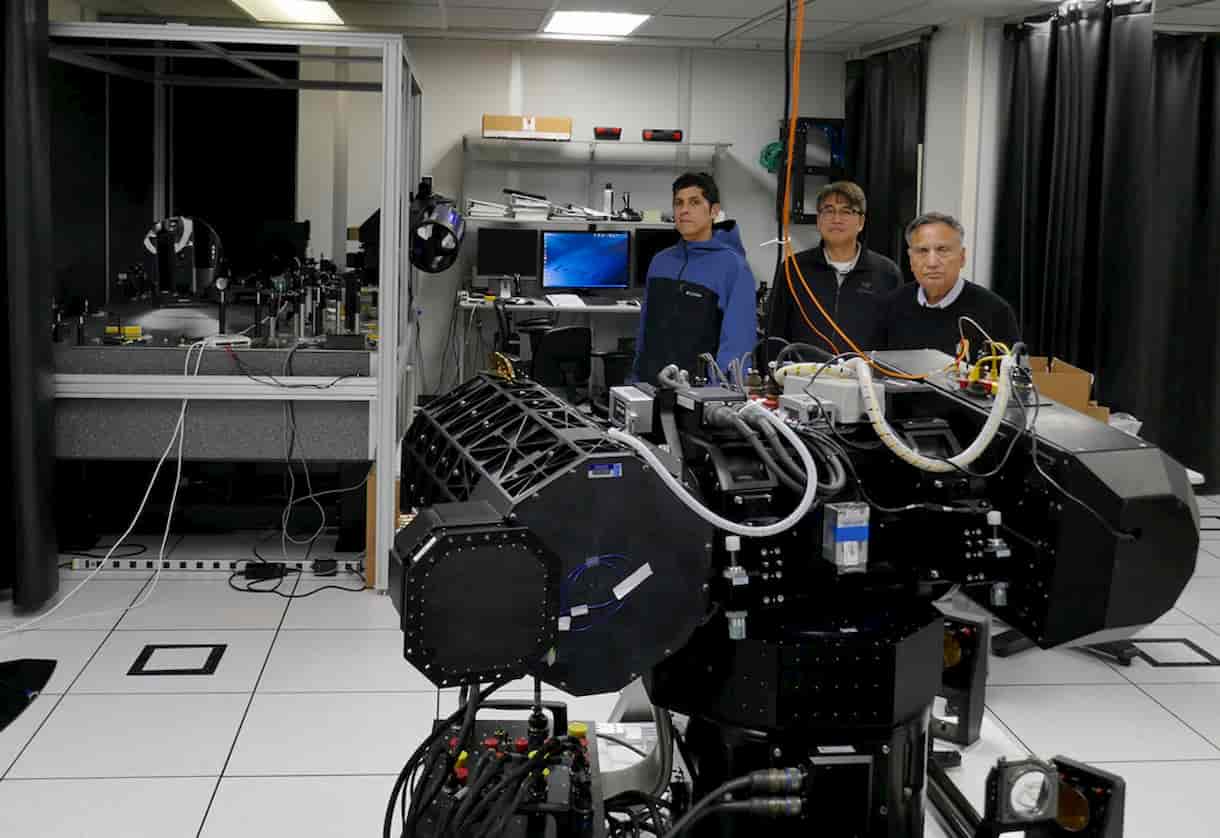
Naval Post Graduate school researchers with the laser system
U.S. naval school develops AI method to accurately assess drone threats
The U.S. Naval Postgraduate School (NPS) has developed a method that uses AI to accurately assess drone threats.
Ad
A press release on 14 February says the new method was developed in response to the recent proliferation of threats from inexpensive, uncrewed autonomous systems (UAS), or drones.
Researchers at the NPS are working with collaborators to automate critical parts of the tracking system used by laser weapon systems (LWS) to effectively neutralize hostile UAS.
Increasing capacity against hostile UAS
The aim of applying AI is to improve the capacity of LWS to rapidly detect and neutralize hostile UAS.
Ad
Because of the numerous steps and procedures required to successfully engage an adversarial UAS, its operation by human agents can be time consuming, especially when many drones are involved. This is where the new system shines.
It will improve target classification, pose estimation, aimpoint selection and aimpoint maintenance to improve overall capability of the LWS to effectively neutralize threats.
Distinguished Professor Brij Agrawal of the NPS Department of Mechanical and Aerospace Engineering, who leads the NPS team said:
“Defending against one drone isn’t a problem. But if there are multiple drones, then sending million-dollar interceptor missiles becomes a very expensive trade off because the drones are very cheap. The Navy has several LWS being developed and tested. LWS are cheap to fire but expensive to build. But once it’s built, then it can keep on firing, like a few dollars per shot.”
The system is being developed in collaboration with Naval Surface Warfare Center Dahlgren Division, Lockheed Martin, Boeing and the Air Force Research Laboratory (AFRL).
By placing the operator on-the-loop overseeing the tracking system instead of in-the-loop manually controlling it, the system can more accurately and quickly assess and neutralize threats.
The research is funded by the Joint Directed Energy Transition Office (DE-JTO) and the Office of Naval Research (ONR) and is expected to revolutionize aerial threat assessment and neutralization for the naval defense forces.
AI use in technology
Artificial intelligence has become rapidly popular and found uses in many ways in technology, some of which are unexpected.
As Techgaged reported last week, scientists have used the technology to develop asphalt that is self-healing to make longer lasting roads.
Meta is also using the technology to develop a way through which bots can read people’s minds and provide care and assistance to them even if they are unable to speak.
These use cases are all geared towards improving the living conscious of humans and making life more worthwhile.
How do you rate this article?
Subscribe to our YouTube channel for crypto market insights and educational videos.






Join our Socials
Briefly, clearly and without noise – get the most important crypto news and market insights first.

Most Read Today
1
Samsung crushes Apple with over 700 million more smartphones shipped in a decade
2Peter Schiff Warns of a U.S. Dollar Collapse Far Worse Than 2008
3Dubai Insurance Launches Crypto Wallet for Premium Payments & Claims
4XRP Whales Buy The Dip While Price Goes Nowhere
5Luxury Meets Hash Power: This $40K Watch Actually Mines Bitcoin
Latest






8
Also read
Similar stories you might like.

Artificial Intelligence
Robert Kiyosaki Warns AI Bubble May Be Bigger Than Dot-Com
Ana | 2025-12-24

Artificial Intelligence
New Epstein Disclosures Collide With an AI Project Built Months Earlier
Ana | 2025-12-22

Artificial Intelligence
Gemini Can Now Detect AI-Generated Files
Shedrach | 2025-12-19

Artificial Intelligence
Fetch.ai Launches Autonomous AI-to-AI USDC Settlement
Shedrach | 2025-12-19

Artificial Intelligence
Tesla Semi Tease Hints At Big Changes Under The Hood
Ana | 2025-12-19

Artificial Intelligence
Scientists Use AI to Crack Nature’s Hidden Laws
Ana | 2025-12-18

Artificial Intelligence
Can AI Ever Be Proven Conscious? A Philosopher Says No
Ana | 2025-12-18

Artificial Intelligence
Researchers Uncover Hidden Bias in Cancer Diagnosis AI
Ana | 2025-12-17

Artificial Intelligence
AI Learns Math Better by Arguing With Itself
Ana | 2025-12-15

Artificial Intelligence
Breakthrough AI Enables Seamless Control of Prosthetic Hands
Shedrach | 2025-12-12