







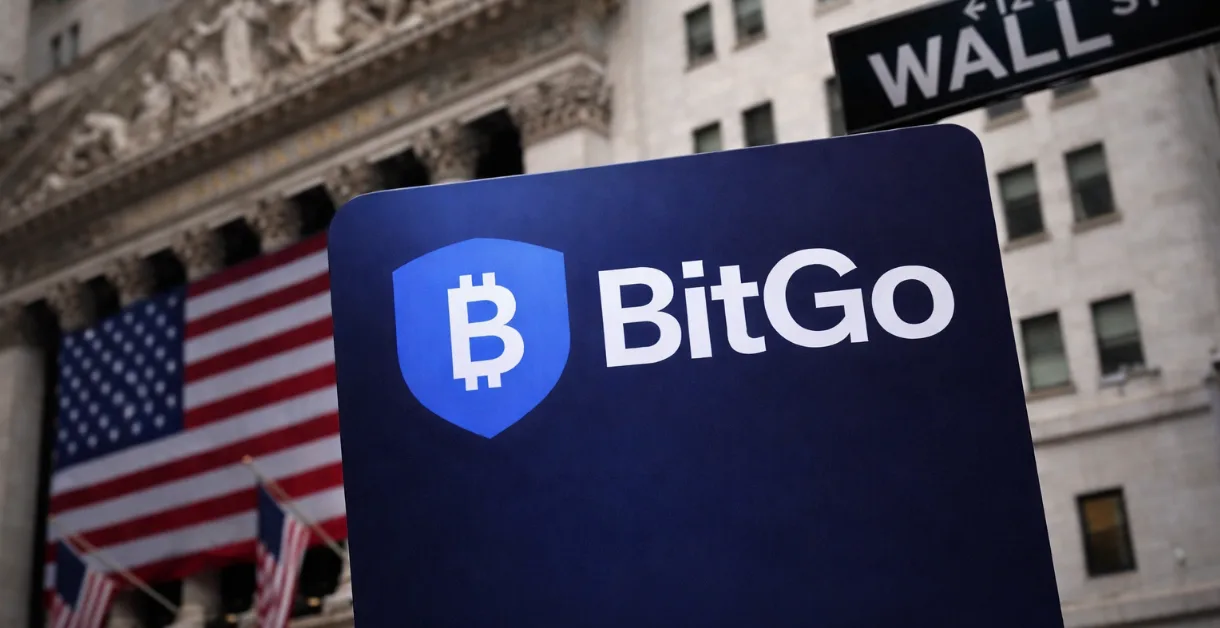
BitGo Logo shows in front of Wall St. With the US Flag waving in the back. Source: TechGaged / Shutterstock.
The First Regulated Tokenized Equity Trade Is Now Live in the U.S.
In Brief
- • BitGo and Figure completed the first tokenized equity trades on a regulated U.S. ATS.
- • Blockchain-based settlement reduces clearing friction and settlement risk.
- • Institutional custody integration signals growing real-world deployment of tokenized securities.
Tokenized equities have moved from theory to execution. BitGo and Figure announced the completion of the first tokenized equity trades on Figure’s Alternative Trading System (ATS). Marking a milestone for blockchain-based securities within a regulated U.S. market structure.
The transaction represents the first time equity securities were issued, settled, and traded in tokenized form through Figure’s SEC-registered ATS infrastructure.
Therefore, the development positions tokenization not as a side experiment, but as an operational extension of regulated capital markets.
What Happened Inside the Trade
The press release confirms that BitGo, acting as a qualified custodian, partnered with Figure to facilitate equity issuance and secondary trading using blockchain infrastructure.
The equities were tokenized, meaning ownership was represented digitally on-chain rather than via traditional book-entry systems.
Crucially, the trading occurred on Figure’s registered Alternative Trading System, not a decentralized exchange.
This a very important distinction since tokenized equities were transacted within existing regulatory frameworks rather than outside them.
Moreover, the structure combined blockchain-based settlement with institutional custody and compliance controls.
By doing so, the firms demonstrated that tokenized securities can operate within U.S. securities law parameters.
The transaction effectively compresses the traditional equity lifecycle. Indeed, issuance, settlement, and secondary transfer occur with near-instant reconciliation rather than multi-day clearing cycles.
Tokenized Equities Change Capital Market Efficiency
Tokenization reduces operational friction across several layers of equity markets. First, settlement risk declines when ownership updates occur in real time.
Traditional equities typically settle on a T+1 or T+2 basis, introducing counterparty and liquidity risk. Therefore, on-chain tokenization allows near-simultaneous finality.
Second, programmable compliance can embed transfer restrictions, eligibility rules, and reporting requirements directly into the asset itself.
As a result, this reduces reliance on manual reconciliation and third-party clearing infrastructure.
Third, custody integration with firms like BitGo signals institutional readiness. Indeed, regulated custody remains one of the largest barriers to tokenized asset adoption.
While tokenized equity markets remain early-stage, this transaction indicates a shift from pilot programs toward operational deployment.
Furthermore, if scalability follows, tokenized securities could materially alter how private and alternative assets are issued and traded.
More Must-Reads:
How do you rate this article?
Subscribe to our YouTube channel for crypto market insights and educational videos.






Join our Socials
Briefly, clearly and without noise – get the most important crypto news and market insights first.

Most Read Today
1
Crypto’s ‘Middle Class’ Is Shrinking Fast — Mid-Priced Tokens Down 32%
2XRP Whales Buying Rises Ahead of Major Ripple XRPL Japan Event
3AIxCrypto (NASDAQ: AIXC) Stock Jumps After On-Chain AI Agent Progress, Enterprise Testing Begins
4Bitcoin Rejects $70K as Geopolitical Tensions Rise
5Robert Kiyosaki Prediction Accuracy: Full Report (1990–2026)
Latest




8
Also read
Similar stories you might like.
Bitcoin
Bitcoin Rejects $70K as Geopolitical Tensions Rise
Ana | 2026-04-07

Blockchain
JPMorgan Projects Massive Growth in Tokenized Markets This Decade
Ana | 2026-04-07
Market
Crypto’s ‘Middle Class’ Is Shrinking Fast — Mid-Priced Tokens Down 32%
Jastra | 2026-04-07

Defi
Korea and France Rush Into Crypto Talks as Regulatory Changes Loom
Ana | 2026-04-07
Altcoins
XRP Whales Buying Rises Ahead of Major Ripple XRPL Japan Event
Rokas | 2026-04-07
Altcoins
Solana Builds Real-Time Threat Detection and Response Network
Rokas | 2026-04-07
Altcoins
SUI at Crossroads: AI MemWal, USDsui and Inflows Could Drive Price Performance
Azeez | 2026-04-07

Altcoins
Chainlink’s ETF, Coinbase Deal, and Dev Surge – What’s Coming?
Azeez | 2026-04-07
Industry
DeFi Development (NASDAQ: DFDV) Files 8-K as Executive Exit and Business Wind-Down Emerge
Rokas | 2026-04-07
Industry
AIxCrypto (NASDAQ: AIXC) Stock Jumps After On-Chain AI Agent Progress, Enterprise Testing Begins
Rokas | 2026-04-07