












Vibrant green and red candlestick patterns showing market volatility. Source: TechGaged / Shutterstock.
TAO Subnet Reality Check: Revenue vs. Subsidies – What Investors Must Know After the Rally
In Brief
- • TAO relies partly on subsidies, not just revenue.
- • Weekly charts show cautious bullish signs.
- • 72B LLM milestone boosts adoption potential.
Bittensor’s TAO made headlines with a sharp March 2026 rally fueled by Nvidia’s endorsement and subnet token mania. Yet behind the price action lies a key question: is network growth driven by genuine demand or largely by protocol subsidies?
As TAO consolidates post-rally, subnet economics reveal both progress and persistent gaps.
Is the TAO Rally Built on Real Revenue or Emissions?
Bittensor’s subnet architecture rewards miners and validators with TAO emissions for contributing intelligence across 129 active subnets. Owners capture 18% of issuance, creating incentives.
However, external revenue—actual payments for AI inference and compute—remains modest.
The December 2025 halving cut daily emissions from 7,200 to 3,600 TAO, tightening supply, yet many subnets still rely heavily on rewards rather than organic fees.
What Do the Weekly Charts Reveal?
The TAOUSD weekly chart, timestamped 04:38 UTC on April 2, shows price at $304.17 after a 1.26% decline.
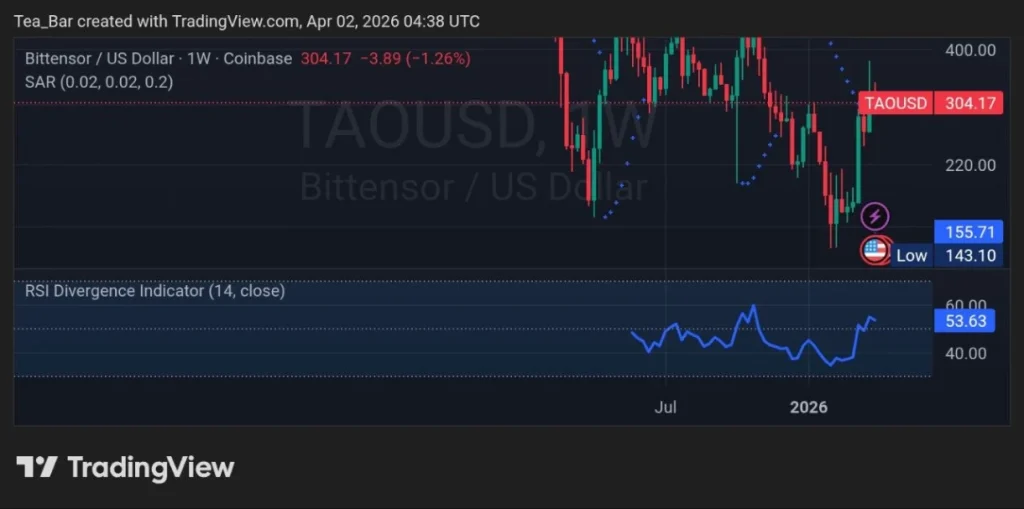
Parabolic SAR dots remain above price, signaling short-term caution, but the RSI Divergence Indicator (14) at 53.63 printed a fresh “Bull” signal, echoing previous 2025–2026 upturns.
The chart also reflects a series of higher lows from the $143 bottom, showing that buyers remain active at key levels.
Against Bitcoin, the TAOBTC pair trades at 0.004592, up 1.46% on the week, suggesting relative strength versus BTC.
Bollinger Bands are contracting after expansion, indicating a period of consolidation before potential continuation.
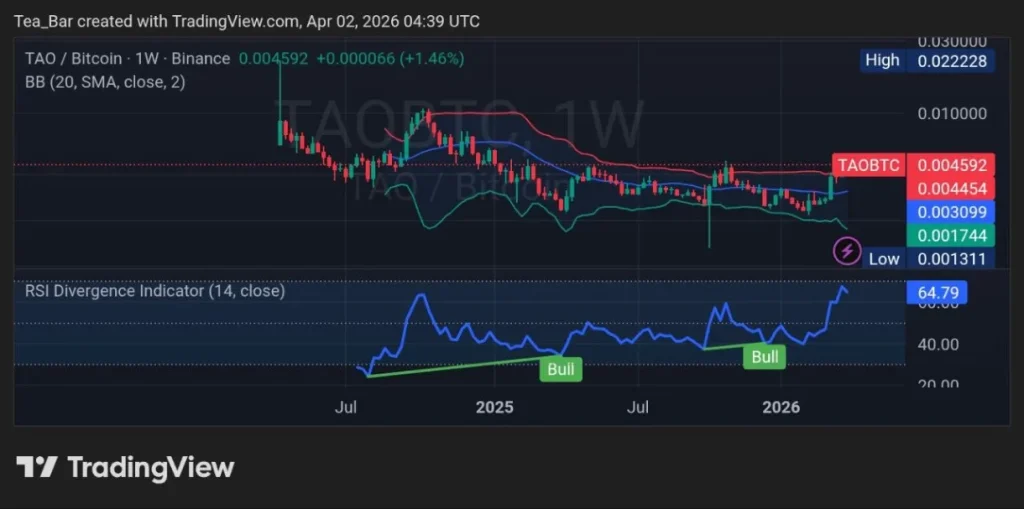
Traders should also note the convergence of support around the 20-week SMA, which has historically provided dynamic support during pullbacks.
Overall, the weekly setup points to measured bullish momentum, with room for further gains if AI adoption and narrative catalysts persist.
Subnet Economics Exposed: Revenue vs. Subsidies
Live data from taostats.io as of April 2, 2026 (04:32 UTC) show the network hosts 129 active subnets, planning to scale to 256 later this year.
Top performer Chutes (Subnet 64) receives about $52 million in annualized TAO emissions—yet generates only $1.3–$2.4 million in external revenue, a subsidy ratio of 22:1 to 40:1.
Across the network, confirmed revenue sits between $3 million and $15 million annually. Validator counts have grown 23% month-over-month to roughly 4,100 active nodes.
The halving has intensified pressure, but rising on-chain activity in inference and agent deployment signals early progress toward revenue independence.
Adding to this, Grayscale recently shared on X that Bittensor successfully trained a 72B parameter LLM using a permissionless network instead of centralized infrastructure—a first at this scale.
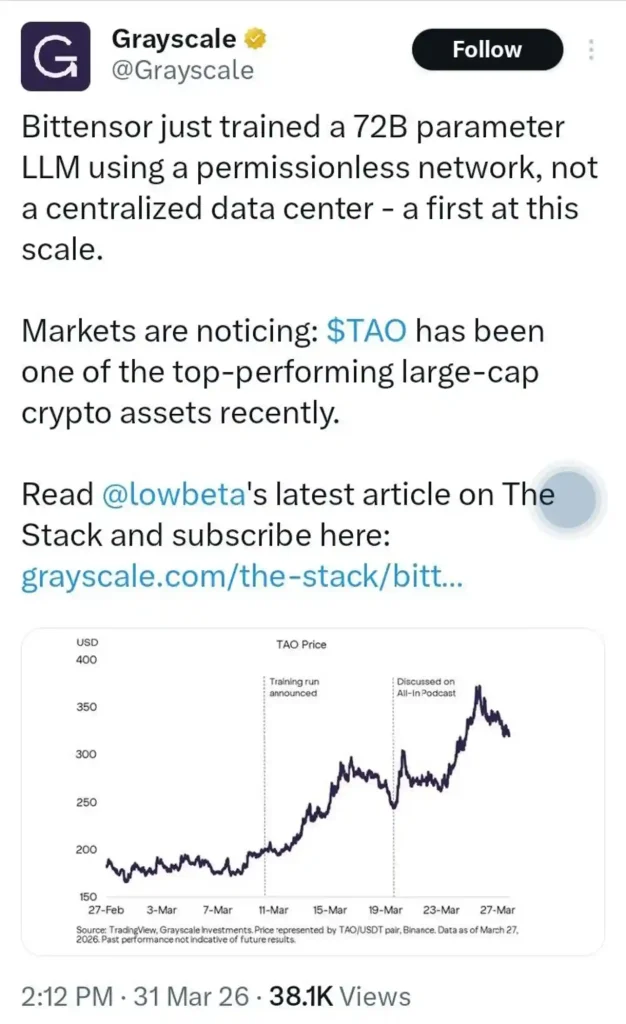
This milestone boosts TAO’s credibility and adoption potential, helping drive its recent strong market performance.
Can Subnet Growth Close the Gap and Justify Higher Valuations?
TAO’s current valuation reflects both technological promise and subsidy-driven liquidity.
With over 70% of tokens staked and subnet tokens acting as leveraged plays, the network shows strong community conviction.
Yet until external revenue scales meaningfully through enterprise AI workloads and pay-per-use models, the subsidy-to-revenue imbalance remains a risk. Investors should keep tracking burn metrics, job volume, and fee generation.
More Must-Reads:
How do you rate this article?
Join our Socials
Briefly, clearly and without noise – get the most important crypto news and market insights first.






8
Also read
Similar stories you might like.

Market
Is It a Good Time to Buy Crypto Right Now?
Sead | 2026-04-01

Defi
Australia Passes Crypto Law, Exchanges Face New Rules
Rokas | 2026-04-01

Bitcoin
History in the Making: Moody’s Rates First Bitcoin-Backed Revenue Bonds
Rokas | 2026-04-01

Altcoins
2 AI Tokens to Buy Right Now
Azeez | 2026-04-01

Bitcoin
CZ Explains Why Quantum Computing Won’t Kill Crypto
Ana | 2026-04-01

Altcoins
Ripple CEO Says U.S. Can’t Survive “Gensler 2.0”
Rokas | 2026-03-31

Market
How Accurate Are Robert Kiyosaki’s Predictions?
Sead | 2026-04-01

Altcoins
TRON Moves Toward Institutions: How Anchorage Support Could Influence TRX Price
Azeez | 2026-03-29

Altcoins
Could SpaceX’s IPO Be the Catalyst That Sends Dogecoin Above $0.10?
Azeez | 2026-03-29
Altcoins
Why Smart Money Is Still Bullish on Solana Despite Extreme Fear Gripping Crypto
Azeez | 2026-03-28