











US dollar bills. Source: TechGaged/Shutterstock
Stablecoins Are Quietly Rewiring Global Finance, And Most People Haven’t Noticed
In Brief
- • Stablecoins are evolving from niche crypto tools into a parallel financial infrastructure, enabling faster, always-on, and programmable global payments.
- • Institutional adoption is accelerating rapidly, with major banks, fintech firms, and payment networks integrating stablecoins into core operations.
- • Despite strong growth and efficiency gains, risks around regulation, concentration, and price stability remain key challenges to widespread adoption.
Ad
For decades, the global financial system has operated on a ‘wait-and-see’ model. Cross-border payments, often taking two or more business days to fully settle due to outdated (dare I say analog) infrastructure, can still move more slowly than a physical package sent from one coast to another.
Luckily, a structural shift reached its tipping point thanks to stablecoins. No longer a niche digital experiment, we are witnessing the birth of the internet’s native dollar. This is far from wishful thinking, as the world’s largest financial gatekeepers are moving from skepticism to systemic integration.
To everyone’s satisfaction, it isn’t just about faster money either. It’s about a fundamental reworking of how value moves, settles, and scales in an always-on, AI-driven economy.
What makes stablecoins the new financial engine
The allure of this type of cryptocurrency is often summarized by speed, and for good reason. But for institutional players, the value proposition is far more systemic. In a global economy that moves at a rapid pace, the legacy financial system is both slow and a hindrance.
Stablecoins solve this by offering three advantages that traditional banking simply can’t match.
1. Atomic settlement
In TradFi, a trade and its settlement are two separate events. When a firm sends a $10 million cross-border wire, that money enters a limbo of sorts for three to five business days as it navigates correspondent banks. As a result, billions are at risk of bank failures or manual errors.
Stablecoins offer atomic settlement, where the transfer of an asset and its payment transpire simultaneously. Both swap hands in one inseparable blockchain event. This minute-level latency (as noted by JPMorgan) eliminates the need for expensive insurance and clearinghouse fees, effectively removing the uncertainty from global commerce.
2. Always-on liquidity
Just like us mere mortals, legacy markets are bound by banking hours and public holidays. For a global enterprise, this means liquidity is on a break during the weekend.
Stablecoins have transformed the corporate treasury into an engine that is always running. They allow businesses to seamlessly transition from batch-based to real-time liquidity management. Instead of holding sizable cash buffers to cover weekend obligations, treasurers can keep their capital in yield-bearing instruments until the precise second it is needed.
To understand why institutions are flocking to this space, one must distinguish between mere supply and true liquidity. As noted in TechGaged’s recent deep dive into stablecoin liquidity, it’s not just about the number of tokens in existence. It’s about the capacity of the market to absorb massive trades without price dislocation.
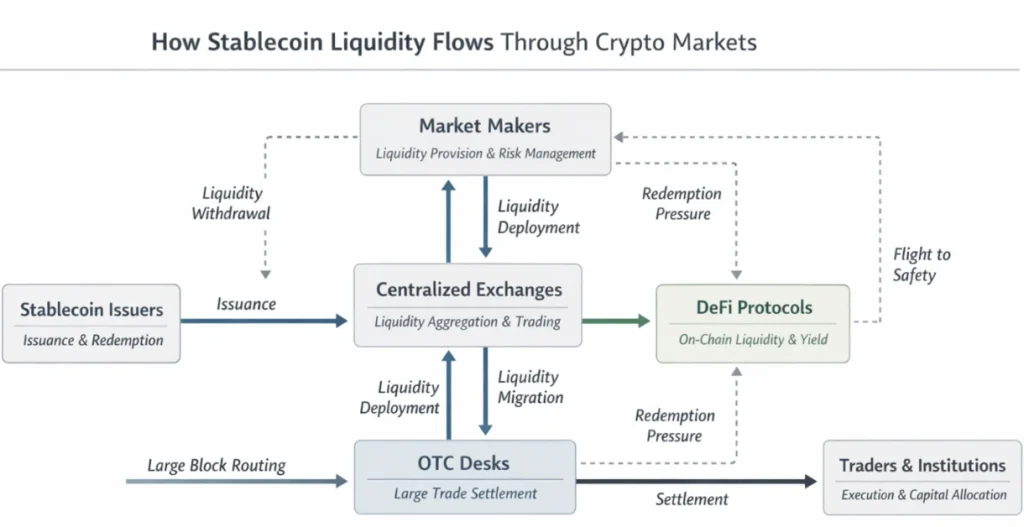
In the volatile opening weeks of 2026, it was stablecoin liquidity, as opposed to simple price action, that became the truest indicator of market health, providing a resilience buffer that traditional fiat rails couldn’t replicate.
Who knows how many billions or even trillions of dollars this almost-instant settlement capability has unlocked in trapped working capital globally?
3. Programmable money
Perhaps the most enticing factor is that a stablecoin is a code. If that sounds weird, it helps to think of traditional fiat as lazy. It requires you or a third-party app to decide when and where it moves.
A tokenized dollar like USDC or PYUSD is “smart.” It can be embedded with smart contracts that only release funds when specific conditions are met. For instance, you pay the supplier only when the IoT sensor at the port confirms that the shipment has arrived.
This automation is the foundation for the AI agent economy, where autonomous software can negotiate, buy, and settle micro-payments without a human middleman. In fact, last month, Stripe officially launched its x402 payment protocol on Base, Coinbase’s Layer 2 blockchain network. It’s proof that this new breed of commerce is only possible with stablecoins, as legacy credit card rails are too slow and expensive for high-frequency, machine-to-machine transactions.
Aggressive push for stablecoins
As a crypto journalist, I come across all sorts of stats and reports. TechGaged’s very own research showed that stablecoins’ market share hit an all-time high of 10.19% in February 2026.
But one data point that arguably has the most staggering effect is the sheer scale of stablecoin throughput last year. Apparently, the global stablecoin transaction value totaled $33 trillion in 2025.
Equally impressive, if not more, than the absolute scale is the trajectory. Those $33 trillion represent a 72% jump year-over-year. As a result, there is no shortage of predictions putting total stablecoin payment flows at $50+ trillion by 2030, despite regulators like the IMF warning about possible disruption of traditional finance and growth.
Now, the caveat here is that the vast majority of value falls on trading, internal reallocation of funds, and automated blockchain activity. Only around 1% was for real-world payments, according to a report from McKinsey and Artemis Analytics. To be precise, a “mere” $380 billion of activity fell on actual payments, such as paying suppliers, sending remittances, or funding payroll.
Yet, every once in a while, there seems to be a new corporation dipping its toes into the stablecoin waters.
Payment networks are all-in
Just recently, Mastercard announced it would buy a stablecoin payments infrastructure firm BVNK for up to $1.8 billion. Its rival Visa previously launched the Visa Tokenized Asset Platform (VTAP), a product designed to help banks issue and manage their own fiat-backed stablecoins on-chain.
Speaking of Mastercard, OKX has expanded its retail payments offering in Europe with a new Mastercard stablecoin payment card. One of the biggest crypto exchanges around now allows users to spend USDC and USDT directly at merchants.
Revolut will participate in the UK Financial Conduct Authority’s stablecoin sandbox sometime soon. With live testing scheduled for Q1 2026, the company is one of four firms selected to trial stablecoin-related activity within a supervised regulatory environment.
The involvement of one of the world’s most popular digital banking apps and fintech companies highlights a broader trend. Large fintech firms now view stablecoins as potential infrastructure for cross-border transfers and digital settlement, as opposed to crypto-native tools. Clear regulatory signals like this one move stablecoin policies (in this case, the UK’s) from planning toward execution.
Banks (and others) are in it as well
Last year, Standard Chartered formed a joint venture with Animoca Brands and HKT to issue a regulated, Hong Kong dollar-backed stablecoin. JPMorgan’s blockchain unit expanded its JPM Coin platform to support euro-denominated payments, with Siemens as its first major corporate client.
In Japan, SBI Holdings and Startale Group have introduced JPYSC, a Japanese yen–denominated stablecoin. Scheduled for launch in Q2 2026, the token is described as Japan’s first stablecoin built on a trust-bank issuance model, targeting institutional settlement, treasury management, and tokenized asset transactions within a regulated environment.
The Central Bank of the United Arab Emirates (CBUAE) has granted regulatory approval for the nation’s first USD-backed stablecoin, USDU. In doing so, the UAE becomes one of the earliest major jurisdictions to approve a central bank-recognized USD-pegged stablecoin. Once again, it’s a clear signal of a decisive regulatory commitment to integrating digital settlement assets into the financial system.
Then, Stripe bought a stablecoin platform Bridge for $1.1 billion. It was the fintech company’s largest acquisition to date, underscoring the aggressive push into the stablecoin foray.
That is by no means an extensive selection, so forgive me if I omitted an important development or two. In any case, it’s clear that stablecoins are the new black. Such institutional adoption, from legacy banks to payment providers, speaks volumes.
But why all of this is happening is the more intriguing and consequential part.
What stablecoins mean for the future of finance
It’s no secret that financial institutions and fintech firms are longing for faster and cheaper cross-border payments. Stablecoins deliver just that, since blockchain-based transfers can move funds in minutes and operate 24/7. As such, they are increasingly being utilized for B2B payments, as well as global payroll and remittances.
That positions the stablecoin market as a serious player in global payments, not a mere competitor.
I say this because, per McKinsey’s report, transaction counts are doubling and customer-to-business activity is growing faster than anything else. This is exactly what occurs when a new payment network goes mainstream.
For giants such as Visa or Mastercard, stablecoins aren’t going to replace them. Not overnight, and likely not ever. Instead, they are going to form a parallel system. While stablecoins currently handle mid-sized transactions away from the typical checkout counter, they are moving closer to traditional retail territory every day.
The winning move for established businesses and platforms isn’t to fight, but to build bridges. This means handling the compliance and “on-off ramps” that connect digital coins to traditional bank accounts.
That’s exactly what Mastercard did with its acquisition of BVNK. It represents a strategic bet on a coming stablecoin adoption wave and a defensive move to protect the company’s core payments business. You can also look at the deal as a validation that digital dollars are, slowly but surely, embedding themselves in mainstream financial infrastructure.
The math is simple. If Visa, Mastercard, and the rest of the gang can plug stablecoins into the global card acceptance infrastructure, they could get a potentially massive growth driver rather than a threat. Considering 77% of consumers say they would open a stablecoin wallet if their bank or fintech app offered one, the math more than checks out.
From an investor’s perspective, stablecoins are moving away from being trading chips toward being actual tools for moving money. You’ve seen how they fared in 2025, which is a huge signal. Usually, in early tech, supply grows faster than use. Here, the usage is growing way faster than the supply of coins.
It’s a sign of a maturing, efficient network.
What’s interesting is that most of this activity is taking place within countries rather than across borders. Stablecoins are integrating themselves into local commerce. For investors, this means the opportunity has shifted from a small remittance-oriented niche to the massive world of general retail and business payments.
What could go wrong?
The transition to a regulated federal standard reached a milestone with the launch of the ProShares GENIUS Money Market ETF (IQMM). This vehicle represents the first institutional-grade bridge between stablecoin reserve mandates and the regulated ETF market.
By investing exclusively in short-term US government securities that satisfy GENIUS Act requirements, IQMM provides a systematic, transparent reserve vehicle. This is no longer just about crypto. It’s about creating the compliant infrastructure necessary to back a multi-trillion-dollar digital dollar supply.
But, it’s not all clear skies. While the growth numbers look great, there are still some fragile points. These are the things to keep an eye on:
Concentration of coins
At the moment, the entire ecosystem is leaning heavily on just a few pillars. Most of the money is tied up with two companies (Tether and Circle) and moves across two main blockchains (Ethereum and Tron).
If any one of those experiences a major technical glitch or some legal problem, the ripple effects would be systemic. In other words, it’s a lot of eggs in very few baskets.
Legal uncertainty
Regulators are finally catching up, which is both a good and a bad thing. In Europe, the MiCA framework is setting the rules, while the US is still debating bills like the Clarity Act.
The main risk here is fragmentation of the legal landscape across the globe. If every country has wildly different rules, it becomes expensive and complicated for companies to move money across borders. And as you know by now, that is supposed to be the whole point of using stablecoins.
Stability is not guaranteed
It’s not like we haven’t seen depegging happen before. The glaring example is USD Coin (USDC) and its depeg in March 2023, triggered by the failure of Silicon Valley Bank (SVB).
While the big players have proven they can bounce back, the risk that a stablecoin might briefly (or permanently) lose its 1:1 peg with the dollar is never zero. This is especially true when the broader markets get hit by a black swan event or some banking jitters.
What to expect throughout 2026
If the current momentum holds, the rest of the year (and possibly beyond) will be about stablecoins moving from the experimental phase to becoming a standard part of the global financial toolkit.
- Supply will keep increasing: Expect the total amount of stablecoins in circulation to hit between $350 billion and $400 billion by the end of 2026. The demand for “digital dollars” isn’t slowing down, especially as big institutions start using them for back-end settlements.
- Usage outpacing issuance: Maybe overly bullish at this point, but data shows that people aren’t just sitting on these coins but are actually spending them. It stands to reason that payment volume will grow by 50% to 80% annually. Basically, the “velocity” of money is increasing, which means the network is becoming more efficient.
- Rise of AI economy: The use of agentic payments (via standards like the aforementioned x402) is only the beginning. Since these agents don’t have bank accounts, stablecoins are the ideal native currency for the automated economy.
- Geographical shift: While Asia (APAC) is still the heavyweight champion of stablecoin use, the Americas will likely contend for the top spot. As the US gets more regulatory clarity and Latin American countries continue to use stablecoins to hedge against local inflation, the Western hemisphere’s slice of the pie is going to get much bigger.
- Blockchain vs blockchain: The competition between networks is heating up. Ethereum will likely keep its crown for big, institutional heavy lifting. Solana and Base are going to fight it out to be the primary home for fast, cheap, everyday transactions. We might even see brand-new chains built specifically to handle payments and nothing else.
Conclusion
If the Iran conflict was the stress test for physical assets, the subsequent market volatility of early 2026 was the trial by fire for global liquidity. As traditional cross-border corridors slowed to a crawl due to increased risk-aversion from manual audits, stablecoins became the primary lifeline for institutional survival.
Yet, their success doesn’t require the total collapse of the legacy banking system. Instead, the true power of stablecoins lies in their ability to serve as a parallel, complementary rail. Namely, one that handles micro-payments, AI-driven commerce, and instant cross-border settlements that traditional ledgers were never designed to support.
That is why they’ll win, even if no one else will lose. Now, the question for institutions is no longer if they should adopt digital dollars. It’s how swiftly they can bridge the gap before the new foundation of finance is fully set in stone.
How do you rate this article?
Subscribe to our YouTube channel for crypto market insights and educational videos.






Join our Socials
Briefly, clearly and without noise – get the most important crypto news and market insights first.
Most Read Today
1
SEC Opens Door for Tokenized Stocks on Nasdaq – A Major Shift for Wall Street
2U.S. Regulators Clarify Capital Rules for Tokenized Securities — Institutional Adoption Looms?
3XRP Needs This One Catalyst to Explode – Analyst Explains Why
4Institutional XRP Demand Under Pressure as ETFs See Outflows
5New Crypto Rules Are Reshaping Bitcoin — And Markets Are Watching
Latest






8
Also read
Similar stories you might like.