













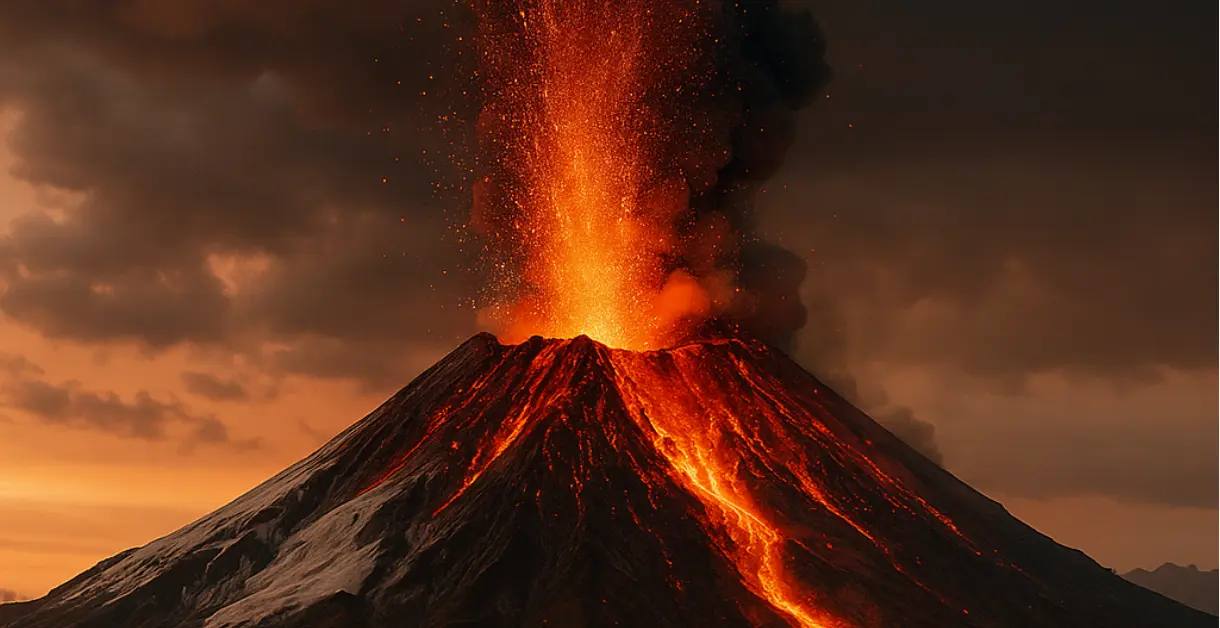
Taftan Volcano Erupting after 700000 years
Scientists Alert Iran as Volcano Shows Uplift After 700,000 Years
In Brief
- • Scientists are urging closer monitoring of Iran’s Taftan volcano due to an unusual rise.
- • Although Taftan has no known eruption history, its persistent gas emissions raises concerns.
- • Similar signs of renewed activity at Yellowstone have also gotten the attention of scientists.
A massive volcano in Iran that has been silent for 700,000 years is suddenly rising, and scientists say the early signs are worrying. New ground-movement data reveals that the long-quiet Taftan volcano is showing measurable uplift, prompting urgent warnings that something significant may be building beneath the surface.
Ad
A published report on the volcano known as Taftan says it has risen by 3.5 inches in 10 months from July 2023 to May 2024.
As the volcano hasn’t lost the 3.5 inch rise since, the scientists fear there is a pressure buildup that could eventually cause a violent release.
Scientists Sound Alarm Over Taftan’s Sudden Ground Uplift
Taftan, located around 31 miles from the nearest city, sits at the collision zone between the Arabian Plate and the Eurasian Plate, a region known for tectonic complexity and subsurface instability.
Ad
Though the volcano has no confirmed eruptions in written history, it is the only peak in the region with ongoing fumarolic activity, the release of steam and volcanic gases.
Because of this gas and steam release, scientists warn that there could be serious gas explosions that could cause damage to both humans and crops tens of miles away if Taftan erupts.
Researchers warn this is significant and are calling for immediate, continuous monitoring, stressing that Taftan’s remote location should not lead to complacency.
A Global Pattern: More Dormant Volcanoes Are Reawakening
Volcanic eruptions have been happening for ages, but for some reason scientists have always been wary of them due to their tendency to destroy.
One other volcano, Yellowstone, got the attention of scientists in March as researchers observed swarms of micro-earthquakes, uplift patterns, and hydrothermal changes considered similar to signs of awakening. This led them to believe that the volcano could be getting ready to erupt again after 1,000 years.
The National Geographic Society warned at the time that such a volcano also called a caldera could cause a huge natural hazard if it erupted.
The simultaneous reactivation of once-quiet volcanic systems worldwide is pushing scientists to re-evaluate assumptions about dormant volcanoes and the timescales on which they can reawaken.
More Must-Reads:
How do you rate this article?
Subscribe to our YouTube channel for crypto market insights and educational videos.






Join our Socials
Briefly, clearly and without noise – get the most important crypto news and market insights first.

Most Read Today
1
Peter Schiff Warns of a U.S. Dollar Collapse Far Worse Than 2008
2Dubai Insurance Launches Crypto Wallet for Premium Payments & Claims
3XRP Whales Buy The Dip While Price Goes Nowhere
4Samsung crushes Apple with over 700 million more smartphones shipped in a decade
5Luxury Meets Hash Power: This $40K Watch Actually Mines Bitcoin
Latest





Most Read Today
MOST ENGAGING
8
Also read
Similar stories you might like.

Science
Scientists Reconstruct Skull of 1.6-Million-Year-Old Ethiopian Homo Erectus
Shedrach | 2025-12-19

Artificial Intelligence
Scientists Use AI to Crack Nature’s Hidden Laws
Ana | 2025-12-18

Research
Engineers Rewrite Aluminum’s Limits With 3D Printing
Ana | 2025-12-16
Research
Ancient Space Rocks Challenge Asteroid Mining Hype
Ana | 2025-12-15

Artificial Intelligence
New Study Shows AI Can Learn Values Like Children
Ana | 2025-12-12

Research
Ancient Campfire Discovery Rewrites Human Evolution
Ana | 2025-12-12

Research
New Research Links Gray Hair to Lower Cancer Risk
Shedrach | 2025-12-11

Artificial Intelligence
Brain-AI Fusion Leaps Forward With Radical New Chip
Ana | 2025-12-10

Research
Asteroid That Could Hit Earth Also Carries Life’s Seeds
Ana | 2025-12-10

Research
Mars Had Rainforests – New Discovery Hints
Ana | 2025-12-05