













Scientists test AI that prevents wildfires by monitoring power lines
Scientists test AI that prevents wildfires by monitoring power lines
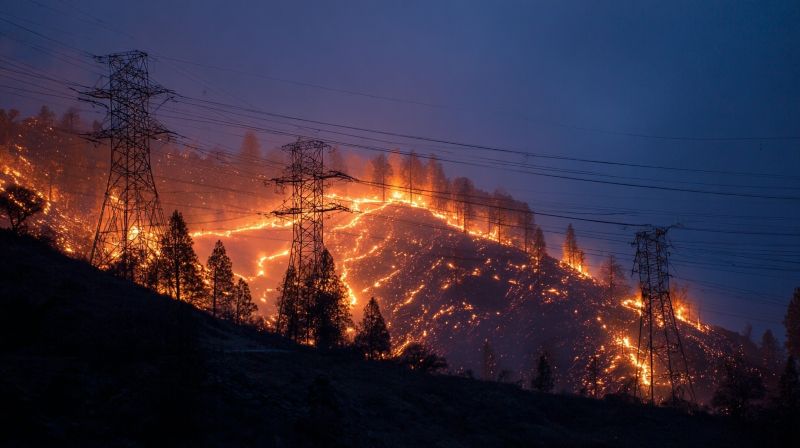
As wildfires continue to ravage the United States every year, destroying homes, threatening wildlife, and crippling infrastructure, many of them begin with damaged or downed power lines, so scientists are using artificial intelligence (AI) to help.
Ad
Specifically, these scientists believe that AI could detect sparks from power lines before they ignite flames, potentially saving lives and billions in damages, and have developed a suitable tool, per a report published by the National Renewable Energy Laboratory (NREL) on August 27.
As it happens, the culprit in many cases of a power-line related fire is what experts refer to as a high-impedance (HiZ) fault, which happens when a live wire touches the ground and creates a current, too weak for most systems to detect but strong enough to trigger sparks that can ignite a wildfire.
Stopping wildfires before they happen
To tackle this challenge, the U.S. Army Construction Engineering Research Laboratory (CERL) has partnered with the NREL to develop an AI-driven detection system. By training artificial neural networks – computational models designed to mimic the human brain – researchers have created a tool that can spot HiZ faults in real-time.
Ad
According to Richard Bryce, a senior researcher in power systems at NREL and lead on this project:
“The intention here is to enhance resilience in the power system and to enable faster responses during extreme events. (…) We want to provide utility companies with the tools for a more resilient power system with better reliability and security for customers that mitigates the potential for wildfires caused by high-impedance faults.”
Meanwhile, crucial to the effort was NERL’s collaboration with power management company Eaton, which simulated dozens of downed-conductor scenarios, accounting for ground conditions like grass or gravel, tree species, and moisture levels, to generate a wide dataset.
Then, the scientists fed this information into NREL’s advanced grid simulation platform, Power Systems Computer Aided Design (PSCAD), equipping machine learning models to identify even the tiniest fault signs. The result is an ensemble of AI models that utilities could deploy to monitor grids nationwide.
As the platform detects a potential fault, it allows for quick dispatching of crews, minimizing both outages and fire risks.
How do you rate this article?
Subscribe to our YouTube channel for crypto market insights and educational videos.






Join our Socials
Briefly, clearly and without noise – get the most important crypto news and market insights first.
Most Read Today
1
Samsung crushes Apple with over 700 million more smartphones shipped in a decade
2Peter Schiff Warns of a U.S. Dollar Collapse Far Worse Than 2008
3Dubai Insurance Launches Crypto Wallet for Premium Payments & Claims
4XRP Whales Buy The Dip While Price Goes Nowhere
5Luxury Meets Hash Power: This $40K Watch Actually Mines Bitcoin
Latest





8
Also read
Similar stories you might like.

Industry
Google Searches for “How to Buy Gold” Explode Globally, Hitting a Two-Decade High
Rokas | 2026-01-26

Industry
Businesses now use crypto as operational capital, CoinGate data reveals a structural shift
Rokas | 2026-01-21

Bitcoin
$455 Billion in Bitcoin Exposed to Quantum Attack Risk via Address Reuse, Up 16% Since 2020
Jastra | 2026-01-20

Altcoins
Iran’s Crypto Activity Surges During Protests; Here’s Why
Ana | 2026-01-16

Industry
Stablecoin Market Share Hits an All-Time High of 10.19%
Jastra | 2026-01-14
No image

Bitcoin
Only Three Governments Increased Bitcoin Holdings in 2025 – U.S. Leads Following 130,000 BTC Seizure
Jastra | 2026-01-05
Industry
Solana Tokens Lose $157B in 2025, The Largest Dollar-Value Drop in the Chain’s History
Jastra | 2025-12-30

Artificial Intelligence
Robert Kiyosaki Warns AI Bubble May Be Bigger Than Dot-Com
Ana | 2025-12-24

Artificial Intelligence
New Epstein Disclosures Collide With an AI Project Built Months Earlier
Ana | 2025-12-22