













Scientists Identify 16 Martian Sites That Could Hold Ancient Life
Scientists Identify 16 Martian Sites That Could Hold Ancient Life
In Brief
- • Scientists mapped 16 huge ancient river basins on Mars carved by long-lasting water flow.
- • These regions contain much of the planet’s river-eroded sediment, making them prime sites to search for past life.
- • Several basins show complex networks of valleys and lakes, suggesting environments that once supported habitability.
Mars has long been imagined as a world that once flowed with water, but a new study has revealed something far more dramatic: vast river drainage systems that once rivaled some of Earth’s biggest watersheds.
Ad
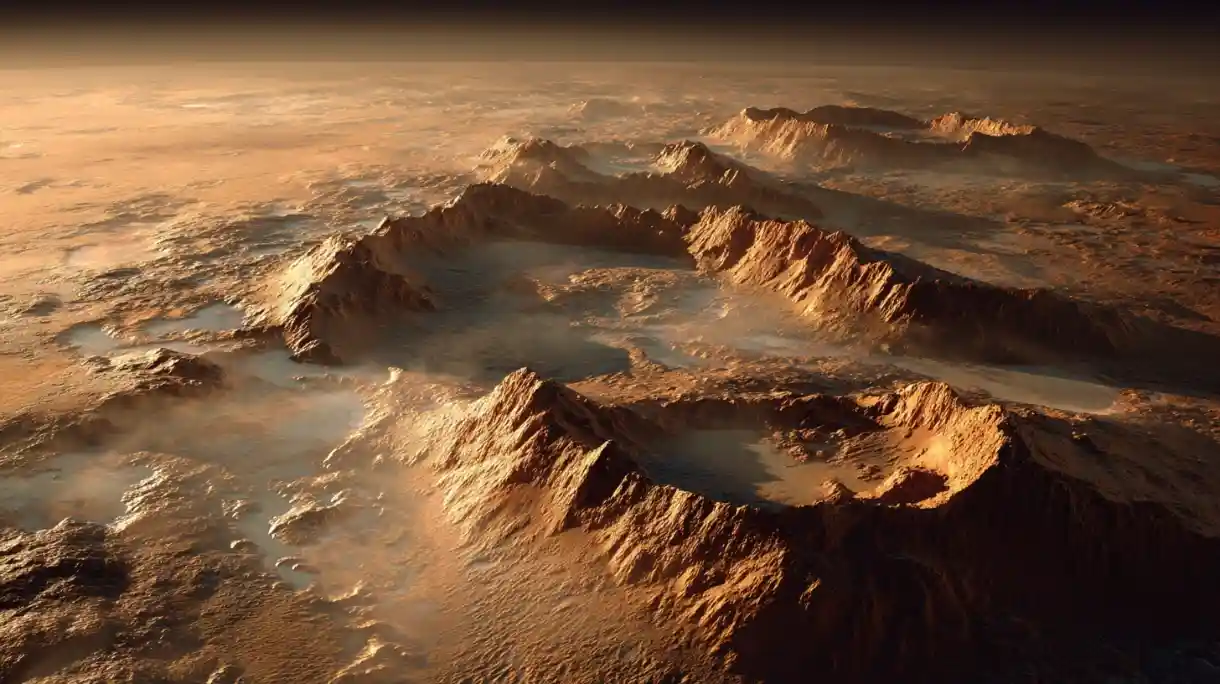
For the first time, scientists have mapped 16 enormous basins on ancient Mars – regions so extensive and so deeply carved by flowing water that they may be among the most promising places to search for traces of long-lost life, according to the recent report.
Billions of years ago, rainfall appears to have shaped the Martian surface in ways few expected. Water pooled in valleys, filled craters, carved canyons, and may have ultimately drained into a colossal ocean.
On Earth, similar river systems host some of the planet’s richest ecosystems, from the Amazon basin to the Indus River valley. If Mars once supported anything resembling those environments, these river-shaped basins could be the places where the earliest evidence of life still lingers.
Indeed, the findings, published in PNAS by researchers at The University of Texas at Austin, reconstruct a world that once moved with water. By merging datasets of Martian valleys, lakes, channels, and sediment deposits, the team uncovered the full scale of Mars’ ancient hydrologic networks.
Ad
According to co-author Timothy Goudge, an assistant professor in the Department of Earth and Planetary Sciences at the UT Jackson School of Geosciences:
“We’ve known for a long time that there were rivers on Mars. But we really didn’t know the extent to which the rivers were organized in large drainage systems at the global scale.”

Sixteen Basins, One Big Question: Could Life Have Been Here?
The reconstruction revealed 19 major groupings of river-related features, 16 of which formed interconnected drainage basins covering more than 100,000 square kilometers each. Notably, that threshold is what geologists consider the minimum size of a ‘large’ river basin on Earth.
While Earth hosts 91 such systems, Mars preserves only a fraction of that number as it lacks tectonics and geological renewal. Yet these few basins appear to represent nearly half of all material ever eroded by Martian rivers.
That concentration of erosion matters, because sediment carries nutrients, minerals, and chemical signatures that can provide fertile ground for early biology. The researchers believe these 16 regions may be the best candidates for identifying where water interacted with rock long enough to spark chemical reactions associated with life.

Some of the mapped systems, such as Paraná Valles, show remarkably complex networks of valleys and ancient lakes, suggesting sustained water flow over long periods. The longer the flow, the higher the chances for the kinds of interactions that could leave behind clues of past habitability.
The team emphasizes that although Mars is largely covered in smaller, isolated drainage systems, these 16 massive basins stand apart. Specifically, they would have been the hubs of planetary-scale water movement, carrying nutrients across huge distances, just as Earth’s great rivers do today.
All things considered, these basins may represent the most valuable places to explore for upcoming Mars missions and future sample-return campaigns.
More Must-Reads:
How do you rate this article?
Subscribe to our YouTube channel for crypto market insights and educational videos.






Join our Socials
Briefly, clearly and without noise – get the most important crypto news and market insights first.
Most Read Today
1
Peter Schiff Warns of a U.S. Dollar Collapse Far Worse Than 2008
2Dubai Insurance Launches Crypto Wallet for Premium Payments & Claims
3XRP Whales Buy The Dip While Price Goes Nowhere
4Samsung crushes Apple with over 700 million more smartphones shipped in a decade
5Luxury Meets Hash Power: This $40K Watch Actually Mines Bitcoin
Latest





8
Also read
Similar stories you might like.

Industry
Google Searches for “How to Buy Gold” Explode Globally, Hitting a Two-Decade High
Rokas | 2026-01-26

Industry
Businesses now use crypto as operational capital, CoinGate data reveals a structural shift
Rokas | 2026-01-21

Bitcoin
$455 Billion in Bitcoin Exposed to Quantum Attack Risk via Address Reuse, Up 16% Since 2020
Jastra | 2026-01-20

Altcoins
Iran’s Crypto Activity Surges During Protests; Here’s Why
Ana | 2026-01-16

Industry
Stablecoin Market Share Hits an All-Time High of 10.19%
Jastra | 2026-01-14
No image

Bitcoin
Only Three Governments Increased Bitcoin Holdings in 2025 – U.S. Leads Following 130,000 BTC Seizure
Jastra | 2026-01-05

Industry
Solana Tokens Lose $157B in 2025, The Largest Dollar-Value Drop in the Chain’s History
Jastra | 2025-12-30

Artificial Intelligence
New Epstein Disclosures Collide With an AI Project Built Months Earlier
Ana | 2025-12-22

Science
Scientists Reconstruct Skull of 1.6-Million-Year-Old Ethiopian Homo Erectus
Shedrach | 2025-12-19