













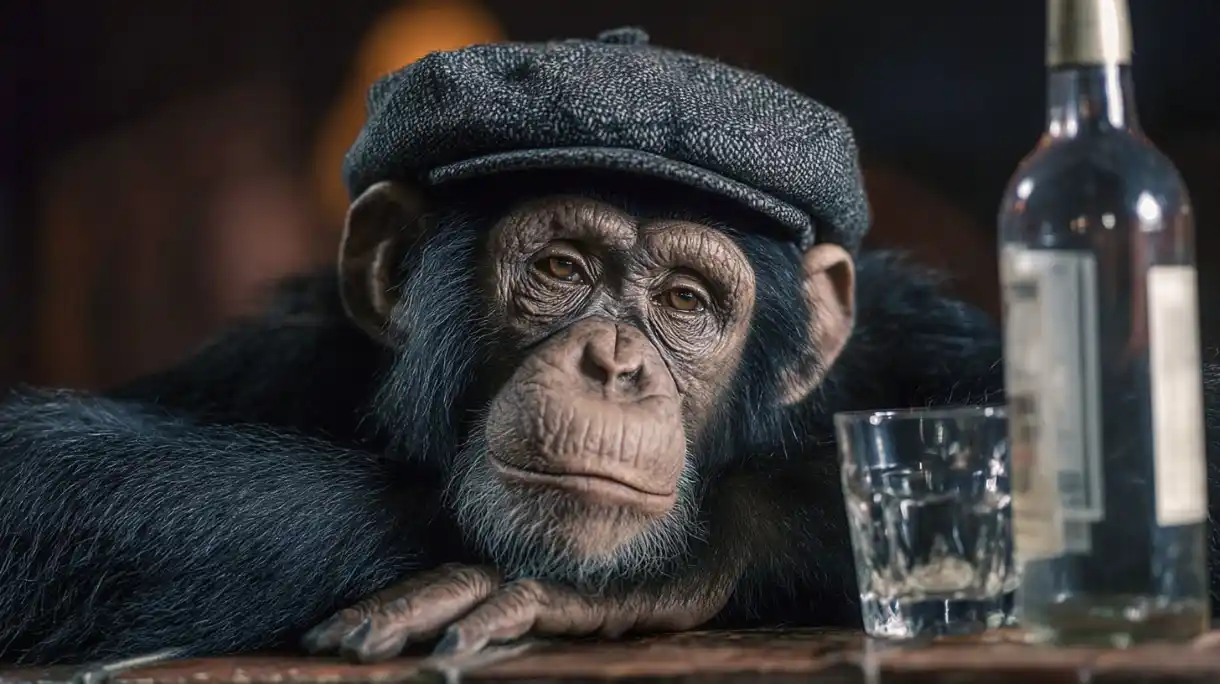
Scientists Find Chimps Consume Shocking Amount of Alcohol Every Day
Wild Chimps Consume Alcohol Equal to Nearly Two Drinks a Day
In Brief
- • Wild chimpanzees consume daily ethanol from fermented fruit equal to nearly two human drinks.
- • Their tolerance supports the “drunken monkey hypothesis.”
- • The findings suggest ethanol was a regular part of primate diets long before humans.
Wild chimpanzees might be getting a mild daily buzz, and they don’t even know it. A new study has revealed that chimps regularly consume enough naturally fermented fruit to equal nearly two alcoholic drinks a day, a finding that dramatically reshapes our understanding of primate evolution and metabolism.
Ad
Researchers from the University of California, Berkeley, conducted the first real-world measurement of ethanol levels in fruits eaten by chimpanzees at two major study sites in Africa: Ngogo in Uganda and Taï in the Ivory Coast.
Their findings show that chimps ingest roughly 14 grams of pure ethanol each day. When adjusted for their smaller body size, that number rises to the human equivalent of nearly two daily drinks. In the words of UC Berkeley graduate student Aleksey Maro of the Department of Integrative Biology:
“Across all sites, male and female chimpanzees are consuming about 14 grams of pure ethanol per day in their diet, which is the equivalent to one standard American drink. When you adjust for body mass, because chimps weigh about 40 kilos versus a typical human at 70 kilos, it goes up to nearly two drinks.”
The discovery emerged as researchers measured ethanol directly from 21 fruit species consumed by chimps. On average, samples contained about 0.26% alcohol by weight. Because wild chimpanzees eat up to 10 lbs of fruit a day, even relatively low alcohol concentrations translate into meaningful daily intake.
Ad

A Surprising Evolutionary Window Into Our Own Alcohol Appetite
Despite this consistent exposure, chimps show no signs of intoxication in the wild. Their feeding pattern is spread throughout the day, and the amount of fruit needed to genuinely inebriate a chimp would physically exceed the volume a stomach could comfortably hold.
Instead, the animals appear adapted to steady, low-level ethanol ingestion, something scientists now believe was also true for human ancestors.
The discovery strengthens the ‘drunken monkey hypothesis,’ first proposed by biologist Robert Dudley, which suggests humans inherited their attraction to alcohol from primates who evolved to seek out calorie-rich, naturally fermented fruits.
Dudley’s idea initially sparked skepticism, but accumulating evidence, from chimp diets to fermented-fruit consumption in monkeys and alcohol-metabolite detection in birds, continues to support the theory.
These findings open a new chapter in understanding primate diets and evolution. They suggest that ethanol wasn’t an occasional dietary byproduct but a regular feature of primate nutrition, shaping behavior long before humans first brewed anything.
More Must-Reads:
How do you rate this article?
Subscribe to our YouTube channel for crypto market insights and educational videos.






Join our Socials
Briefly, clearly and without noise – get the most important crypto news and market insights first.
Most Read Today
1
Peter Schiff Warns of a U.S. Dollar Collapse Far Worse Than 2008
2Dubai Insurance Launches Crypto Wallet for Premium Payments & Claims
3XRP Whales Buy The Dip While Price Goes Nowhere
4Samsung crushes Apple with over 700 million more smartphones shipped in a decade
5Luxury Meets Hash Power: This $40K Watch Actually Mines Bitcoin
Latest





8
Also read
Similar stories you might like.

Industry
Google Searches for “How to Buy Gold” Explode Globally, Hitting a Two-Decade High
Rokas | 2026-01-26

Industry
Businesses now use crypto as operational capital, CoinGate data reveals a structural shift
Rokas | 2026-01-21

Bitcoin
$455 Billion in Bitcoin Exposed to Quantum Attack Risk via Address Reuse, Up 16% Since 2020
Jastra | 2026-01-20

Altcoins
Iran’s Crypto Activity Surges During Protests; Here’s Why
Ana | 2026-01-16
Industry
Stablecoin Market Share Hits an All-Time High of 10.19%
Jastra | 2026-01-14
No image

Bitcoin
Only Three Governments Increased Bitcoin Holdings in 2025 – U.S. Leads Following 130,000 BTC Seizure
Jastra | 2026-01-05

Industry
Solana Tokens Lose $157B in 2025, The Largest Dollar-Value Drop in the Chain’s History
Jastra | 2025-12-30

Artificial Intelligence
New Epstein Disclosures Collide With an AI Project Built Months Earlier
Ana | 2025-12-22
Science
Scientists Reconstruct Skull of 1.6-Million-Year-Old Ethiopian Homo Erectus
Shedrach | 2025-12-19