












Scientists develop robots that can consume each other to grow stronger
Scientists develop robots that can consume each other to grow stronger
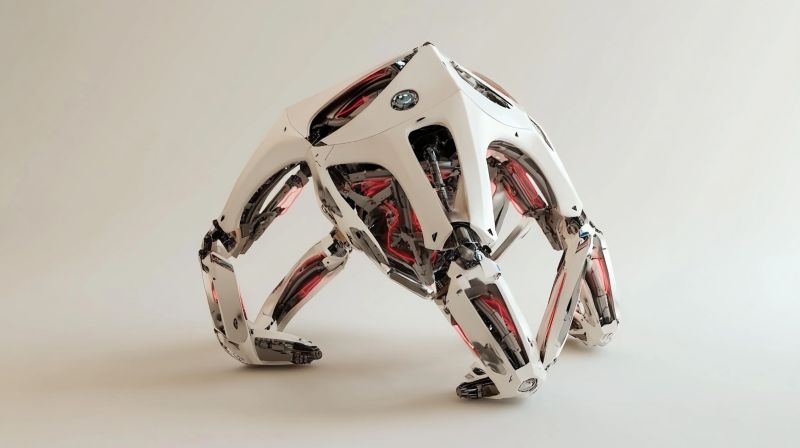
As the robotics industry continues to advance and evolve at lightning speeds, a team of scientists has managed to create robots that can consume parts of other machines, including robots, to grow stronger and repair themselves.
Ad
Indeed, scientists at Columbia University School of Engineering and Applied Science have designed robots that can physically ‘grow,’ ‘heal,’ and enhance themselves by incorporating material from their environment or other robots, according to a report by Tech Xplore published on July 16.
‘Robot Metabolism’ helps robots grow stronger
Per the study, the goal of developing this process, called ‘Robot Metabolism,’ was to overcome the limitations of existing robots, which are typically closed systems that can neither grow nor self-repair nor adapt to their environment. Now they can absorb and reuse parts from their surroundings.
In the words of Philippe Martin Wyder, lead author and researcher at Columbia Engineering and the University of Washington:
Ad
“True autonomy means robots must not only think for themselves but also physically sustain themselves. (…) Just as biological life absorbs and integrates resources, these robots grow, adapt, and repair using materials from their environment or from other robots.”
As such, Robot Metabolism creates a new dimension of autonomy for robots as it gives them a digital interface to the physical world, allowing artificial intelligence (AI) to advance physically, aside from moving forward cognitively. Initially, the scientists envision using these advances in specialized environments like disaster recovery or space exploration – where AI can build physical structures or robots like it already does with words.
Demonstrating ‘Robot Metabolism’
To demonstrate these newly developed capabilities, the researchers used the Truss Link – a robotic magnet stick inspired by the Geomag toy – and is a simple, bar-shaped module equipped with free-form magnetic connectors that can expand, contract, and connect with other modules at various angles, allowing them to form evolvingly complex structures.
They showcased how individual Truss Links self-assembled into two-dimensional shapes that could then transform into three-dimensional robots, further improving themselves by integrating new parts, thus effectively ‘growing’ into more capable machines. One example is a 3D tetrahedron robot which integrated an additional link to use like a walking stick and increase its downhill speed by over 66.5%.

As Hod Lipson, co-author and James and Sally Scapa Professor of Innovation and chair of the Department of Mechanical Engineering at Columbia University, and director of the Creative Machines lab where the work took place, explained that this was an emerging field and a form of ‘machine metabolism’:
“Robot minds have moved forward by leaps and bounds in the past decade through machine learning, but robot bodies are still monolithic, unadaptive, and unrecyclable. (…) Biological bodies, in contrast, are all about adaptation – lifeforms can grow, heal, and adapt. In large part, this ability stems from the modular nature of biology that can use and reuse modules (amino acids) from other lifeforms. Ultimately, we’ll have to get robots to do the same – to learn to use and reuse parts from other robots.”
Elsewhere, researchers at the Chinese Academy of Sciences have created a new multimodal tactile sensor inspired by human fingertips, which can detect the direction of forces and accurately distinguish among 12 common materials, this way enhancing robots’ ability to feel materials.
How do you rate this article?
Subscribe to our YouTube channel for crypto market insights and educational videos.






Join our Socials
Briefly, clearly and without noise – get the most important crypto news and market insights first.
Most Read Today
1
Samsung crushes Apple with over 700 million more smartphones shipped in a decade
2Peter Schiff Warns of a U.S. Dollar Collapse Far Worse Than 2008
3Dubai Insurance Launches Crypto Wallet for Premium Payments & Claims
4XRP Whales Buy The Dip While Price Goes Nowhere
5Luxury Meets Hash Power: This $40K Watch Actually Mines Bitcoin
Latest





8
Also read
Similar stories you might like.

Industry
Google Searches for “How to Buy Gold” Explode Globally, Hitting a Two-Decade High
Rokas | 2026-01-26

Industry
Businesses now use crypto as operational capital, CoinGate data reveals a structural shift
Rokas | 2026-01-21

Bitcoin
$455 Billion in Bitcoin Exposed to Quantum Attack Risk via Address Reuse, Up 16% Since 2020
Jastra | 2026-01-20

Altcoins
Iran’s Crypto Activity Surges During Protests; Here’s Why
Ana | 2026-01-16

Industry
Stablecoin Market Share Hits an All-Time High of 10.19%
Jastra | 2026-01-14
No image

Bitcoin
Only Three Governments Increased Bitcoin Holdings in 2025 – U.S. Leads Following 130,000 BTC Seizure
Jastra | 2026-01-05
Industry
Solana Tokens Lose $157B in 2025, The Largest Dollar-Value Drop in the Chain’s History
Jastra | 2025-12-30

Artificial Intelligence
Robert Kiyosaki Warns AI Bubble May Be Bigger Than Dot-Com
Ana | 2025-12-24

Artificial Intelligence
New Epstein Disclosures Collide With an AI Project Built Months Earlier
Ana | 2025-12-22