











Ripple coin with rising price chart background. Source: TechGaged / Shutterstock
Ripple CTO Pushes Back On Centralization Accusations
In Brief
- • Ripple CTO rebuts claims XRP Ledger is centralized.
- • Debate centers on validator governance and decentralization definitions.
- • Clash highlights unresolved industry divide over blockchain design.
Ad
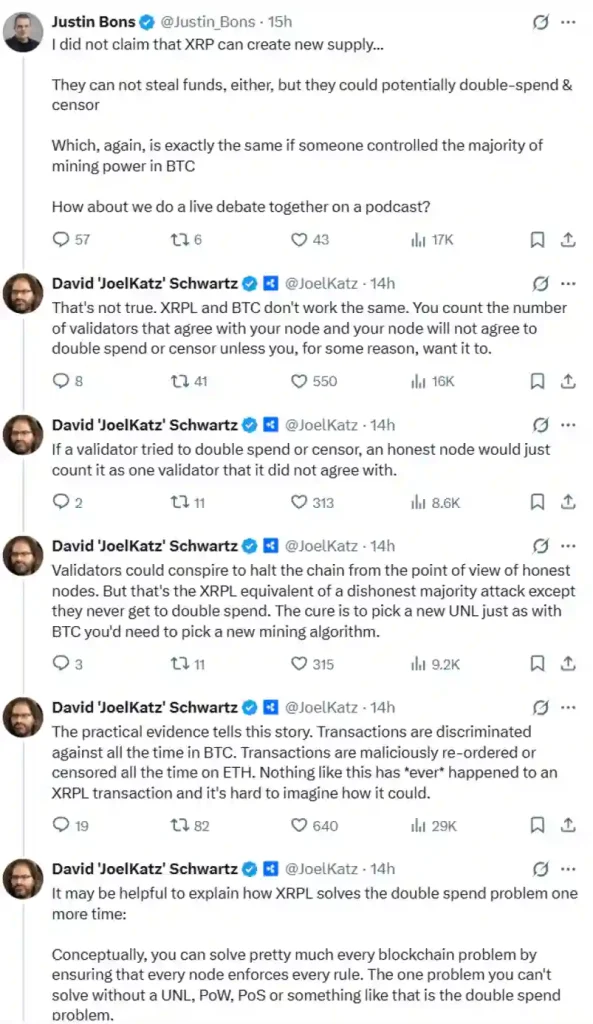
A heated debate over blockchain decentralization has erupted after CyberCapital founder Justin Bons slammed several major networks as centralized. The claims sparked a detailed public response from Ripple CTO David Schwartz, setting off a broader discussion about governance models across the crypto industry. The exchange is drawing renewed attention to one of the industry’s oldest open questions: what actually counts as decentralized.
Centralization Claims Spark Backlash
Specifically, in a widely shared X post from February 24, Bons argued that networks with permissioned elements should not be considered truly decentralized. He specifically raised the issue of systems that rely on curated validator lists or institutional governance structures, framing permissionless consensus as the crucial feature of legitimate networks.
The commentary singled out multiple networks, including the XRP Ledger, and described validator coordination models as potential sources of centralization risk. Bons framed the issue as philosophical as much as technical, arguing that governance structures ultimately determine how tough a network is to external pressure. According to him, XRPL:
“Has a “Unique Node List”, which makes the validators effectively permissioned. As any divergence from this centrally published list would cause a fork, effectively giving the Ripple Foundation & company absolute power & control over the chain.”
Ripple CTO David Schwartz responded directly, pushing back on what he described as flawed assumptions about how consensus works in practice, calling them “as objectively nonsensical as claiming someone with a majority of mining power can create a billion bitcoins.”
Schwartz argued that decentralization debates often ignore real-world system design and user autonomy, stressing that participants can choose their own validators and software rules.
A Deeper Governance Divide
The exchange quickly evolved into a broader discussion about how networks resolve conflicts. Bons focused on governance risks and coordination challenges, suggesting that validator influence could become a problem under certain scenarios:
“Since we have to acknowledge the source of their power/authority: XRP, the foundation & the company are effectively the ‘king maker’ here. As you are solving the coordination problem, not through work or stakeholders. But by literally publishing a validator list & claiming that is not permissioned because anyone can run one…”
Schwartz replied that decentralization should be judged through practical system properties, such as public state visibility, clear rules, open participation, and the lack of ability of any single actor to force network-wide behavior.
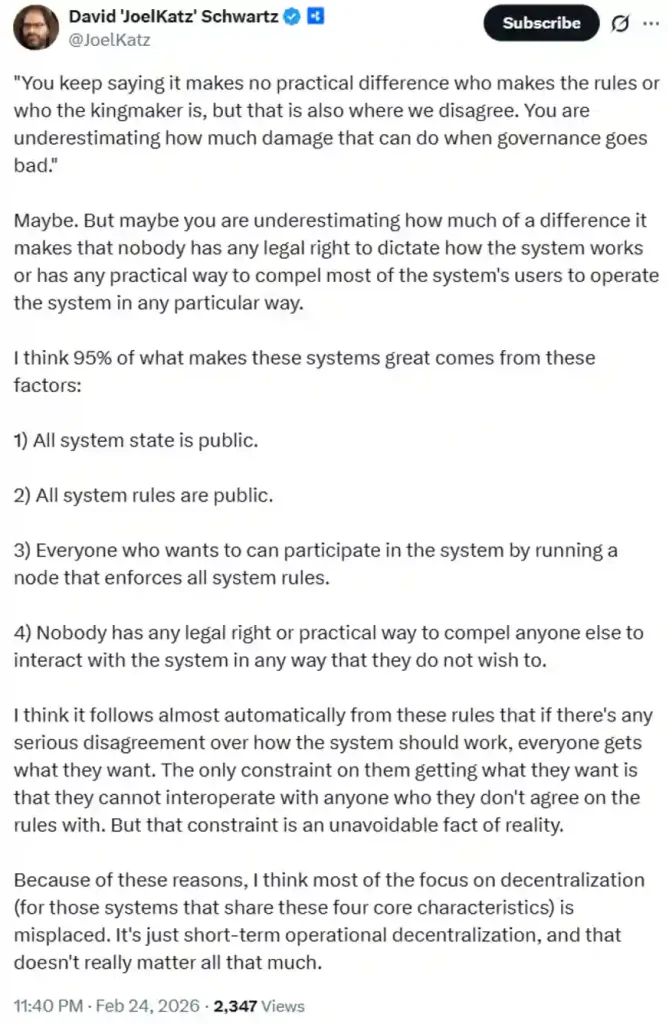
He also noted that disagreements in blockchain systems typically result in forks rather than centralized control, stressing the historical examples across crypto.
“Look at the BTC/BCH fork. Each side proposed its preferred rules and people chose the side they wanted to be on. There really was no coordination needed. It’s the people who agreed who formed a side.”
The back-and-forth reflects a long divide within the industry. Some participants focus on theoretical purity around permissionless design, whereas others emphasize operational resilience and real-world adoption dynamics.
Debates like this tend to reopen during periods of institutional growth in crypto, when governance trade-offs become more visible. As blockchain use cases expand beyond early adopters, disagreements over decentralization standards are increasingly shaping how networks position themselves.
For now, the exchange illustrates how complex the decentralization conversation remains. Though technical architectures continue evolving, the definition of what makes a network truly decentralized is still being actively contested across the industry.
More Must-Reads:
How do you rate this article?
Subscribe to our YouTube channel for crypto market insights and educational videos.






Join our Socials
Briefly, clearly and without noise – get the most important crypto news and market insights first.
Most Read Today
1
DOGE-BTC Ratio Triggers Historic Cycle Signal; Major Shift In The Making
2Bitcoin Vs Gold Ratio Near 2022 Bear Market Levels; What Next?
3BlackRock’s Next Crypto Move Could Change Ethereum Investing Forever
4Chainlink Lawyer Joins SEC Crypto Unit: End of Regulation by Enforcement?
5Hong Kong Stablecoin Firm Moves Toward $1B U.S. Listing
Latest






8
Also read
Similar stories you might like.

Bitcoin
TD Cowen Analyst Makes Bullish Bitcoin Case: ‘Stronger, Cheaper Than Ever’
Ana | 2026-02-25

Bitcoin
Rare Solo Bitcoin Mining Win Happens Again: $200K on $75 Equipment
Ana | 2026-02-25

Defi
Mastercard Expands Crypto Push With New Web3 Role
Ana | 2026-02-25

Altcoins
U.S. Midterms Could Drive Crypto Cycle, Analyst Says
Ana | 2026-02-25

Altcoins
DOGE-BTC Ratio Triggers Historic Cycle Signal; Major Shift In The Making
Ana | 2026-02-24

Altcoins
Ethereum Pattern Suggests Potential Move Toward $1K
Ana | 2026-02-24

Altcoins
Analyst Links XRP Reserve Push To Liquidity Crisis; Here’s Why
Ana | 2026-02-24

Bitcoin
Bitcoin Vs Gold Ratio Near 2022 Bear Market Levels; What Next?
Ana | 2026-02-24

Industry
Ukraine And Baltics Bust Crypto Scam Ring Targeting EU Investors
Ana | 2026-02-24

Altcoins
XRP Fear Peaks As Analyst Sees Bottom Forming
Ana | 2026-02-23