












Real-time star collisions? AI might let us witness them live
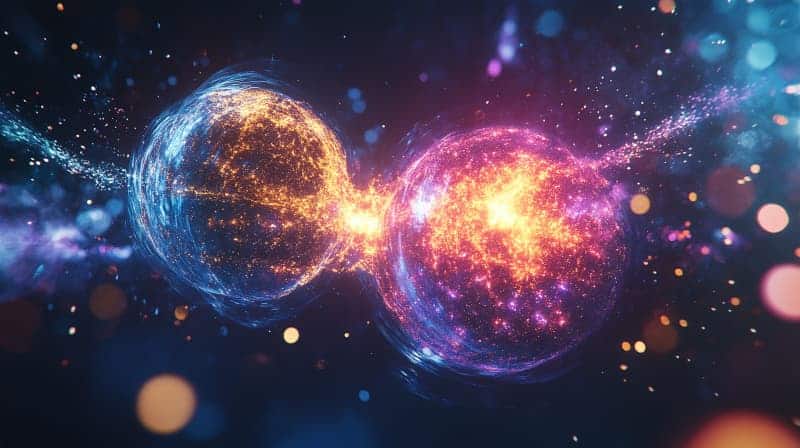
Currently, most of anything happening in the universe can only be seen long after the fact, and that includes star collisions, but recently, researchers have developed a machine-learning technique that could help them observe such events in real time.
Ad
Indeed, the scientists have devised an algorithm trained on simulations of the data that a gravitational-wave observatory collects in the minutes before two neutron stars collide, which creates a rarely witnessed event called a kilonova, according to a report by Nature published on March 5.
In 2017, astronomers observed such a collision, known as GW170817, which released powerful gravitational waves – ripples in space-time – but it took 11 hours to locate the explosion in the sky. This delay limited their ability to study the event in full detail.
Observing real-time star collisions
Now, researchers from leading institutions, including the Max Planck Institute and the University of Nottingham, have unveiled DINGO-BNS, a machine-learning system capable of analyzing these signals in just one second, described in a recent paper.
Ad
Compared to traditional methods that take a lot of time and computational power, DINGO-BNS uses artificial intelligence (AI) to process vast amounts of data instantly, allowing astronomers to pinpoint neutron star collisions before they even take place.
In other words, the algorithm allows observatories to alert other astronomers that a collision is about to happen at a given time and location in the sky, with 30% more precision than existing rapid-response techniques, ensuring more accurate sky mapping and deeper insights into these cosmic events.
As Mansi Kasliwal, an astrophysicist at the California Institute of Technology in Pasadena, explained:
“The combination of speed and accuracy in the localization presented in this paper is actually fantastic.”
In other space-related news, NASA has just managed to acquire and track GPS navigation signals on the surface of the Moon, the agency’s new tests have shown promise of nuclear fuel for deep space missions, and a startup is raising funds to send an autonomous spacecraft to mine asteroids.
How do you rate this article?
Subscribe to our YouTube channel for crypto market insights and educational videos.






Join our Socials
Briefly, clearly and without noise – get the most important crypto news and market insights first.
Most Read Today
1
Samsung crushes Apple with over 700 million more smartphones shipped in a decade
2Peter Schiff Warns of a U.S. Dollar Collapse Far Worse Than 2008
3Dubai Insurance Launches Crypto Wallet for Premium Payments & Claims
4XRP Whales Buy The Dip While Price Goes Nowhere
5Luxury Meets Hash Power: This $40K Watch Actually Mines Bitcoin
Latest





8
Also read
Similar stories you might like.

Artificial Intelligence
Robert Kiyosaki Warns AI Bubble May Be Bigger Than Dot-Com
Ana | 2025-12-24
Artificial Intelligence
New Epstein Disclosures Collide With an AI Project Built Months Earlier
Ana | 2025-12-22

Artificial Intelligence
Gemini Can Now Detect AI-Generated Files
Shedrach | 2025-12-19

Artificial Intelligence
Fetch.ai Launches Autonomous AI-to-AI USDC Settlement
Shedrach | 2025-12-19
Artificial Intelligence
Tesla Semi Tease Hints At Big Changes Under The Hood
Ana | 2025-12-19
Artificial Intelligence
Scientists Use AI to Crack Nature’s Hidden Laws
Ana | 2025-12-18

Artificial Intelligence
Can AI Ever Be Proven Conscious? A Philosopher Says No
Ana | 2025-12-18
Artificial Intelligence
Researchers Uncover Hidden Bias in Cancer Diagnosis AI
Ana | 2025-12-17

Artificial Intelligence
AI Learns Math Better by Arguing With Itself
Ana | 2025-12-15
Research
Ancient Space Rocks Challenge Asteroid Mining Hype
Ana | 2025-12-15