













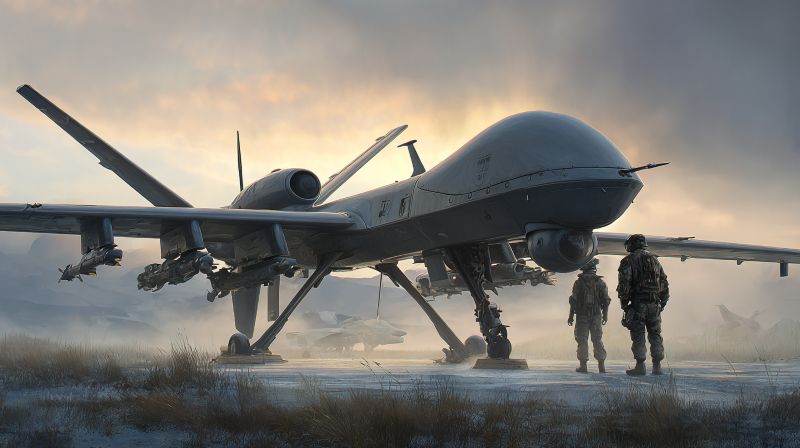
A military drone
NASA in partnership with the U.S. War Department is set to bring routine cargo drone operations in the U.S. airspace.
Ad
The space exploration agency revealed in a press release on 12 September that it is working with the War Department to support the use of modern drones for long distance cargo transportation to boost efficiency, reduce human workload, and enhance safety.
Successful demonstration
As part of steps to achieve the goal of using drones for cargo purposes, staff of NASA at the Ames Research Center in Silicon Valley recently participated in a live flight demonstration showing how drones can successfully fly out of sight, a concept known as beyond visual line of sight (BVLOS).
Autonomous cargo drones carried various payloads over a distance of more than 75 miles across North Dakota, between Grand Forks Air Force Base and Cavalier Space Force Station.
Ad
Through its UAS Service Supplier (USS) technology, NASA managed to demonstrate that cargo drones could operate safely even in complex, shared airspace.
Flight data including location, altitude, and other critical data were transmitted live to the NASA system during the flight test so that the condition of the drones and their surroundings were fully monitored.
Real-time monitoring
Researchers from the collaboration between NASA and the Department of War also known as the Federal USS Synthesis Effort (FUSE), were able to test real-time tracking, situational awareness, and other factors important to safe integration of drone traffic management into U.S. national airspace.
Todd Ericson, senior advisor to the NASA administrator said:
“FUSE builds upon our interagency cooperation to contribute enhanced capabilities for drones flying beyond the visual line of sight. This mission is the next big step toward true autonomous flight and will yield valuable insights that we can leverage as both the commercial drone, cargo and urban air taxi industries continue to expand and innovate.”
If successful, autonomous and semi-autonomous drones could be used to transport critical medical supplies to remote locations, monitor wildfires from above, and allow customers to receive deliveries directly in their backyards, the press release said.
How do you rate this article?
Subscribe to our YouTube channel for crypto market insights and educational videos.






Join our Socials
Briefly, clearly and without noise – get the most important crypto news and market insights first.

Most Read Today
1
Peter Schiff Warns of a U.S. Dollar Collapse Far Worse Than 2008
2Samsung crushes Apple with over 700 million more smartphones shipped in a decade
3Dubai Insurance Launches Crypto Wallet for Premium Payments & Claims
4XRP Whales Buy The Dip While Price Goes Nowhere
5Luxury Meets Hash Power: This $40K Watch Actually Mines Bitcoin
Latest





Most Read Today

MOST ENGAGING
8
Also read
Similar stories you might like.
Business &Amp; Technology
Boeing Leverages NASA’s Tech to Improve Flight Trajectory Prediction
Shedrach | 2025-12-11
Business &Amp; Technology
NASA Tests Special Drones for Martian Expeditions
Shedrach | 2025-12-04

Science
3I/ATLAS Leaks Nickel Gas Far From the Sun – NASA Can’t Explain It
Ana | 2025-11-19

Research
Trump’s push for humans on Mars sparks debate among scientists
Ana | 2025-06-05
Automotive
NASA tests Toyota-built moon exploration vehicle known as “Lunar Cruiser”
Shedrach | 2025-05-13

Research
Do we stand a chance against a city-killer asteroid? Experts weigh in
Ana | 2025-03-28
Computer &Amp; It
How to write a GPS receiver from scratch
Ana | 2025-03-19

Business &Amp; Technology
It’s official: Nokia delivers the first cellular network on the Moon
Ana | 2025-03-12

Research
NASA’s Mars plans blurred by mysterious eye syndrome
Ana | 2025-03-07
Research
NASA cracks the code: GPS now works on the Moon
Ana | 2025-03-05