













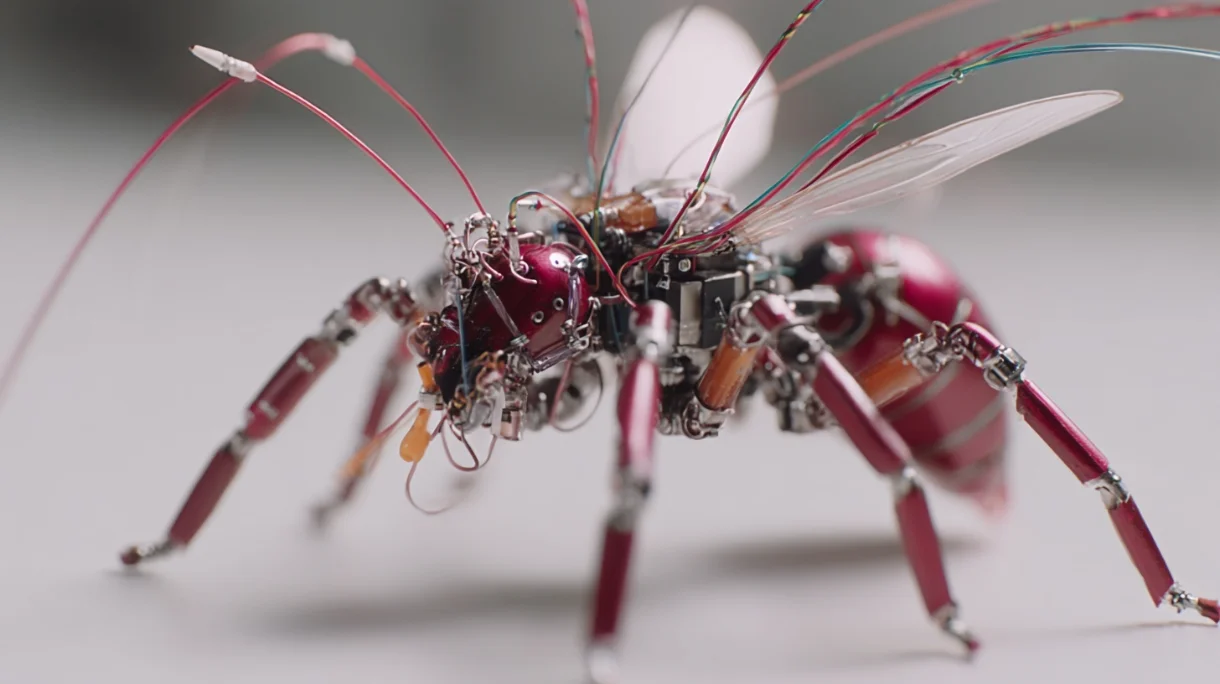
MIT Just Gave Robots Insect-Level Reflexes
MIT Just Gave Robots Insect-Level Reflexes
In Brief
- • MIT created a microrobot with insect-level flight agility.
- • AI control gives it fast, reflex-like responses.
- • The tech could aid search-and-rescue missions.
For years, engineers have dreamed of tiny flying robots that could slip through rubble after earthquakes or navigate spaces too dangerous for humans. But the problem wasn’t so much in size as it was in control.
Ad
Now, researchers at the Massachusetts Institute of Technology (MIT) say they’ve crossed a critical threshold. Their latest microrobot can flip, accelerate, and recover midair with agility comparable to insects, marking a major breakthrough in small-scale robotics.

Why Microrobots Have Always Struggled
Traditional drones rely on smooth, predictable motion. That approach works at larger scales but fails in tight, chaotic environments like collapsed buildings. Insects, by contrast, thrive there, executing rapid flips, sharp turns, and sudden stops without losing control.
Previous microrobots flew cautiously, tracing slow arcs through the air. They lacked the snap-quick reflexes that insects evolved over millions of years. MIT’s new design changes that equation.
Ad
Major Leap in Speed and Acceleration
The insect-scale robot, about the size of a microcassette and lighter than a paperclip, demonstrated a dramatic jump in performance. It showed a 447% increase in speed, a 255% boost in acceleration, 10 controlled somersaults in 11 seconds, and stable flight even when pushed off course by wind.

Crucially, it stayed within about two inches of its intended path, even during aggressive maneuvers. According to Kevin Chen, associate professor at MIT:
“We want to be able to use these robots in scenarios that more traditional quad copter robots would have trouble flying into, but that insects could navigate. Now, with our bioinspired control framework, the flight performance of our robot is comparable to insects in terms of speed, acceleration, and the pitching angle.”
Real Breakthrough Was the Brain
The hardware, in the form of flapping wings and artificial muscles, was already capable. The bottleneck was the controller. Instead of hand-tuning flight behavior, the team built a model-predictive controller capable of planning complex maneuvers like flips and sharp turns while respecting physical limits. The catch was that this required too much computing power to run onboard.
To solve that, the researchers used imitation learning. They trained a lightweight neural network to copy the decisions of the powerful planner, effectively distilling expert-level control into a fast, efficient policy. Once trained, the microrobot could react instantly, without heavy computation.
Flying Like a Bee, Not a Drone
The robot can now perform saccade movements, a behavior insects use to dart forward, stop abruptly, and stabilize their vision. This opens the door to future onboard cameras and sensors, allowing microrobots to navigate visually in real environments.

According to the researchers, this combination of soft robotics and advanced control algorithms marks a shift in what tiny robots can realistically do.
Why This Matters Beyond the Lab
In real-world disasters, every second counts. Robots that can slip through cracks, recover from collisions, and move decisively could reach trapped survivors long before human rescuers.
The team’s next steps include adding onboard sensors, enabling outdoor flight, and exploring how swarms of microrobots might coordinate without colliding.
More Must-Reads:
How do you rate this article?
Subscribe to our YouTube channel for crypto market insights and educational videos.






Join our Socials
Briefly, clearly and without noise – get the most important crypto news and market insights first.
Most Read Today
1
Peter Schiff Warns of a U.S. Dollar Collapse Far Worse Than 2008
2Dubai Insurance Launches Crypto Wallet for Premium Payments & Claims
3XRP Whales Buy The Dip While Price Goes Nowhere
4Samsung crushes Apple with over 700 million more smartphones shipped in a decade
5Luxury Meets Hash Power: This $40K Watch Actually Mines Bitcoin
Latest





8
Also read
Similar stories you might like.

Research
Engineers Rewrite Aluminum’s Limits With 3D Printing
Ana | 2025-12-16

Artificial Intelligence
Robot Bartender ADAM Wows Fans at Vegas Golden Knights Game
Shedrach | 2025-12-12

Artificial Intelligence
Musk Predicts The Year Robots Will Replace Our Jobs
Ana | 2025-12-01

Artificial Intelligence
Chinese Robot Breaks Guinness World Record by Walking 106 km
Shedrach | 2025-11-22

Science
New MIT Breakthrough Makes Water Appear From Nowhere
Ana | 2025-11-20
Business &Amp; Technology
Spider Robot Can 3D-Print a House in 24 Hours – The Future of Construction?
Ana | 2025-11-19

Artificial Intelligence
Elon Musk Stuns Fans: Optimus’ Viral Hand Wasn’t New Version
Ana | 2025-11-13
Artificial Intelligence
Optimus Army Incoming: Tesla Breaks Ground on Robot Production Site
Ana | 2025-11-14

Artificial Intelligence
Scientists create autonomous robotic flowers that can cure cancer
Shedrach | 2025-10-25

Artificial Intelligence
Man loses nuclear clearance after uploading AI-generated ‘robot porn’ to DOE
Ana | 2025-10-15