












It's official: Nokia delivers the first cellular network on the Moon
It’s official: Nokia delivers the first cellular network on the Moon
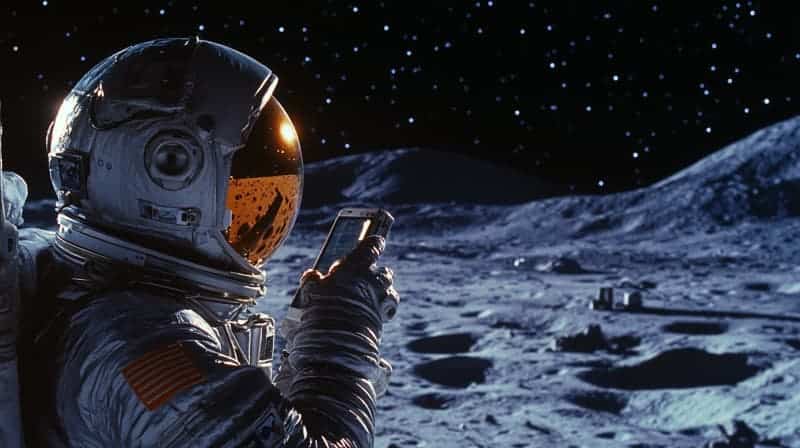
As humanity continues to expand its influence into the Final Frontier, we have just established the first cellular network on the Moon, courtesy of Nokia and Intuitive Machines.
Ad
Indeed, Nokia Bell Labs’ Lunar Surface Communications System (LSCS) has recently landed on the Moon aboard the Athena lander as part of Intuitive Machines IM-2 mission to the lunar south pole region. It then powered up and transmitted operational data back to Earth, according to a press release from March 10.
First lunar cellular network
In line with the mission’s objectives, Nokia placed its first cellular network on the Moon and efficiently validated key aspects of the network’s operation, including the transmission of operational data to Intuitive Machines’ ground station and Nokia’s mission control center on Earth, alongside the activation of multiple communication solution components.
As it happens, the IM-2 mission itself is part of NASA’s Commercial Lunar Payload Services initiative, and NASA’s Tipping Point initiative partially funded Nokia’s latest technology demonstration.
Ad
That said, we’ll still have to wait a bit to actually ‘phone home’ from the Moon because of significant power limitations due to the orientation of the Athena lander’s solar panels after landing. Nonetheless, Nokia Bell Labs’ LSCS, engineered for optimized power consumption, completed multiple tests in the 25 minutes during which it was able to receive power.
The LSCS’s ‘network in a box’ (NIB) installed on Athena efficiently booted and received telecommands from the Nokia mission control center in Sunnyvale, California, and issued responses. Nokia’s operations and management software on Athena also powered up and connected to Intuitive Machines’ ground station.
In fact, NIB telemetry data confirmed a successful operational ‘on-air’ state, which meant all its subcomponents – base station, radio, and network core – were all functioning as intended. For the entire duration of the 25-minute power window, the NIB operated with no service interruptions.
Challenges for lunar phone calls
On landing, the LSCS device module aboard Intuitive Machines’ Micro Nova Hopper was ready to receive a connection. However, when the NIB was activated a few hours later, the Hopper module’s temperature had dipped below working range due to the conditions in Athena’s crater landing site, and a connection between the device module and the NIB could no longer be established.
Commenting on the achievement, Thierry E. Klein, President of Bell Labs Solutions Research at Nokia, stated:
“We delivered and deployed the first cellular network on the Moon and we are incredibly proud of the results that we have achieved despite the very challenging circumstances. If our device modules had been functional when our network in a box was powered up, all indications tell us that we would have been able to complete the first-ever cellular call on the Moon. (…) We were able to take commercial off-the-shelf components that connect billions of people on Earth and harden them to operate on the Moon.”
Earlier, NASA and the Italian Space Agency (ASI) managed to acquire and track GPS navigation signals on the Moon’s surface after Firefly Aerospace’s Blue Ghost lunar lander descended on the Earth’s only natural satellite and delivered the Lunar GNSS Receiver Experiment (LuGRE).
How do you rate this article?
Subscribe to our YouTube channel for crypto market insights and educational videos.






Join our Socials
Briefly, clearly and without noise – get the most important crypto news and market insights first.
Most Read Today
1
Peter Schiff Warns of a U.S. Dollar Collapse Far Worse Than 2008
2Samsung crushes Apple with over 700 million more smartphones shipped in a decade
3Dubai Insurance Launches Crypto Wallet for Premium Payments & Claims
4XRP Whales Buy The Dip While Price Goes Nowhere
5Luxury Meets Hash Power: This $40K Watch Actually Mines Bitcoin
Latest





8
Also read
Similar stories you might like.

Business &Amp; Technology
Boeing Leverages NASA’s Tech to Improve Flight Trajectory Prediction
Shedrach | 2025-12-11
Business &Amp; Technology
NASA Tests Special Drones for Martian Expeditions
Shedrach | 2025-12-04

Science
3I/ATLAS Leaks Nickel Gas Far From the Sun – NASA Can’t Explain It
Ana | 2025-11-19

Business &Amp; Technology
Musk Teases Wild Plan: Earth Sucks? Build ‘Moon Base Alpha’
Ana | 2025-11-13

Military
NASA and War Department set to put autonomous cargo drones in the air
Shedrach | 2025-09-12

Research
Study shows Saturn’s moon Titan could host early cell structures
Ana | 2025-07-15
Research
Astronomers use moon’s quiet side to study cosmic ‘Dark Ages’
Ana | 2025-07-09

Research
China 3D prints moon buildings using lunar soil
Ana | 2025-07-02

Research
Sky show or orbital threat? Meteor storm incoming
Ana | 2025-06-19

Research
Trump’s push for humans on Mars sparks debate among scientists
Ana | 2025-06-05