









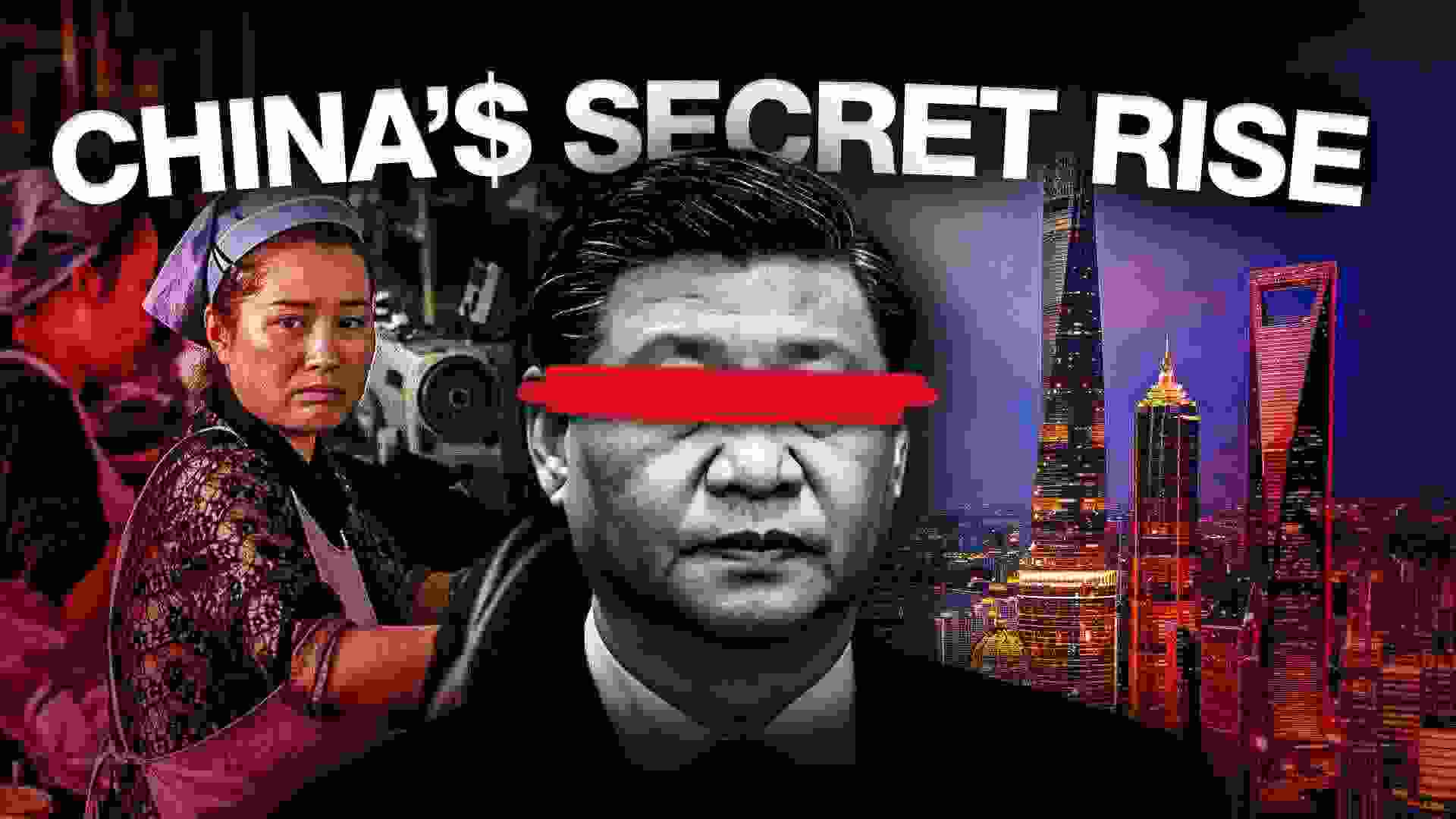
A picture of Chinese president
How China became the ‘world’s factory’: The hidden history
When you think of China’s economy, you probably picture endless assembly lines, container ships stacked with goods, and the phrase “Made in China.”
Ad
And you’d be right. China became the “world’s factory,” producing everything from sneakers to smartphones.
But here’s the part you rarely hear: the rise of China’s factory power was never just about cheap labor. Its roots run deeper — into decisions made decades ago, and even into traditions that stretch back thousands of years.
Watch our full video on how China became the “world’s factory”.
Ad
Most people imagine China’s past and present in conflict — ancient temples on one side, gleaming skyscrapers on the other. But the real story is how these two forces merged, creating a superpower whose future is being shaped not just in its factories, but also in its culture and history.
Building the world’s factory
So how did China become the global factory in the first place?
For much of the 20th century, China was a poor and isolated nation. However, that changed in 1978, when Deng Xiaoping launched “Reform and Opening Up.”
The idea was simple but radical: allow markets to thrive, while the state kept control. Special Economic Zones — like Shenzhen — became test sites for this experiment. What was once a fishing village exploded into a megacity, attracting foreign investors and multinational factories.
Within a generation, millions of workers moved from farms to assembly lines. The scale was staggering: the largest migration in human history.
By the early 2000s, especially after joining the World Trade Organization, China was making everything — clothes, electronics, machinery — and selling it to the world. Hundreds of millions of people escaped poverty, powered by a model built on exports, cheap labor, and industrial might.
But the “factory of the world” came at a cost: polluted air, rising inequality, and an economy dependent on being the workshop for others. Beijing knew this model had an expiration date. To stay ahead, China had to move from simply making the world’s products to designing, innovating, and branding them.
And here’s the hidden twist: to reinvent its factory power, China began turning not only to new technology, but also to its own past.
The Hidden History Behind the Factory
China didn’t just build a new economy by copying the West. It reimagined the idea of a factory by weaving history, culture, and tradition into its next phase of growth.
Case study 1: The digital silk road
The old Silk Road once carried goods and ideas across continents. Today, its successor — the Belt and Road Initiative — extends that legacy. Beyond ports and railways, the Digital Silk Road is wiring countries with Chinese-built 5G networks, data centers, and fiber-optic cables.
It’s not just infrastructure; it’s influence. Just as the ancient Silk Road made China central to global trade, the Digital Silk Road makes it central to the digital economy. Heritage becomes a brand — a cultural wrapping for China’s new kind of factory, one that produces networks and standards instead of just goods.
Case study 2: Smart cities, ancient souls
Factories built modern China’s cities. But in places like Xi’an, history is being fused with high-tech. AI systems monitor the ancient city wall, scanning for structural weaknesses.
Across the country, digital tools like 3D scanning and VR preserve the Forbidden City, the Mogao Caves, and countless other sites.
Here, technology doesn’t replace the past — it safeguards it. In the world’s factory, production isn’t only about goods; it’s about preserving identity.
Case study 3: E-commerce and the last artisans
Factories made China rich, but they also threatened to erase traditional crafts. Potters, woodcarvers, and embroiderers struggled to make a living.
Then came e-commerce platforms like Taobao and Douyin. Through livestreaming, artisans in remote villages could reach millions. A handcrafted vase or embroidered dress suddenly had global demand.
In this way, the digital economy became an extension of the factory — one that produces not just mass goods, but culture itself.
Beyond the Factory Model
So, where does this leave China today?
The country no longer wants to be just the world’s assembly line. Plans like Made in China 2025 and AI Plus aim to dominate robotics, green energy, and advanced tech. The Dual Circulation Strategy shifts growth from exports toward domestic consumption, making China less dependent on foreign buyers.
But challenges loom:
- The workforce is shrinking as the population ages.
- Growth is slowing after decades of breakneck expansion.
- And the world’s factory is also the world’s top polluter, racing to balance industrial output with climate goals.
The hidden history shows that China’s path forward isn’t simply about producing goods. It’s about transforming the very idea of a factory — from a place of mass production to a system that fuses innovation with tradition, scale with culture.
Watch our full video on how China became the “world’s factory”.
Defining the 21st century
The world watched as China became the “factory of the world.” But the story few people know is how that factory is evolving — shaped not just by cheap labor and exports, but by five thousand years of heritage repurposed for the future.
China isn’t just producing products anymore. It’s producing influence, identity, and power.
And as this hidden history unfolds, it won’t just define China’s future. It will help define the 21st century for all of us.
How do you rate this article?
Subscribe to our YouTube channel for crypto market insights and educational videos.






Join our Socials
Briefly, clearly and without noise – get the most important crypto news and market insights first.

Most Read Today
1
Peter Schiff Warns of a U.S. Dollar Collapse Far Worse Than 2008
2Samsung crushes Apple with over 700 million more smartphones shipped in a decade
3Dubai Insurance Launches Crypto Wallet for Premium Payments & Claims
4XRP Whales Buy The Dip While Price Goes Nowhere
5Luxury Meets Hash Power: This $40K Watch Actually Mines Bitcoin
Latest


Most Read Today

MOST ENGAGING
8
Also read
Similar stories you might like.
Automotive
China Greenlights First Commercial Driverless Vehicle Operation
Shedrach | 2025-12-17
Artificial Intelligence
Musk Predicts The Year Robots Will Replace Our Jobs
Ana | 2025-12-01
Research
China Moves Closer to Moon Construction After Retrieving Intact “Lunar Soil Bricks”
Shedrach | 2025-11-20
Science
First Chinese 3D-printed Turbojet Engine Completes Maiden Flight Test
Shedrach | 2025-11-15

Business &Amp; Technology
Sweat-Powered Tech Turns Any Cup Into a Health Sensor
Ana | 2025-11-14

Business &Amp; Technology
Lawsuit says Roblox became ‘a school shooter’s playground’ under a16z
Ana | 2025-10-29

Research
China unveils world’s largest centrifuge with 300 times Earth’s gravity
Shedrach | 2025-09-29
Research
Scientists rethink human evolution after groundbreaking skull discovery
Shedrach | 2025-09-26

Military
China turns 75‑Year‑Old Soviet jets into modern drone bombers
Shedrach | 2025-09-25
Artificial Intelligence
Tesla deploys first-ever Unsupervised FSD in Europe – but there’s a catch
Ana | 2025-09-05