













Bitcoin gold bars. Source: TechGaged / Shutterstock
Gold Drops But Bitcoin Isn’t Taking Over Yet; Here’s Why
In Brief
- • Gold is weakening, but Bitcoin isn’t confirming a rotation.
- • Both assets remain below key trend levels.
- • The rotation narrative is still unproven.
Ad
The idea of capital rotating from gold into Bitcoin (BTC) is gaining traction again as gold enters a correction phase. Data shows gold has fallen below its 180-day moving average after a strong run, while Bitcoin continues to consolidate below its own key level. Despite the narrative, current signals suggest a full rotation has not yet materialized.
Gold weakens but Bitcoin not confirming shift
According to an analysis shared by CryptoQuant analyst Darkfost in an X post on March 27, gold’s recent pullback is tied in part to margin calls and forced liquidations, following an extended rally. The move has pushed gold below its 180-day moving average, often seen as a key trend indicator.
At the same time, Bitcoin is holding relatively stable but remains below its own 180-day moving average, currently near $89,700. That detail is important as a true capital rotation typically requires divergence between the two assets, not alignment.
Right now, both assets are trending in the same direction rather than decoupling. That weakens the case for a meaningful shift in capital flows from traditional safe havens into crypto.
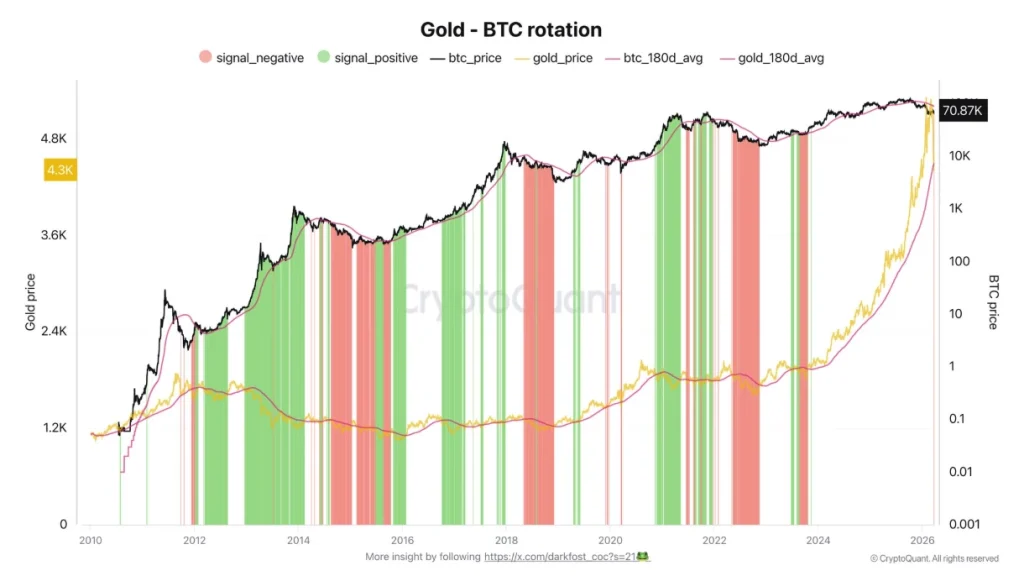
This suggests that, though gold is correcting, Bitcoin is not yet showing the strength needed to confirm it is absorbing that capital.
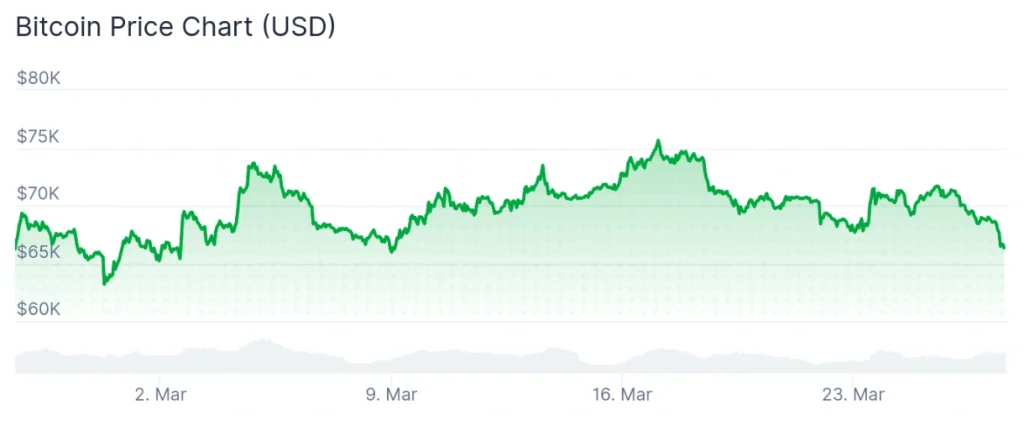
Currently, Bitcoin is changing hands at the price of $66,343.42, down 4.3% on the day, losing 5.8% over the past week, but advancing 1.4% across the month, according to the most recent chart information.
Why the rotation narrative remains premature
When it comes to tracking rotation, a bullish signal appears when Bitcoin trades above its 180-day average while gold trades below it, signaling capital potentially moving into crypto. A bearish or neutral signal occurs when both assets sit below that level, as they do now.
This current setup points to a shared risk-off or consolidation phase rather than a rotation event.
It also highlights a key limitation in the narrative. Capital flows between markets are difficult to prove in real time, and correlation alone does not confirm that funds exiting gold are entering Bitcoin.
At this moment, the data suggests the rotation narrative is still speculative. Until Bitcoin breaks above its longer-term trend while gold remains weak, the idea of a meaningful shift in capital remains unconfirmed.
That leaves the market in a waiting phase, where both assets aren’t competing for dominance. Instead, they’re reacting to broader macro conditions.
How do you rate this article?
Subscribe to our YouTube channel for crypto market insights and educational videos.






Join our Socials
Briefly, clearly and without noise – get the most important crypto news and market insights first.
Most Read Today
1
SEC Moves Toward Tokenization Rules With Timeline Set
2Strategy Now Drives Nearly All Bitcoin Treasury Demand
3Middle East Tensions Spark New XRP Buy-The-Dip Call
4Morgan Stanley Bitcoin ETF Launch Imminent After NYSE Listing
5Senator Lummis Warns Crypto Bill Delay Risks U.S. Financial Position
Latest






8
Also read
Similar stories you might like.

Bitcoin
Bitcoin FUD Is Everywhere Right Now And That May Be Bullish
Ana | 2026-03-27

Bitcoin
Peter Schiff Slams Bitcoin Mortgages As “Horrible Idea”, Explains Why
Ana | 2026-03-27

Altcoins
Volatility Risk Builds as Bitcoin, Ethereum Face Largest 2026 Options Expiry Event
Rokas | 2026-03-27

Bitcoin
$45M Bitcoin Outflow From Bhutan Raises Market Questions
Rokas | 2026-03-27

Bitcoin
Morgan Stanley Bitcoin ETF Launch Imminent After NYSE Listing
Ana | 2026-03-26
Defi
Senator Lummis Warns Crypto Bill Delay Risks U.S. Financial Position
Ana | 2026-03-26
Bitcoin
Strategy Now Drives Nearly All Bitcoin Treasury Demand
Ana | 2026-03-26

Altcoins
Middle East Tensions Spark New XRP Buy-The-Dip Call
Rokas | 2026-03-26

Blockchain
SEC Moves Toward Tokenization Rules With Timeline Set
Rokas | 2026-03-26

Altcoins
20 Crypto-Friendly Businesses Named Among America’s 300 Most Innovative Companies
Ana | 2026-03-25