













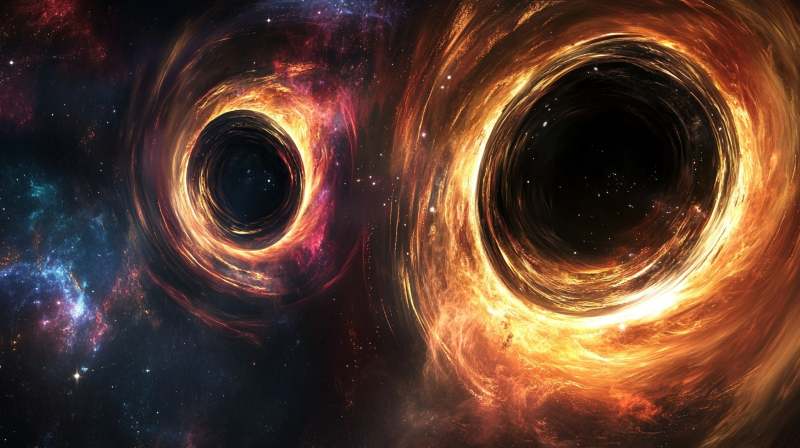
‘Forbidden’ black holes collide in record-breaking cosmic event
As humanity’s fascination with the mysteries of the universe continues, space researchers have just spotted a collision between fast-spinning, so-called ‘forbidden’ black holes that challenge the established rules of physics.
Ad
Indeed, a gravitational wave detector in the United States has recorded the biggest ever merger of colliding black holes, suggesting major implications for scientists’ understanding of how such bodies grow in the universe, according to a report by Scientific American published on July 15.
Observing ‘forbidden’ black hole collision
Specifically, the Laser Interferometer Gravitational-Wave Observatory (LIGO), a facility involving two detectors in the U.S., made this discovery, which Priyamvada Natarajan, a theoretical astrophysicist at Yale University in New Haven, Connecticut, who wasn’t involved in the research, referred to as “super exciting,” as “We’re seeing these forbidden high-mass black holes.”
As it happens, LIGO detects gravitational waves by firing lasers down long, L-shaped arms, during which tiny shifts in arm lengths uncover the passage of gravitational waves – ripples in space-time caused by the acceleration of massive bodies – through the planet.
Ad
Since its first detection in 2025, LIGO has helped observe hundreds of similar mergers, with the latest one, from November 2023, being the largest to date. The researchers presented the results at the GR-Amaldi gravitational waves meeting in Glasgow, United Kingdom, on July 14 this year.
By modelling the detected signal, researchers have calculated that the event, which they called GW231123, resulted from two black holes with masses of about 100 and 140 times that of the Sun merging to form a final black hole weighing in at some 225 solar masses.
According to Mark Hannam, a physicist at Cardiff University, U.K., and part of the LVK Collaboration, a wider network of gravitational-wave detectors that encompasses LIGO, Virgo in Italy, and KAGRA in Japan, “It’s the most massive [merger] so far, (…) about 50% more than the previous record holder.”
Breaking the law (of physics)
Now, here’s the part where it gets truly interesting.
Notably, most stellar mass black holes captured by LIGO range from a few to 100 times the mass of the Sun and scientists believe them to form when massive stars end their lives as supernovas. However, the GW231123 black holes are in or near a predicted range of 60-130 solar masses at which this process isn’t expected to work.
Instead, theories predict that they should break apart, and Hannam believes “they probably didn’t form by this normal mechanism,” but probably stem from earlier merger events – hierarchical mergers of massive bodies that led to the event recorded by LIGO.
As Alan Weinstein, a physicist at the California Institute of Technology, Pasadena, and also part of the LVK Collaboration, explained, it’s like “four grandparents merging into two parents merging into one baby black hole.”
Furthermore, models of the black holes suggest they were spinning extremely fast – about 40x per second, which is near the limit of what Einstein’s general theory of relativity predicts black holes can reach while remaining stable. According to Weinstein:
“They’re spinning very close to the maximal spin allowable.”
Meanwhile, astronomers plan to study the ‘Cosmic Dawn’ or the ‘Dark Ages’ of the universe – right after the Big Bang, when the space was still largely dark and empty before the first stars and galaxies appeared – by sending a miniature spacecraft to the far side of the moon, from where it would listen out for an ‘ancient whisper.’
How do you rate this article?
Subscribe to our YouTube channel for crypto market insights and educational videos.






Join our Socials
Briefly, clearly and without noise – get the most important crypto news and market insights first.
Most Read Today
1
Peter Schiff Warns of a U.S. Dollar Collapse Far Worse Than 2008
2Samsung crushes Apple with over 700 million more smartphones shipped in a decade
3Dubai Insurance Launches Crypto Wallet for Premium Payments & Claims
4XRP Whales Buy The Dip While Price Goes Nowhere
5Luxury Meets Hash Power: This $40K Watch Actually Mines Bitcoin
Latest






8
Also read
Similar stories you might like.

Industry
Google Searches for “How to Buy Gold” Explode Globally, Hitting a Two-Decade High
Rokas | 2026-01-26

Industry
Businesses now use crypto as operational capital, CoinGate data reveals a structural shift
Rokas | 2026-01-21

Bitcoin
$455 Billion in Bitcoin Exposed to Quantum Attack Risk via Address Reuse, Up 16% Since 2020
Jastra | 2026-01-20

Altcoins
Iran’s Crypto Activity Surges During Protests; Here’s Why
Ana | 2026-01-16
Industry
Stablecoin Market Share Hits an All-Time High of 10.19%
Jastra | 2026-01-14
No image

Bitcoin
Only Three Governments Increased Bitcoin Holdings in 2025 – U.S. Leads Following 130,000 BTC Seizure
Jastra | 2026-01-05
Industry
Solana Tokens Lose $157B in 2025, The Largest Dollar-Value Drop in the Chain’s History
Jastra | 2025-12-30

Artificial Intelligence
New Epstein Disclosures Collide With an AI Project Built Months Earlier
Ana | 2025-12-22

Science
Scientists Reconstruct Skull of 1.6-Million-Year-Old Ethiopian Homo Erectus
Shedrach | 2025-12-19