

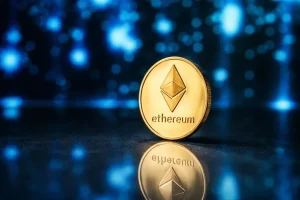









Single Ethereum coin against a blue digital backdrop, representing ETH activating ERC-8004 and advancing on-chain standards for the Ethereum network.
Ethereum Switched On a New Standard That Changes How AI Uses Crypto
In Brief
- • ERC-8004 brings verified AI agents with identity and payment logic directly onto Ethereum.
- • The standard enables trustless AI agent discovery and execution across platforms.
- • This quietly reinforces Ethereum as the settlement layer for AI-driven economic activity.
Ad
Ethereum has activated ERC-8004 on mainnet, introducing a new on-chain identity, reputation, and verification standard designed specifically for AI agents.
At its core, ERC-8004 turns AI agents into accountable economic actors on Ethereum, allowing their identity, work history, evaluation, and payments to live on the same settlement layer.
Therefore, it introduces a structural shift in how AI and blockchain interact, from experimentation to enforceable coordination.
What ERC-8004 Actually Introduces on Ethereum
According to Ethereum’s official specification, ERC-8004 establishes a universal framework for AI agent identity and verification.
Moreover, this makes it possible to track not just what an agent does, but whether it should be trusted.
The standard links three elements on-chain. Starting with the task an AI agent performs, then the evaluation of that task, and the payment for the work.
By integrating with Ethereum’s x402 payment standard, ERC-8004 ensures that agents are paid only when work is verifiable. As a result, it creates a closed accountability loop.
Additionally, ERC-8004 allows AI agents to become discoverable across platforms through shared standards like A2A and MCP.
Instead of being locked inside single marketplaces or applications, agents can now interact across ecosystems while maintaining a consistent reputation and identity.
In practical terms, this pushes Ethereum closer to becoming a settlement layer not just for assets, but for machine-to-machine economic activity.
This Matters Beyond AI Builders and Price Action
While the update is framed as an AI unlock, the deeper significance lies in Ethereum’s positioning. Indeed, ERC-8004 reinforces Ethereum’s role as the coordination layer where identity, payment, and execution converge.
This is especially relevant as institutions, developers, and enterprises explore autonomous agents for payments, compliance, data validation, and financial operations.
Indeed, by introducing an accountability standard at the protocol level, Ethereum reduces fragmentation risk, a key barrier for real-world adoption.
The move also aligns with Ethereum’s broader strategy of enabling complex economic behavior without sacrificing decentralization.
ERC-8004 doesn’t function like a hype-driven catalyst. However, it strengthens Ethereum’s long-term narrative at a critical moment.
While ETH’s currently trading within a broader consolidation range, standards like ERC-8004 tend to impact price indirectly.
Therefore, developer adoption, enterprise experimentation, and increased on-chain activity could support higher baseline demand for ETH.
In the short term, ETH is more likely to react if follow-up announcements emerge around enterprise pilots, agent-based payment systems, or Layer-2 integrations leveraging ERC-8004.
Until then, this upgrade reinforces Ethereum’s structural advantage. Which markets often price in after adoption, not before.
More Must-Reads:
How do you rate this article?
Subscribe to our YouTube channel for crypto market insights and educational videos.






Join our Socials
Briefly, clearly and without noise – get the most important crypto news and market insights first.

Most Read Today
1
Sui Approaches 800K Users as Token Unlock Nears — Can Price Stay Resilient?
2Could SpaceX’s IPO Be the Catalyst That Sends Dogecoin Above $0.10?
3Mystery Deepens as $400M ‘Lost’ Bitcoin Suddenly Moves
4Bitcoin Miners Turn to AI as Profits Collapse
5TRON Moves Toward Institutions: How Anchorage Support Could Influence TRX Price
Latest





8
Also read
Similar stories you might like.

Industry
Trump Backs Bitcoin, Stablecoins In New Pro-Crypto Push
Ana | 2026-03-30

Industry
Canada Proposes Ban on Crypto Political Donations
Ana | 2026-03-30

Altcoins
Ethereum Foundation Makes Record ETH Staking Move
Ana | 2026-03-30
Bitcoin
Bitcoin Miners Turn to AI as Profits Collapse
Ana | 2026-03-30

Bitcoin
Mystery Deepens as $400M ‘Lost’ Bitcoin Suddenly Moves
Rokas | 2026-03-30

Altcoins
Kiyosaki Warns of Inflation Crisis, Lists 6 Safest Investments for 2026
Rokas | 2026-03-30
Altcoins
TRON Moves Toward Institutions: How Anchorage Support Could Influence TRX Price
Azeez | 2026-03-29
Altcoins
Gold Enters DeFi: Tether’s XAUt Expansion to BNB Chain Could Shift Market Dynamics
Azeez | 2026-03-29

Altcoins
Sui Approaches 800K Users as Token Unlock Nears — Can Price Stay Resilient?
Azeez | 2026-03-29

Altcoins
Could SpaceX’s IPO Be the Catalyst That Sends Dogecoin Above $0.10?
Azeez | 2026-03-29