













Ethereum coin closeup. Source: TechGaged / Shutterstock
Ethereum Development Advances With New Block Model
In Brief
- • Eureka raised funding to develop programmable Ethereum blocks.
- • The model embeds execution logic directly into block building.
- • It could expand what developers can build on Ethereum.
Ad
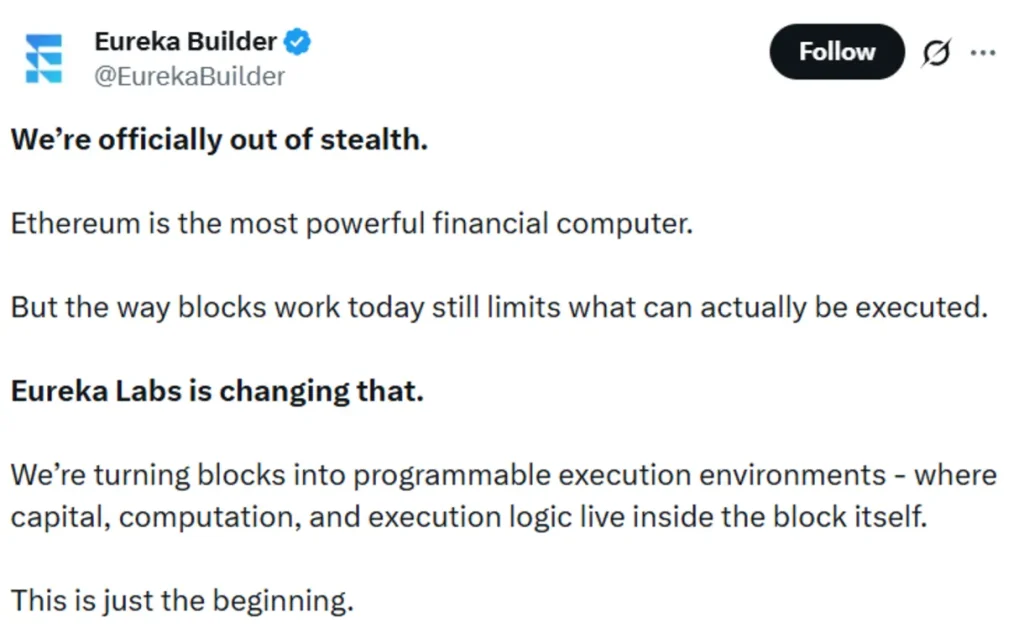
Eureka Labs raised $6.7 million to develop a new Ethereum (ETH) block model that turns blocks into programmable execution environments. The startup is positioning blocks as more than transaction containers, enabling logic, capital access, and computation directly at the block level. The shift matters because it could expand what developers can actually build on Ethereum.
What “programmable blocks” actually change
Eureka’s approach rethinks how Ethereum blocks function at a core level.
Today, blocks mainly organize and confirm transactions. According to a report published on March 24, Eureka wants to move execution logic into the block-building process itself, allowing more control over how transactions interact.
That includes features like intra-block credit, where users can access temporary liquidity within a single block as long as it is repaid before finalization. It also introduces state-aware computation, letting builders run calculations based on the exact state a block will have before it is confirmed.
The model extends further. It allows access to external data during execution and guarantees transaction ordering at the block level, rather than relying only on smart contracts.
The goal is to give developers more predictable and flexible building blocks for applications that require precise timing, capital efficiency, or complex execution.
Why this matters for Ethereum and DeFi
This is an infrastructure-level shift, not just another application layer upgrade.
By moving logic into block construction, Ethereum could support more advanced trading strategies, more efficient decentralized finance (DeFi) systems, and entirely new types of applications that are difficult to execute today.
There is also a competitive angle. Block building already concentrates among a few dominant players, and new approaches like this could reshape the manner of capturing value within the network.
Eureka is still early. Despite being one of the larger builders by activity, it holds a small share of the market compared to leading players.
Still, the direction is clear. Developers are starting to treat the block itself as a programmable surface, not just a container.
If that model gains traction, it could change the way developers design Ethereum applications from the ground up.
How do you rate this article?
Subscribe to our YouTube channel for crypto market insights and educational videos.






Join our Socials
Briefly, clearly and without noise – get the most important crypto news and market insights first.
Most Read Today
1
Exclusive: AI Finance Is Now “Institutional Grade”, Says True Trading Co-Founder Igor Stadnyk
2SEC Opens Door for Tokenized Stocks on Nasdaq – A Major Shift for Wall Street
3XRP Ownership Patterns Are Changing — And It May Signal Something Bigger
4Ethereum Supply Concentration Is Rising — A Quiet Shift Is Underway
5Cardano Traders Are Capitulating — A Turning Point or Warning Sign?
Latest







8
Also read
Similar stories you might like.

Altcoins
Morgan Stanley: Wall Street’s Crypto Shift Was Years in the Making
Rokas | 2026-03-25

Altcoins
Ethereum Supply Concentration Is Rising — A Quiet Shift Is Underway
Rokas | 2026-03-24

Market
A Healthy Pullback Or Something More — What Drove Crypto Markets This Week
Sead | 2026-03-23

Defi
SEC Move Opens New Phase For Bitcoin And Ethereum ETFs
Rokas | 2026-03-23

Research
Stablecoins Are Quietly Rewiring Global Finance, And Most People Haven’t Noticed
Sead | 2026-03-20