













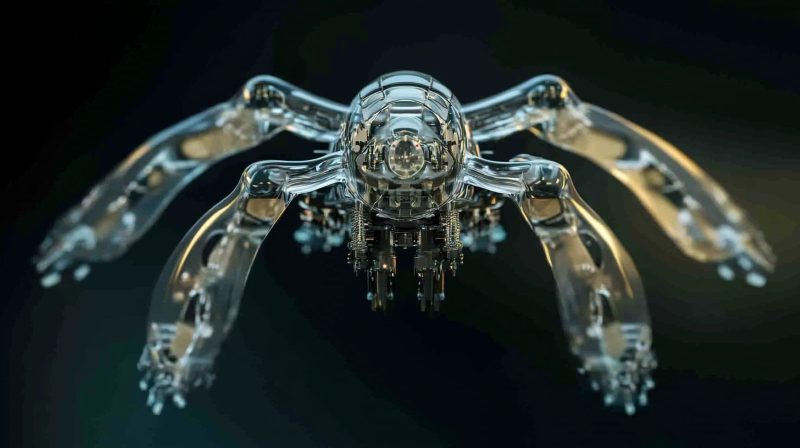
Engineers unleash shapeshifting microrobots that morph, lock, and move untethered
Engineers unleash shapeshifting microrobots that morph, lock, and move untethered
As humanity’s efforts in the field of robotics continue, a team of roboticists has designed innovative lightweight terrestrial-aerial shapeshifting microrobots that can ‘lock’ into specific configurations and operate untethered.
Ad
Indeed, engineers at Tsinghua University, working with a trio of colleagues from Beihang University, all in China, have developed a new type of tiny robots that continuously transform its shape and retain its form to operate in this condition, according to a report by Tech Xplore on April 27.
Making the shapeshifting microrobots
Specifically, the researchers have described their design in the journal Natural Machine Intelligence, pointing out that the key to the new microbots’ capabilities is the thin-film-shaped small-scale actuator that they created by spinning a coating of silicone onto a silicon wafer.
Then, they transfer-printed a polyimide film onto the substrate, after which they continued by adding a layer of copper using electron beam evaporation, photolithography, and wet-etching of the copper layer, and finally completing it using laser cutting.
Ad

How the shapeshifting microrobots work
With the introduction of sensors, motors, and Lego-like blocks, the actuator facilitates the creation of tiny robots – nine centimeters long and weighing 25 grams – with shapeshifting abilities. As such, it’s the smallest untethered robot that can operate on land or through the air.
Per the researchers, the resulting microbots can form a wide array of shapes, ranging from rolling vehicles that can move along at speeds of up to 1.6 meters per second to flying drones – all running without a tether – and even one mini-robot that can do both.

This way, they create opportunities for various types of uses, such as in toy manufacturing or research projects for kids, as well as in commercial applications, like biology research in small venues like insect nests, and even in search and rescue operations.
Meanwhile, fellow roboticists at Imperial College London and the University of Bristol have made a breakthrough of their own, having devised a flying robot to handle hazardous building projects, with various potential benefits to the safety, sustainability, and scale in the construction industry.
How do you rate this article?
Subscribe to our YouTube channel for crypto market insights and educational videos.






Join our Socials
Briefly, clearly and without noise – get the most important crypto news and market insights first.
Most Read Today
1
Samsung crushes Apple with over 700 million more smartphones shipped in a decade
2Peter Schiff Warns of a U.S. Dollar Collapse Far Worse Than 2008
3Dubai Insurance Launches Crypto Wallet for Premium Payments & Claims
4XRP Whales Buy The Dip While Price Goes Nowhere
5Luxury Meets Hash Power: This $40K Watch Actually Mines Bitcoin
Latest






8
Also read
Similar stories you might like.

Industry
Google Searches for “How to Buy Gold” Explode Globally, Hitting a Two-Decade High
Rokas | 2026-01-26

Industry
Businesses now use crypto as operational capital, CoinGate data reveals a structural shift
Rokas | 2026-01-21

Bitcoin
$455 Billion in Bitcoin Exposed to Quantum Attack Risk via Address Reuse, Up 16% Since 2020
Jastra | 2026-01-20

Altcoins
Iran’s Crypto Activity Surges During Protests; Here’s Why
Ana | 2026-01-16

Industry
Stablecoin Market Share Hits an All-Time High of 10.19%
Jastra | 2026-01-14
No image

Bitcoin
Only Three Governments Increased Bitcoin Holdings in 2025 – U.S. Leads Following 130,000 BTC Seizure
Jastra | 2026-01-05

Industry
Solana Tokens Lose $157B in 2025, The Largest Dollar-Value Drop in the Chain’s History
Jastra | 2025-12-30

Artificial Intelligence
New Epstein Disclosures Collide With an AI Project Built Months Earlier
Ana | 2025-12-22

Science
Scientists Reconstruct Skull of 1.6-Million-Year-Old Ethiopian Homo Erectus
Shedrach | 2025-12-19