













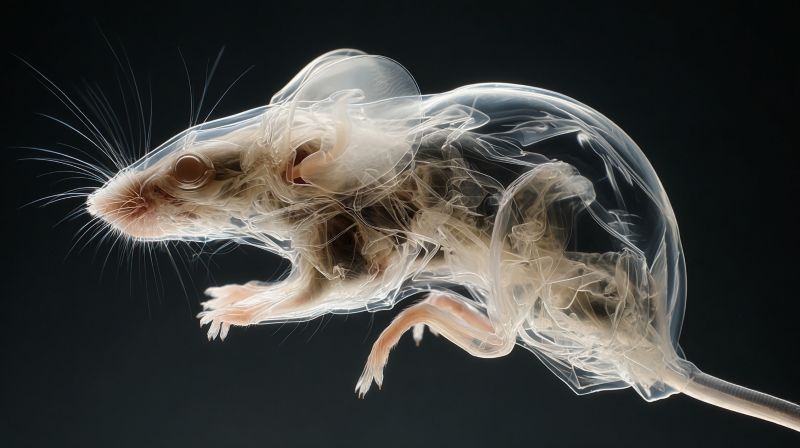
Doritos ingredient turns mice into see-through creatures
Amid constant advances in various scientific fields, researchers have once more outdone themselves with a surprising trick – using tartrazine, which is a vivid yellow-orange dye and one of the key ingredients in Doritos, to effectively create ‘see-through’ mice.
Ad
Specifically, scientists at Stanford University have applied a diluted tartrazine solution to the mouse skin, altering how light passes through the tissue, due to shifting the way in which water bends light so that it more closely matches surrounding fats, reducing scatter present in normal skin and fat.
Then, cameras tuned to red and near-infrared wavelengths can capture sharper, deeper images from living tissue, according to the original description of the method published in the journal Science last year and reported by Earth.com on September 2.
In the words of Zihao Ou, the lead author of the study, who is now an assistant professor of physics at The University of Texas at Dallas, “It looks like a magic trick” if you aren’t familiar with the fundamental physics behind this process. That said, the effect doesn’t last long, but it’s enough to reveal live internal activity.
Ad

Potential use cases in medicine, research, and more
In tests, researchers observed the gut moving food, mapped blood vessels on the head without surgery, and even saw muscle fiber patterns through the skin. Once washed off, the skin returned to normal, and the dye passed safely through the mice.
As it happens, most imaging methods that make tissue transparent only work on dead samples, often damaging them in the process. By contrast, tartrazine leaves tissue alive and flexible, providing a rare look at living systems without invasive surgery.
The discovery could be of immense help for biology labs, as it offers a low-cost, non-invasive way to study organ motion, blood flow, and nerve coordination in real time. For students, it means learning from live animals with fewer harsh procedures.
Although this technique may not apply to humans anytime soon, the principle is promising. In fact, tartrazine is just one example, and scientists could tailor other safe dyes to specific imaging tools, pushing optical research forward. For now, one thing’s clear – a snack food ingredient has literally opened a new window into living biology.
Other cool discoveries include glow-in-the-dark succulents, an alien world in Alpha Centauri’s habitable zone, the ‘dark side’ of the human genome, a dental floss-based vaccine delivery system, and a mysterious object moving in sync with Neptune.
How do you rate this article?
Subscribe to our YouTube channel for crypto market insights and educational videos.






Join our Socials
Briefly, clearly and without noise – get the most important crypto news and market insights first.
Most Read Today
1
Samsung crushes Apple with over 700 million more smartphones shipped in a decade
2Peter Schiff Warns of a U.S. Dollar Collapse Far Worse Than 2008
3Dubai Insurance Launches Crypto Wallet for Premium Payments & Claims
4XRP Whales Buy The Dip While Price Goes Nowhere
5Cathie Wood: $28 Billion Bitcoin Deleveraging Drove Recent Pullback
Latest





8
Also read
Similar stories you might like.

Industry
Google Searches for “How to Buy Gold” Explode Globally, Hitting a Two-Decade High
Rokas | 2026-01-26

Industry
Businesses now use crypto as operational capital, CoinGate data reveals a structural shift
Rokas | 2026-01-21

Bitcoin
$455 Billion in Bitcoin Exposed to Quantum Attack Risk via Address Reuse, Up 16% Since 2020
Jastra | 2026-01-20

Altcoins
Iran’s Crypto Activity Surges During Protests; Here’s Why
Ana | 2026-01-16

Industry
Stablecoin Market Share Hits an All-Time High of 10.19%
Jastra | 2026-01-14
No image

Bitcoin
Only Three Governments Increased Bitcoin Holdings in 2025 – U.S. Leads Following 130,000 BTC Seizure
Jastra | 2026-01-05

Industry
Solana Tokens Lose $157B in 2025, The Largest Dollar-Value Drop in the Chain’s History
Jastra | 2025-12-30
Artificial Intelligence
New Epstein Disclosures Collide With an AI Project Built Months Earlier
Ana | 2025-12-22
Science
Scientists Reconstruct Skull of 1.6-Million-Year-Old Ethiopian Homo Erectus
Shedrach | 2025-12-19