
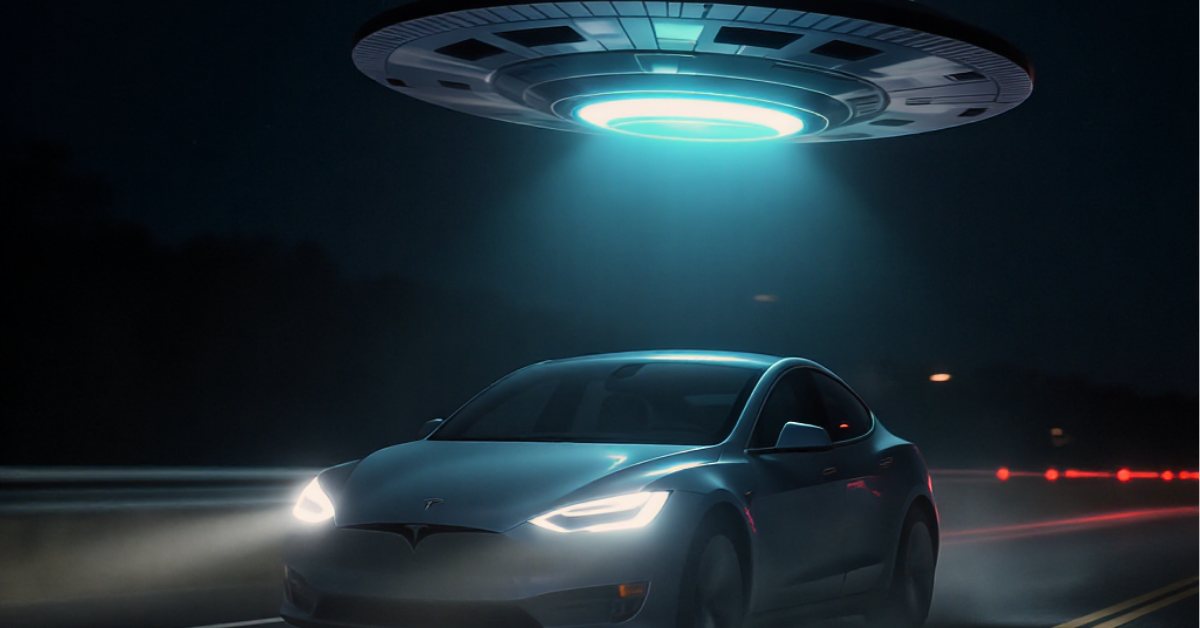
Image showing an UFO Hovering over a Tesla Vehicle at Night with no issue
Musk’s “Don’t Crash” Rule Applies Even if a UFO Lands on the Road
In Brief
- • Key Takeaways:
As completely autonomous vehicles begin to look more a reality with each day, Tesla Senior Vice President for Automotive Tom Zhu recently pointed to Elon Musk’s “prime directive” for the full self-driving (FSD) autopilot system, even if a UFO lands right in front of the car.
Ad
- Is it realistic to expect autonomous cars to react correctly to once-in-a-lifetime events?
- This philosophy might make AI safer, but could also set an impossible engineering standard.
- Is Tesla now the true leader in real-world safety stress-testing?
Teslas’ Senior VP reminded the world of Elon Musk’s core rule for Full Self-Driving: the system must avoid a crash no matter how bizarre the situation, even if a UFO suddenly lands on the road. Zhu resurfaced Musk’s 2021 statement in an X post on October 29, emphasizing Tesla’s uncompromising approach to safety.
Indeed, four years ago, Musk said that the prime directive and absolute priority for FSD was to avoid accidents and keep passengers safe under any condition and in virtually every scenario, even if the scenario looks like something taken from a sci-fi book or movie:
“For self-driving, even if the road is painted completely wrong and a UFO lands in the middle of the road, the car still cannot crash and still needs to do the right thing. The prime directive for the autopilot system is: Don’t crash. That really overrides everything. No matter what the lines say or how the road is done, the thing that needs to happen is minimizing the probability of impact while getting you to your destination conveniently and comfortably.”
Global FSD Rollout With One Primary Goal
Zhu repeated Musk’s words as he commented on the news that a Tesla Model Y was struck by what may have been a meteor as it was driving down the freeway in Australia. Despite the violent impact and a scorched windshield, the vehicle protected its occupants and continued driving safely.
The incident has proven that Zhu wasn’t simply parroting empty words of his boss and that the company aims to match the philosophy shared by the management.
Ad
Safety Tested in Extreme Real-World Scenarios
Tesla’s Full Self-Driving system is being shaped around one core philosophy: it must be capable of making the safest possible decision even when reality doesn’t follow the rules. Elon Musk’s “prime directive” forces engineers to train FSD not just for common road conditions, but also for rare, chaotic, and unpredictable events that human drivers would struggle to react to.
This means the AI must recognize danger, ignore misleading cues, and prioritize collision avoidance over strict rule-following, a fundamentally different approach than traditional autonomous driving systems. While no system can prepare for every scenario, Tesla’s ongoing development shows a clear intention: FSD should not only handle typical road hazards but also react intelligently when the unexpected occurs.
Recent real-world incidents have already served as early stress tests for this philosophy. One example is the Tesla Model Y in Australia that was struck by what appeared to be a meteor, yet still managed to keep passengers safe and continue driving.
This focus on real-world resilience could ultimately set a new industry standard for autonomous vehicle safety.
More Must-Reads
How do you rate this article?
Subscribe to our YouTube channel for crypto market insights and educational videos.
Join our Socials
Briefly, clearly and without noise – get the most important crypto news and market insights first.
Most Read Today
1
Peter Schiff Warns of a U.S. Dollar Collapse Far Worse Than 2008
2Dubai Insurance Launches Crypto Wallet for Premium Payments & Claims
3XRP Whales Buy The Dip While Price Goes Nowhere
4Samsung crushes Apple with over 700 million more smartphones shipped in a decade
5Luxury Meets Hash Power: This $40K Watch Actually Mines Bitcoin
Latest
8
Also read
Similar stories you might like.
Artificial Intelligence
Robert Kiyosaki Warns AI Bubble May Be Bigger Than Dot-Com
Ana | 2025-12-24
Artificial Intelligence
New Epstein Disclosures Collide With an AI Project Built Months Earlier
Ana | 2025-12-22
Artificial Intelligence
Gemini Can Now Detect AI-Generated Files
Shedrach | 2025-12-19

Artificial Intelligence
Fetch.ai Launches Autonomous AI-to-AI USDC Settlement
Shedrach | 2025-12-19
Artificial Intelligence
Tesla Semi Tease Hints At Big Changes Under The Hood
Ana | 2025-12-19
Artificial Intelligence
Scientists Use AI to Crack Nature’s Hidden Laws
Ana | 2025-12-18
Artificial Intelligence
Can AI Ever Be Proven Conscious? A Philosopher Says No
Ana | 2025-12-18
Artificial Intelligence
Researchers Uncover Hidden Bias in Cancer Diagnosis AI
Ana | 2025-12-17

Artificial Intelligence
AI Learns Math Better by Arguing With Itself
Ana | 2025-12-15
Artificial Intelligence
Breakthrough AI Enables Seamless Control of Prosthetic Hands
Shedrach | 2025-12-12