











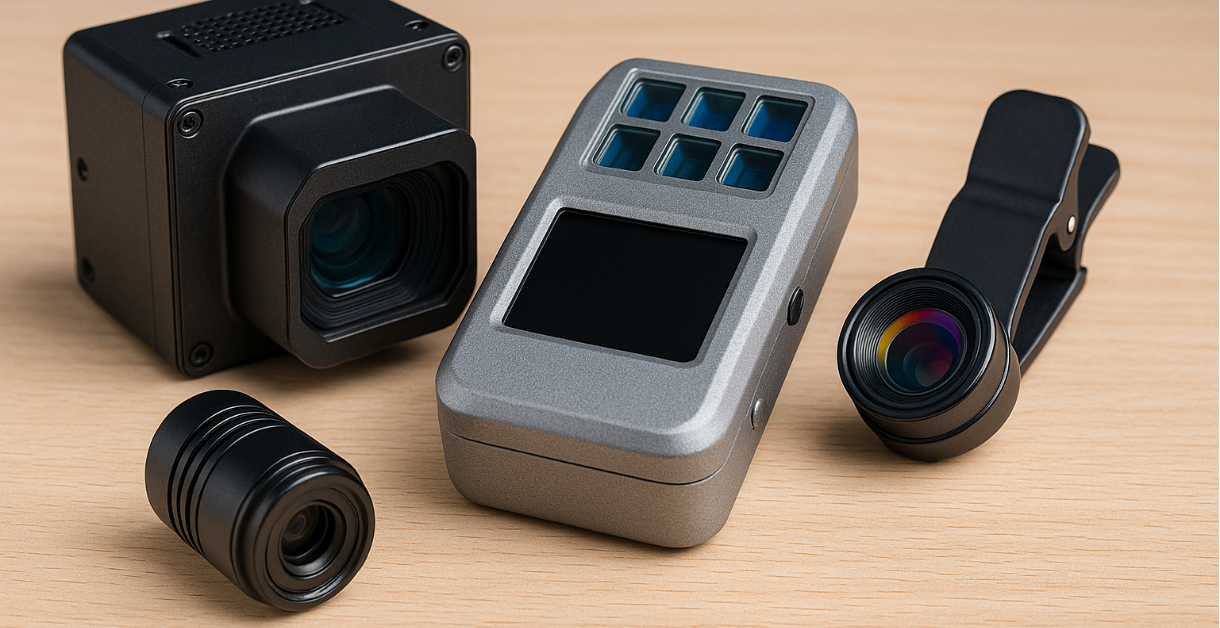
Image of a compact hyperspectral sensor placed on a desk with all its parts
Compact Sensors Change How Scientists Track the Planet’s Health
In Brief
- • Advances in miniaturized hyperspectral sensors enable UAV-based remote sensing with resolutions down to 4 cm.
- • Push broom and whiskbroom structures deliver a cost-effective solution for precision agriculture and pollution monitoring.
- • Applications include vegetation stress detection, water quality analysis, and cryosphere research.
The most powerful tools for monitoring the planet no longer live in orbit, but fit in a pocket. A new generation of compact hyperspectral sensors is moving environmental science closer to the ground. Giving researchers unprecedented insight into crops, water, and climate systems at resolutions once reserved for satellites.
Ad
A New View of Earth Emerges
For decades, hyperspectral imaging has been one of environmental science’s most powerful tools. By capturing hundreds of narrow spectral bands across the visible, near-infrared and mid-infrared spectrum, they reveal subtle chemical and biological signatures invisible to conventional cameras.
Until recently, hyperspectral imaging was confined to satellites and crewed aircraft. These platforms are very expensive and constrained by weather and orbital schedules. Which resulted in a gap between global observation and local insight.
However, the gap is now closing. Advances in sensor miniaturization are pushing hyperspectral imaging out of orbit and into the hands of researchers, farmers and conservation teams on the ground. Compact sensors can now be adapted to drones, carried into the fields, and enable scientific-grade monitoring at unprecedented resolution and accessibility.
Ad

How Compact Hyperspectral Sensors Work
Research highlights several architectural approaches that make miniaturization possible. Push broom sensors, which capture linear spectral slices as a platform moves forward, are now the dominant design for drone-based deployments.
Whiskbroom sensors use rotating mirrors to sample individual pixels. While slower and more prone to distortion, they have been adapted into lower-cost UAV systems.
Framing sensors rely on tunable filters to capture two-dimensional spectral images, trading simplicity for reduced photon throughput. While windowing sensors sweep scenes in discrete exposures, offering flexibility at the cost of longer integration times.
By functioning together, these designs show that high-quality hyperspectral data no longer requires large, specialized platforms.
Why this Shift Matters
Hyperspectral imaging is evolving from an exclusive, resource-intensive technique into a widely accessible method for understanding the planet.
Compact sensors deployed on drones and handheld devices are bridging the gap between global observation and local insight.
For environmental science, this represents more than incremental progress. It signals a fundamental change in how ecosystems are monitored, pollution is detected, and climate-driven changes are documented.
Closer, faster and with far greater precision than before.
More Must-Reads:
How do you rate this article?
Subscribe to our YouTube channel for crypto market insights and educational videos.






Join our Socials
Briefly, clearly and without noise – get the most important crypto news and market insights first.
Most Read Today
1
Peter Schiff Warns of a U.S. Dollar Collapse Far Worse Than 2008
2Dubai Insurance Launches Crypto Wallet for Premium Payments & Claims
3XRP Whales Buy The Dip While Price Goes Nowhere
4Samsung crushes Apple with over 700 million more smartphones shipped in a decade
5Luxury Meets Hash Power: This $40K Watch Actually Mines Bitcoin
Latest




8
Also read
Similar stories you might like.

Bitcoin
Bitcoin Slides Alongside Gold and Silver as Pressure Hits Markets
Patrick | 2026-01-29

Crypto News
Peter Schiff Warns of a U.S. Dollar Collapse Far Worse Than 2008
Patrick | 2026-01-29
Crypto News
Dubai Insurance Launches Crypto Wallet for Premium Payments & Claims
Patrick | 2026-01-29
Altcoins
XRP Trades Under Heavy Structure as Derivatives Pressure Continue
Patrick | 2026-01-29

Crypto News
UAE Central Bank Approves First USD-Backed Stablecoin, USDU
Patrick | 2026-01-29

Bitcoin
Why Bitcoin Looks Weak Today But Strong Long-Term
Ana | 2026-01-29

Altcoins
Tom Lee’s Bitmine Deepens Massive Ethereum Staking Bet to $7.6B
Ana | 2026-01-29
Altcoins
Dogecoin Bulls vs. Bears? One Key Line Decides Everything
Ana | 2026-01-29

Altcoins
XRP Whales Buy The Dip While Price Goes Nowhere
Ana | 2026-01-29

Altcoins
Russia Finalizes Rules for Bitcoin, Ethereum, and Stablecoins
Ana | 2026-01-29