












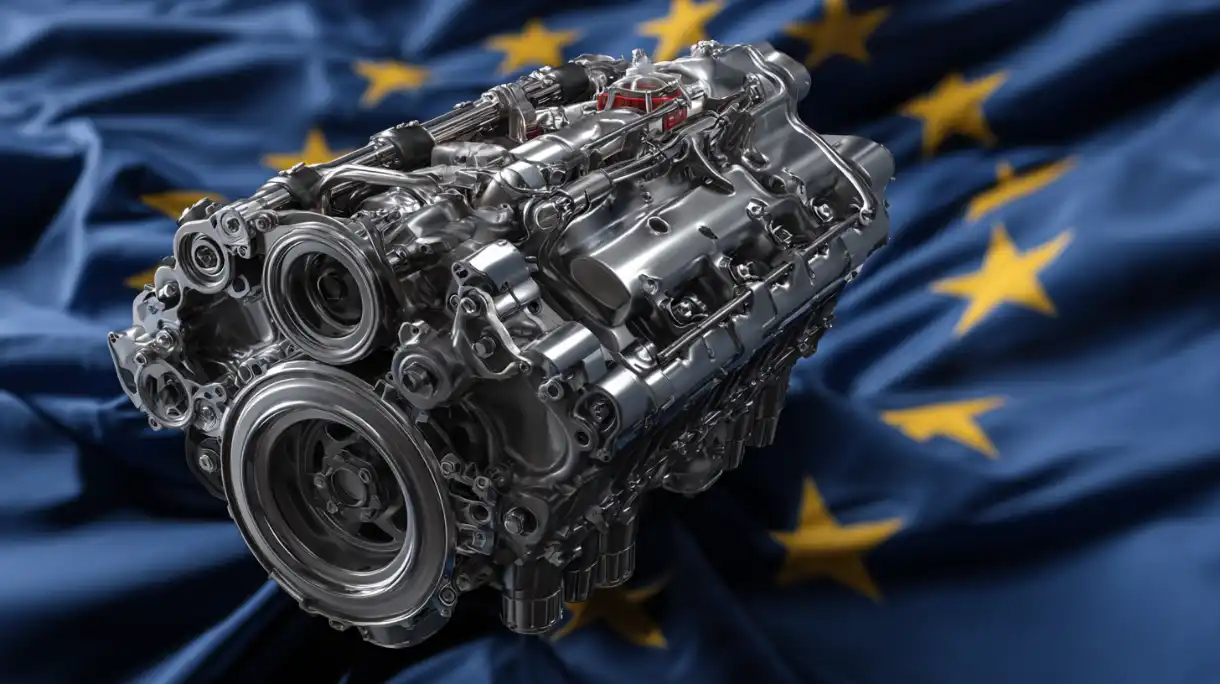
Internal combustion engine and European Union flag.
The European automotive market reached a historic turning point in 2025, as combustion engines no longer account for the majority of new cars sold. New data shows petrol and diesel models falling to just 36.6% of new EU registrations. What powered Europe for more than a century has now slipped into minority status, marking a decisive shift toward electrified mobility.
Ad
This transition has been building for years, driven by tightening EU emissions rules and the looming 2035 deadline for ending combustion vehicle sales. Consumers have also gravitated toward models with lower running costs and better efficiency, particularly hybrids that eliminate charging concerns. At the same time, EV infrastructure has expanded rapidly, making fully electric options more viable in markets that once lagged behind.
According to TechGaged analysts, reviewing the latest ACEA (European Automobile Manufacturers’ Association) figures, electrified vehicles—hybrids, plug-in hybrids, and battery-electric cars—accounted for more than 60% of the EU market year-to-date (January to October) in 2025.
Hybrids led with a commanding 34.6% share, while battery-electric models reached 16.4% and plug-in hybrids rose to 9.1%. Petrol continued its steep decline, sliding to 27.4% market share and representing just 31.28% of all registered units, while diesel dropped to 9.2%.
Ad
The data illustrates how quickly the market has shifted. Hybrid models surpassed three million units, making them the most common new powertrain in the EU. Petrol remains the largest combustion category, yet its downward trajectory is unmistakable as electrified options dominate dealerships and consumer interest. Only a decade ago, combustion engines accounted for more than 90% of new EU cars, but in 2025, battery and hybrid drivetrains sit firmly in command.
Europe’s Wildly Divergent 2025
The broader industry picture in 2025 was marked by global uncertainty, yet Europe stood out as the most stable region for electrification. Markets like the United States experienced softened EV demand following incentive cuts, while Japan saw only marginal growth. China remained the global EV powerhouse, pushing aggressively into Europe with competitively priced models that challenged legacy manufacturers on their home turf.
Despite the turbulence abroad, Europe continued to accelerate. Germany posted a surprising 39.4% increase in battery-electric sales even after eliminating EV subsidies in 2023, proving that European demand is increasingly independent of government incentives.
Hybrids also surged as manufacturers positioned them as the ideal “transition technology,” offering the efficiency benefits of electrification without requiring home charging or public infrastructure.
In contrast, combustion vehicles faced mounting pressure. Cities expanded low-emission zones, pushing older ICE (internal combustion engine) models out of urban cores and making electrified models more attractive.
Fuel prices remained volatile throughout the year, while maintenance costs for petrol and diesel vehicles continued to rise relative to their electrified counterparts. Automakers redirected development budgets toward EV platforms, software systems, and next-generation battery technologies, signaling a long-term commitment to electrification.
What 2026 Means for Europe’s Powertrain Landscape
The year ahead is expected to bring another wave of transformation. Analysts anticipate battery-electric market share rising to 18–20% as a flood of affordable models arrives, including the Renault 5 E-Tech, the Volkswagen ID.2, and several aggressive Chinese entrants. Hybrids are likely to retain the top spot for at least one more year, though their share may peak as European charging networks mature.
Plug-in hybrids, which saw a resurgence in 2025 thanks to corporate fleet demand and favorable tax treatment, may stabilize unless additional regulatory pressure is applied.
Diesel is projected to continue its descent, potentially falling below 7% of the market as more automakers discontinue diesel variants entirely. Petrol will remain under pressure as electrified alternatives gain share across every segment, from city cars to premium SUVs.
Europe has clearly crossed a symbolic threshold. Combustion engines now account for less than 40% of the market, and petrol represents only 31.28% of 2025 registrations.
Electrified vehicles are no longer niche alternatives—they are the new mainstream. The post-combustion era has arrived, and the only question now is how rapidly Europe will push the transition to its inevitable conclusion.
How do you rate this article?
Subscribe to our YouTube channel for crypto market insights and educational videos.






Join our Socials
Briefly, clearly and without noise – get the most important crypto news and market insights first.

Most Read Today
1
Peter Schiff Warns of a U.S. Dollar Collapse Far Worse Than 2008
2Dubai Insurance Launches Crypto Wallet for Premium Payments & Claims
3XRP Whales Buy The Dip While Price Goes Nowhere
4Samsung crushes Apple with over 700 million more smartphones shipped in a decade
5Luxury Meets Hash Power: This $40K Watch Actually Mines Bitcoin
Latest




8
Also read
Similar stories you might like.

Bitcoin
Bitcoin Slides Alongside Gold and Silver as Pressure Hits Markets
Patrick | 2026-01-29

Crypto News
Peter Schiff Warns of a U.S. Dollar Collapse Far Worse Than 2008
Patrick | 2026-01-29

Crypto News
Dubai Insurance Launches Crypto Wallet for Premium Payments & Claims
Patrick | 2026-01-29
Altcoins
XRP Trades Under Heavy Structure as Derivatives Pressure Continue
Patrick | 2026-01-29

Crypto News
UAE Central Bank Approves First USD-Backed Stablecoin, USDU
Patrick | 2026-01-29

Bitcoin
Why Bitcoin Looks Weak Today But Strong Long-Term
Ana | 2026-01-29

Altcoins
Tom Lee’s Bitmine Deepens Massive Ethereum Staking Bet to $7.6B
Ana | 2026-01-29

Altcoins
Dogecoin Bulls vs. Bears? One Key Line Decides Everything
Ana | 2026-01-29

Altcoins
XRP Whales Buy The Dip While Price Goes Nowhere
Ana | 2026-01-29

Altcoins
Russia Finalizes Rules for Bitcoin, Ethereum, and Stablecoins
Ana | 2026-01-29