












Clear representation of crypto legislation being passed with bitcoin and ethereum in the picture.
Clarity Act 2026: Everything You Should Know
In Brief
- • The Crypto Clarity Act tries to clearly divide the SEC and CFTC roles in crypto regulation.
- • The debate centers on stablecoins, DeFi governance, and market oversight.
- • The bill passed the House but is still being revised in the Senate.
Ad
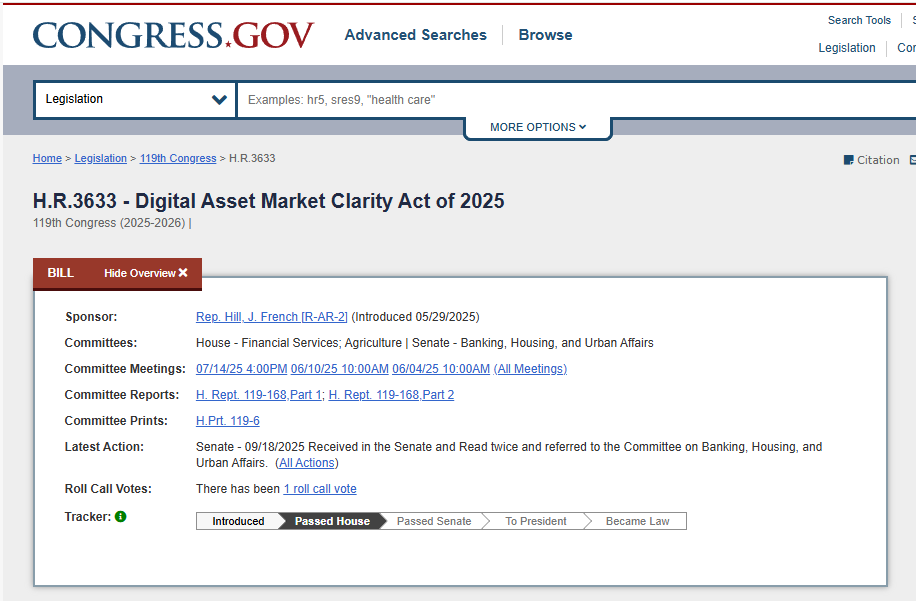
The Digital Asset Market CLARITY Act of 2025 (bill H.R.3633) is a U.S. market-structure bill designed to clarify the line between when a digital asset is treated as a security and when it is treated as a commodity. Moreover, it’s meant to formalize how crypto trading venues and intermediaries register and operate under federal oversight.
One of the core themes is the division of responsibilities between the SEC and the CFTC. The CRS summary describes the bill as giving the CFTC a central role in regulating “digital commodities” and related intermediaries.
It will also preserve parts of SEC authority over certain primary market activities, while introducing a new exemption pathway for some fundraising subject to disclosure requirements.
The bill also introduces concepts meant to address the “when does decentralization matter” question. Including criteria tied to blockchain maturity and whether a network is “controlled” by a person or a coordinated group.
Why Crypto Needs It
The simplest reason is that the U.S. crypto markets have spent years in a gray zone, with different agencies, courts, and enforcement actions shaping outcomes without a clear statutory framework.
Supporters argue the industry is operating with fragmented oversight and outdated rules. Additionally, they say that a clearer framework could reduce “regulation-by-enforcement” dynamics while keeping activity onshore.
That framing is explicit in Senate Banking Committee majority materials, which state that the bill aims to set “clear rules of the road” and allocate SEC vs. 0CFTC jurisdiction more cleanly.
The CRS also highlights a practical gap the bill seeks to address: creating a pathway for intermediaries (exchanges, brokers, dealers) to register under an explicit digital commodity regime.
Related video: US CLARITY Act Explained: The New Crypto Rules in Simple Terms
The Drama Around It
There’s a lot of speculation and noise surrounding the passing of this bill. Moreover, this is due to “clarity” being a bundle of tradeoffs that hits the most sensitive parts of the structure.
1) Who Controls the Spot Market: SEC vs CFTC
A major fight is whether the bill structure meaningfully empowers the CFTC (the industry’s preferred venue for spot market oversight) or whether changes in Senate drafting dilute that posture. Coinbase’s CEO Brian Armstrong argued the latest Senate effort would erode the CFTC’s authority.
2) Stablecoin Rewards & Incentives
Stablecoin reward mechanics are now a flashpoint because they touch consumer behavior. Meaning bank deposit competition, and what “yield” means when the token is pegged to dollars. Also, Armstrong warned the draft would “kill” the ability to offer rewards on stablecoin holdings, and noted stablecoin provisions are among the most contentious points in the Senate debate.
3) DeFi, Software, and the “Control vs Code” Line
Senate Banking majority messaging emphasizes protecting software developers and peer-to-peer activity while applying risk management standards to centralized intermediaries that interact with DeFi.
That sounds straightforward until you try to define “control” in real systems. Where front ends, sequencers, governance, and admin keys can turn “decentralized” into a complicated gradient rather than a binary.
4) Investor Protection and State Authority
Critics from traditional investor-protection circles worry that definitions and preemption could weaken the enforcement capacity.
Furthermore, NASAA said they couldn’t support the bill in its current form, raising concerns that parts of Title I could weaken state authority and pointing to inconsistencies in asset definitions.

Does it Affect Crypto Decentralization?
This is where most experts agree the bill stops being a simple “clarity good” narrative.
On one hand, after reviewing the document, Armstrong said Coinbase couldn’t support the measure in its current form and that “We’d rather have no bill than a bad bill,” while listing concerns, including stablecoin rewards and CFTC authority.
Also, Cardano founder Charles Hoskinson slammed Ripple CEO Brad Garlinghouse after Garlinghouse praised the Senate Banking Committee’s version of the Clarity Act. Arguing with a solid stance that “clarity beats chaos.”
Regardless of where you land, the takeaway is that major ecosystem leaders disagree on what decentralization should mean under law.
Moreover, even if a bill claims that self-custody is protected and that “developers aren’t intermediaries,” implementation tends to drift toward the easiest enforcement layer. Which are centralized on-ramps, stablecoin issuers, and large intermediaries.
Senate Banking materials emphasize focusing rules on control rather than code. However, the hard part is that control can exist in UI hosting, sequencer operation, admin keys, or token governance concentration, not just custody.
How Everything Looks in 2026
- The House version passed in 2025 and moved to the Senate.
- In January 2026, the Senate Banking Committee’s work hit a halt when the committee postponed a key markup after Coinbase’s objections went public.
- The bill isn’t dead. However, it’s being rewritten in real-time under pressure from industry, lawmakers, and investor-protection groups.
Frequently Asked Questions:
What is the Crypto Clarity Act in simple terms?
The Crypto Clarity Act is a proposed U.S. bill that aims to clearly define when a crypto asset is regulated as a security versus a commodity, and which federal agency oversees different parts of the crypto market.
Why does the Crypto Clarity Act matter for crypto markets?
It matters because unclear regulation has increased legal risk for exchanges, builders, and investors. A defined framework could reduce enforcement uncertainty and make it easier for institutions to operate in U.S. crypto markets.
Does the Crypto Clarity Act affect decentralized finance (DeFi)?
Indirectly, yes. While the bill emphasizes regulating intermediaries rather than software, critics argue its definitions of “control” could still impact DeFi front ends, governance structures, or infrastructure providers.
Why are some crypto leaders criticizing the Crypto Clarity Act?
Some industry leaders argue the current draft weakens the role of the CFTC, restricts stablecoin rewards, or risks centralizing pressure points in crypto infrastructure, potentially harming decentralization.
Is the Crypto Clarity Act bullish or bearish for crypto?
It’s viewed as structurally bullish by supporters because it could bring legal certainty and institutional confidence. Critics caution that poorly designed rules could concentrate power and limit permissionless innovation.
How do you rate this article?
Join our Socials
Briefly, clearly and without noise – get the most important crypto news and market insights first.

Most Read Today
1
Chainlink’s 499% Social Volume Spike: Why Attention is Outpacing Price
2Cardano (ADA) Price Analysis: Quiet Accumulation as Technical Signals Begin to Strengthen
3Mantle’s $1B Milestone: Why MNT is the Next Layer 2 Powerhouse to Watch
4Digital Silver’s Silent Strength: Litecoin (LTC) Fundamental and Technical Dive
5Zcash: The VC-Backed Rebirth of Private Finance
Latest







8
Also read
Similar stories you might like.

Altcoins
Crypto Whale Transfers Spike Ahead of Clarity Act Decision; Here’s Why
Ana | 2026-02-27

Altcoins
BlackRock’s Next Crypto Move Could Change Ethereum Investing Forever
Rokas | 2026-02-21

Blockchain
21Shares Quietly Upgrades Its Most Critical Infrastructure
Rokas | 2026-02-15

Bitcoin
Institutions Are Losing Patience, and Bitcoin Developers Just Got a Warning
Rokas | 2026-02-15

Altcoins
This Major Bank Turns Bitcoin Into Bank-Grade Collateral
Rokas | 2026-02-15

Altcoins
Ripple Teams Up With a Major UK Asset Manager
Patrick | 2026-02-11

Blockchain
LINK Futures Go Live on CME Group
Patrick | 2026-02-10

Altcoins
Sui’s Token Standard Just Got Exchange-Grade Support
Rokas | 2026-02-08

Crypto News
From DeFi to ETFs: Why Bitwise’s UNI Filing Matters
Rokas | 2026-02-07

Defi
How Stablecoin Liquidity Works & Why It Quietly Drives Crypto Markets
Rokas | 2026-02-20