











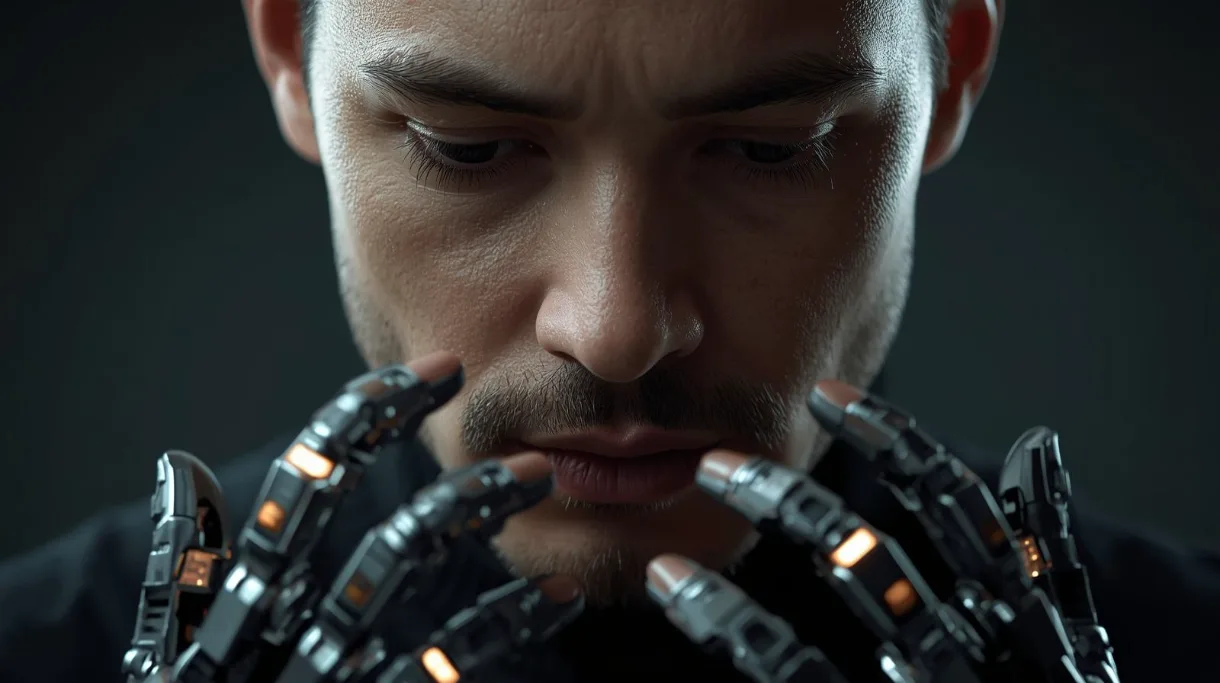
A man looking at his bionic hands
Breakthrough AI Enables Seamless Control of Prosthetic Hands
In Brief
- • University of Utah researchers developed an AI “co-pilot” that enhances prosthetic hand control.
- • The system processes sensor data to autonomously adjust grip force and finger movements.
- • The breakthrough reflects broader advances in AI learning and integration in human life.
The control of prosthetic hands has been a major challenge for amputees for years, but that is about to be over. Scientists at the University of Utah have built an AI co-pilot specifically to help with the control of bionic hands to improve quality of life.
Ad
The new AI research published on 9 December details how the integration of proximity and pressure sensors in prosthetic hands can help to improve grasping without crushing things or letting them slip. This precision which is encoded in human feedback mechanisms is missing in existing prosthetic hands.
AI Restoring Faith in Prosthetics
Amputees have over the years had to deal with prosthetic hands that in many cases, they end up abandoning due to their lack of practicality. Jake George, an electrical and computer engineer at the University of Utah said most amputees abandon their artificial hands because they are difficult to control.
To fix this problem, George and his team came up with an AI bionic hand co-pilot that helps with the control, giving the hands autonomy so they can grab and move things with precision, just like a normal human hand which works with automatic reflexes in agreement with the central nervous system.
Ad
The team of researchers began by replacing the fingertips of an existing prosthetic hand with silicone-wrapped pressure and proximity sensors. With that, the hand could detect when it was close to an object and could measure how much force it required to grab the object without breaking it or letting it slip.
The team also built an AI controller that processes the information gathered by the sensors and moves the joints accordingly to adjust the force of the grip. With several such back and forth movements, the team was able to collect sufficient data to train the AI on recognizing different objects and switch between different grip types with precise control of each finger, giving users control over their artificial hands.
AI Integration in Human Life on the Increase
AI was initially used for many things outside of direct human life, but its application is on a rapid increase because of their ability to evolve. A recent study has revealed that AI has the ability to learn values just like children, making them capable of becoming better at anything.
It is this type of learning that enables the technology to become more precise, such as in predicting pedestrian behavior with such accuracy that is unprecedented, and is why amputees can now use bionic hands with much precision again.
More Must-Reads:
How do you rate this article?
Subscribe to our YouTube channel for crypto market insights and educational videos.






Join our Socials
Briefly, clearly and without noise – get the most important crypto news and market insights first.

Most Read Today
1
Peter Schiff Warns of a U.S. Dollar Collapse Far Worse Than 2008
2Dubai Insurance Launches Crypto Wallet for Premium Payments & Claims
3XRP Whales Buy The Dip While Price Goes Nowhere
4Samsung crushes Apple with over 700 million more smartphones shipped in a decade
5Luxury Meets Hash Power: This $40K Watch Actually Mines Bitcoin
Latest




Most Read Today
MOST ENGAGING
8
Also read
Similar stories you might like.

Artificial Intelligence
Robert Kiyosaki Warns AI Bubble May Be Bigger Than Dot-Com
Ana | 2025-12-24

Artificial Intelligence
New Epstein Disclosures Collide With an AI Project Built Months Earlier
Ana | 2025-12-22
Artificial Intelligence
Gemini Can Now Detect AI-Generated Files
Shedrach | 2025-12-19

Artificial Intelligence
Fetch.ai Launches Autonomous AI-to-AI USDC Settlement
Shedrach | 2025-12-19
Artificial Intelligence
Tesla Semi Tease Hints At Big Changes Under The Hood
Ana | 2025-12-19
Artificial Intelligence
Scientists Use AI to Crack Nature’s Hidden Laws
Ana | 2025-12-18
Artificial Intelligence
Can AI Ever Be Proven Conscious? A Philosopher Says No
Ana | 2025-12-18
Artificial Intelligence
Researchers Uncover Hidden Bias in Cancer Diagnosis AI
Ana | 2025-12-17

Artificial Intelligence
AI Learns Math Better by Arguing With Itself
Ana | 2025-12-15
Artificial Intelligence
New Study Shows AI Can Learn Values Like Children
Ana | 2025-12-12