













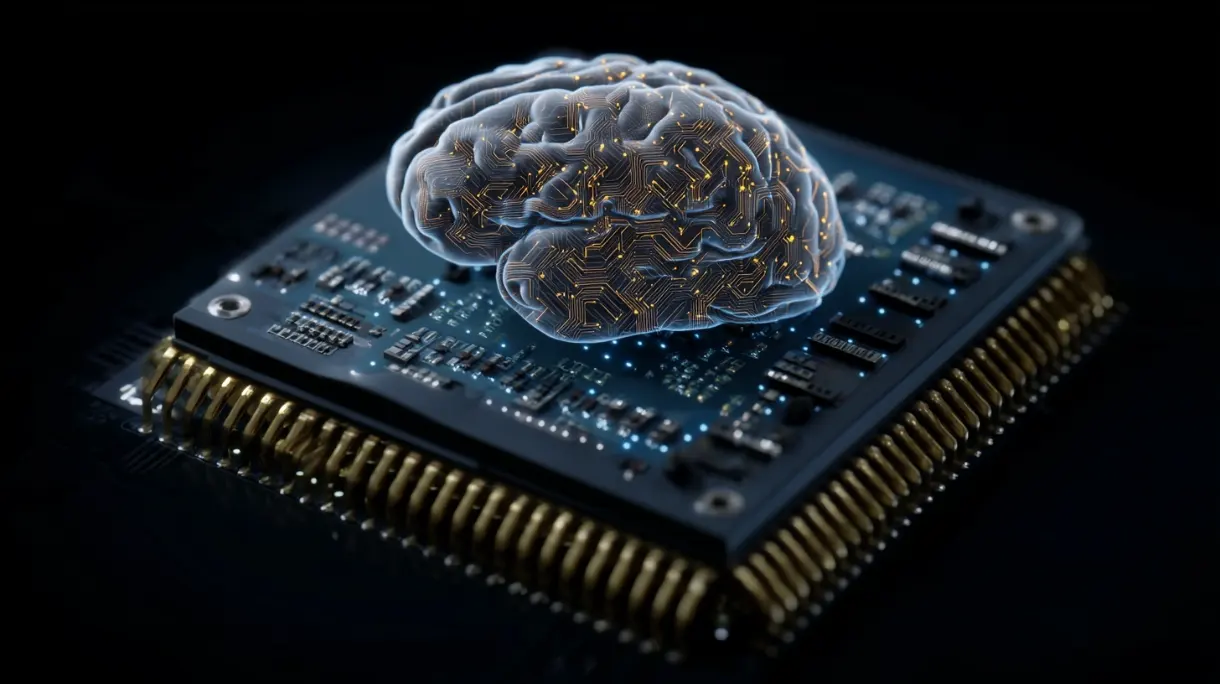
Brain-AI Fusion Leaps Forward With Radical New Chip
Brain-AI Fusion Leaps Forward With Radical New Chip
In Brief
- • Researchers created an ultra-thin wireless brain-computer chip.
- • It records and stimulates thousands of neural signals with minimal surgery.
- • Early tests show strong potential for advanced neuroprosthetics and brain-AI links.
A new brain-computer interface (BCI) the size of a fingernail and as thin as wet tissue paper may mark one of the biggest leaps in neuroscience and human-machine interaction in decades.
Ad
Researchers from Columbia University, NewYork-Presbyterian, Stanford University, and the University of Pennsylvania have unveiled a fully integrated, single-chip implant that promises faster, safer, and dramatically more powerful brain communication than anything that exists today.

The device, called the Biological Interface System to Cortex (BISC), compresses an entire suite of neural-recording electronics into a single silicon chip that slides between the skull and the brain.
Unlike traditional systems that require bulky canisters of hardware and surgically implanted wiring, BISC operates wirelessly and transfers brain activity at unprecedented speeds.
Ad
Its creators believe it could one day help restore speech, movement, and vision, manage treatment-resistant epilepsy, and even enable direct interaction between the human brain and artificial intelligence (AI).
New Class of Brain Interface
Specifically, the chip measures only 3 mm3 and is thinned to 50 micrometers, allowing it to flex and contour to the brain’s surface. Yet inside this sliver of silicon are 65,536 electrodes, more than 1,000 simultaneous recording channels, and over 16,000 channels for neural stimulation.
Columbia engineer Ken Shepard, who guided the system’s development, describes it as “a piece of wet tissue paper” resting on the brain, but capable of transmitting data at 10 megabits per second, which is at least 100 times faster than the best wireless BCI systems available today.
“Most implantable systems are built around a canister of electronics that occupies enormous volumes of space inside the body. Our implant is a single integrated circuit chip that is so thin that it can slide into the space between the brain and the skull, resting on the brain like a piece of wet tissue paper.”
A wearable relay station communicates with the implant through a custom ultrawideband radio link, then passes data through Wi-Fi to a computer, in effect creating an invisible, high-bandwidth network connection straight to neural tissue. As Stanford neuroscientist Andreas Tolias notes:
“BISC turns the cortical surface into an effective portal, delivering high-bandwidth, minimally invasive read–write communication with AI and external devices. Its single-chip scalability paves the way for adaptive neuroprosthetics and brain-AI interfaces to treat many neuropsychiatric disorders, such as epilepsy.”
Toward Real-World Patients
Early preclinical testing shows that the implant remains stable and delivers high-quality recordings without the inflammation or signal degradation caused by devices that penetrate brain tissue.
Neurosurgeon Dr. Brett Youngerman is preparing the device for clinical studies in severe epilepsy, where its ability to read and stimulate neural circuits at high speed could offer new ways to predict and interrupt seizures. As he explained:
“The key to effective brain-computer interface devices is to maximize the information flow to and from the brain, while making the device as minimally invasive in its surgical implantation as possible. BISC surpasses previous technology on both fronts.”
As a result, the system’s surgical footprint is minimal. Surgeons can insert the chip through a small skull opening and slide it directly onto the brain’s surface, eliminating the need for wires tethered to bone or large implants that take up space inside the body.
Columbia, Stanford, and Penn researchers also demonstrated that BISC’s ultra-high-resolution signals can be decoded by advanced machine-learning frameworks to identify intentions, perceptions, and brain states more accurately than existing BCIs.

Indeed, this performance opens the door to AI-assisted neuroprosthetics, smarter medical interventions, and long-term devices that enhance communication for patients with paralysis or neurodegenerative diseases.
BISC could change the treatment of brain disorders, how people communicate when they lose speech, and how humans interact with increasingly intelligent machines. It signals a future in which the boundaries between biological and digital systems grow thinner.
More Must-Reads:
How do you rate this article?
Subscribe to our YouTube channel for crypto market insights and educational videos.






Join our Socials
Briefly, clearly and without noise – get the most important crypto news and market insights first.
Most Read Today
1
Peter Schiff Warns of a U.S. Dollar Collapse Far Worse Than 2008
2Dubai Insurance Launches Crypto Wallet for Premium Payments & Claims
3XRP Whales Buy The Dip While Price Goes Nowhere
4Samsung crushes Apple with over 700 million more smartphones shipped in a decade
5Luxury Meets Hash Power: This $40K Watch Actually Mines Bitcoin
Latest




8
Also read
Similar stories you might like.

Artificial Intelligence
Robert Kiyosaki Warns AI Bubble May Be Bigger Than Dot-Com
Ana | 2025-12-24

Artificial Intelligence
New Epstein Disclosures Collide With an AI Project Built Months Earlier
Ana | 2025-12-22

Artificial Intelligence
Gemini Can Now Detect AI-Generated Files
Shedrach | 2025-12-19

Artificial Intelligence
Fetch.ai Launches Autonomous AI-to-AI USDC Settlement
Shedrach | 2025-12-19

Artificial Intelligence
Tesla Semi Tease Hints At Big Changes Under The Hood
Ana | 2025-12-19

Science
Scientists Reconstruct Skull of 1.6-Million-Year-Old Ethiopian Homo Erectus
Shedrach | 2025-12-19
Artificial Intelligence
Scientists Use AI to Crack Nature’s Hidden Laws
Ana | 2025-12-18

Artificial Intelligence
Can AI Ever Be Proven Conscious? A Philosopher Says No
Ana | 2025-12-18
Artificial Intelligence
Researchers Uncover Hidden Bias in Cancer Diagnosis AI
Ana | 2025-12-17

Research
Engineers Rewrite Aluminum’s Limits With 3D Printing
Ana | 2025-12-16