







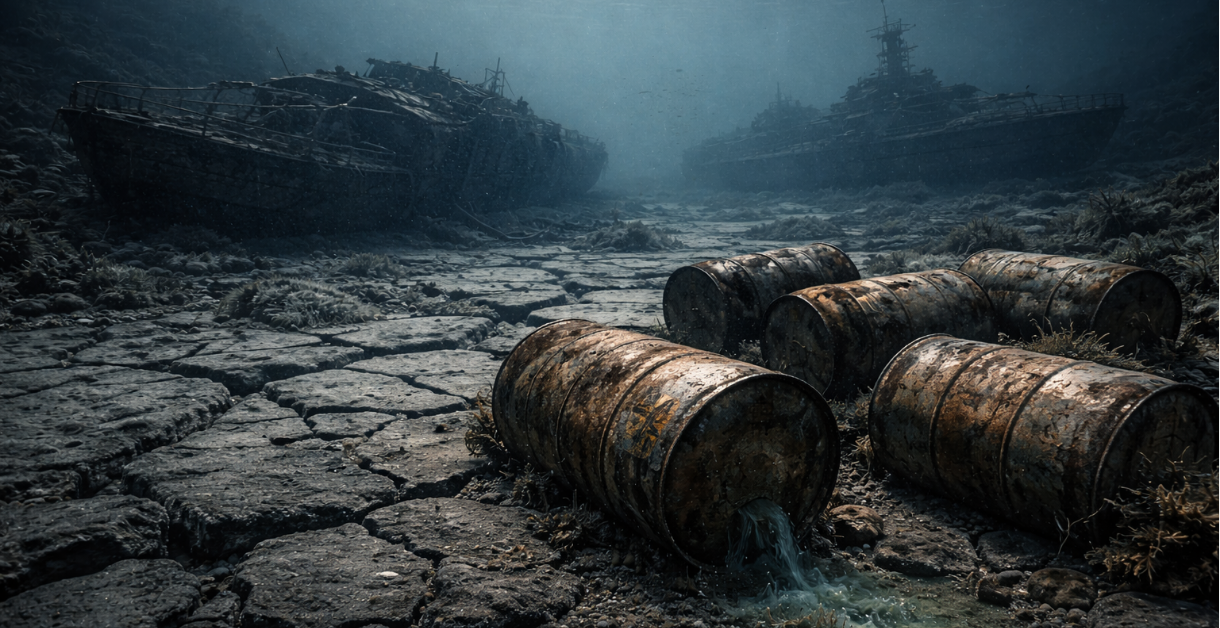
Image showing the depths of the baltic sea, with ship wreckages and chemical waste lying on the ocean floor.
Beneath the Baltic Sea: Mysteries, Wrecks, and Hidden History
In Brief
- • The Baltic Sea is one of Europe’s most strategic waterways, hiding thousands of years of history beneath its surface.
- • Documented discoveries include unexplained geological anomalies, WWII wreckage, and the world’s largest chemical weapons graveyard.
- • Strange acoustic signals and submerged prehistoric landscapes add to its reputation as a natural and historical laboratory.
Located in Northern Europe, bordered by Scandinavia, Central Europe, and the Baltic States, the Baltic Sea is far more than a vacation destination. On its seafloor lie real, documented discoveries. From unexplained geological formations to the largest chemical weapons graveyard in the world.
Ad
The Baltic Sea Anomaly
In 2011, Swedish divers from the Ocean X team detected an unusual sonar reading at a depth of 90 meters between Sweden and Finland. The object was almost perfectly circular, measuring about 60 meters across.
Initial footage revealed irregular “steps” resembling a man-made structure. While most scientists believe the anomaly is a remnant of the last Ice Age, granite and gneiss formations typical of Scandinavia, its symmetry and surrounding tracks continue to spark debate.
Natural geological formations rarely produce such shapes. Moreover, although similar Ice Age formations exist across the Baltic basin, this particular anomaly remains one of the most discussed underwater mysteries in Northern Europe.
Ad
The World’s Largest Chemical Weapons Graveyard
After World War II, the Allies faced a daunting problem, what to do with Nazi Germany’s massive chemical arsenal. Their solution, unthinkable by modern standards, was to dump more than 50,000 tons of chemical weapons into the Baltic Sea between 1945 and 1947.
Among the substances were mustard gas, phosgene, and tabun. Which are highly toxic agents, and most of the dumps were concentrated near Bornholm (Denmark) and Gotland (Sweden). But currents and corrosion mean their ecological impact could spread across the wider Baltic region.
Scientists have already documented corrosion in many of the containers after more than 75 years underwater. The Baltic Sea, as a result, holds what some researchers call a “delayed ecological bomb,” with long-term consequences that remain unpredictable.
Europe’s Greatest Underwater Time Capsule
The Baltic Sea is one of Europe’s most densely packed regions for World War II wreckage. Estimates suggest 8,000 – 10,000 larger ships rest on its seafloor, while the total number of wrecks could exceed 100,000.
Swedish state institutions report that the Baltic is home to both civilian and military vessels, destroyers, patrol boats, and more, many still containing explosives, fuel, or hazardous materials.
The Baltic’s unusually low salinity slows corrosion, meaning these wrecks remain remarkably well preserved. Together, they form Europe’s greatest underwater time capsule, offering historians and archaeologists a unique glimpse into wartime history.
Myth Debunked: Why the Baltic Seafloor “Speaks”
Geologically, the Baltic Sea is young. Its seabed is riddled with post-glacial cracks, valleys, and canyons. These structures produce strange infrasound pulses and “click” acoustic signals detected by scientists.
In some areas, researchers have also recorded ELF (extremely low-frequency) electromagnetic anomalies, linked to both natural processes and wartime infrastructure.
While pop culture often turns these signals into myths, science offers rational explanations that range from low-frequency vibrations caused by moving water in fissures, all the way to chemical reactions near wreck sites that produce unusual sound patterns.
These signals are not supernatural, they are a natural part of the Baltic’s unique underwater geography. Whether viewed as a strategic corridor, an ecological challenge, or an underwater museum, the Baltic Sea reminds us that the past is never far beneath the surface.
As technology advances, more secrets are likely to emerge from its depths.
More Must-Reads:
How do you rate this article?
Subscribe to our YouTube channel for crypto market insights and educational videos.






Join our Socials
Briefly, clearly and without noise – get the most important crypto news and market insights first.
Most Read Today
1
Peter Schiff Warns of a U.S. Dollar Collapse Far Worse Than 2008
2Dubai Insurance Launches Crypto Wallet for Premium Payments & Claims
3XRP Whales Buy The Dip While Price Goes Nowhere
4Samsung crushes Apple with over 700 million more smartphones shipped in a decade
5Luxury Meets Hash Power: This $40K Watch Actually Mines Bitcoin
Latest



8
Also read
Similar stories you might like.
Bitcoin
Bitcoin Slides Alongside Gold and Silver as Pressure Hits Markets
Patrick | 2026-01-29
Crypto News
Peter Schiff Warns of a U.S. Dollar Collapse Far Worse Than 2008
Patrick | 2026-01-29
Crypto News
Dubai Insurance Launches Crypto Wallet for Premium Payments & Claims
Patrick | 2026-01-29
Altcoins
XRP Trades Under Heavy Structure as Derivatives Pressure Continue
Patrick | 2026-01-29

Crypto News
UAE Central Bank Approves First USD-Backed Stablecoin, USDU
Patrick | 2026-01-29
Bitcoin
Why Bitcoin Looks Weak Today But Strong Long-Term
Ana | 2026-01-29

Altcoins
Tom Lee’s Bitmine Deepens Massive Ethereum Staking Bet to $7.6B
Ana | 2026-01-29

Altcoins
Dogecoin Bulls vs. Bears? One Key Line Decides Everything
Ana | 2026-01-29
Altcoins
XRP Whales Buy The Dip While Price Goes Nowhere
Ana | 2026-01-29

Altcoins
Russia Finalizes Rules for Bitcoin, Ethereum, and Stablecoins
Ana | 2026-01-29