













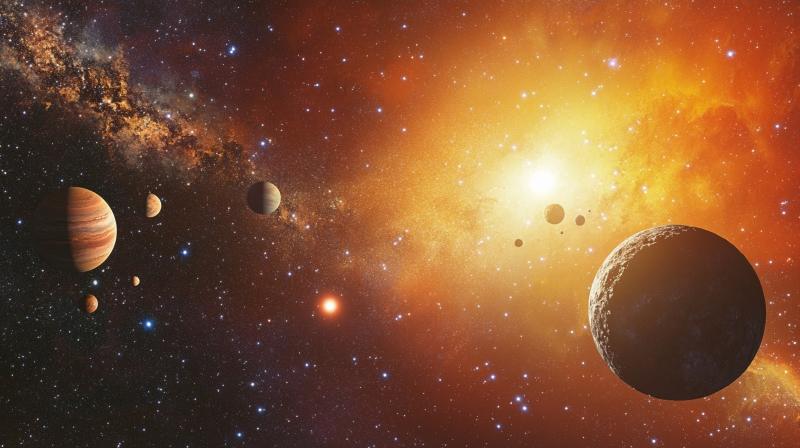
Astronomers witness baby planets forming around distant infant star
Shortly after spotting a newborn alien solar system, scientists have also got a unique opportunity to experience another rare cosmic first – baby planets forming around the newborn star called HOPS-315 – giving them a glimpse into the early planetary formation process.
Ad
As it happens, astronomers have discovered the earliest seeds of rocky planets coming into being in the gas surrounding a baby sun-like star, receiving for the first time a snapshot of ‘time zero,’ when new worlds begin to form, according to a report published on July 20.
Specifically, the infant star in question is HOPS-315, a yellow dwarf in the making like the sun, only a lot younger at 100,000 to 200,000 years old and about 1,370 light-years away (one light-year = 6 trillion miles). Here, an international research team discovered signs of early planet formation.
Signs of baby planets
What enabled them to observe these condensing solid specks was a gap in the outer part of the gas disk around the infant star, thanks to the way the star tilts toward Earth. In the words of Leiden Observatory’s Melissa McClure from the Netherlands, who led the team:
Ad
“We’ve captured a direct glimpse of the hot region where rocky planets like Earth are born around young protostars. (…) For the first time, we can conclusively say that the first steps of planet formation are happening right now.”
Indeed, they identified silicon monoxide gas and crystalline silicate minerals, the ingredients for the first solid materials to form in our own solar system over 4.5 billion years ago, and it’s taking place in a location much like the asteroid belt between Mars and Jupiter, containing the planets’ leftover building blocks.
Furthermore, McClure explained that this was a first-ever discovery of condensing of hot minerals around a young star, something the scientific community never experienced before, “so we didn’t know if it was a universal feature of planet formation or a weird feature of our solar system.”
Now, thanks to a stunning picture taken by the European Southern Observatory (ESO) in Chile and its Atacama Large Millimeter/submillimeter Array (ALMA) telescope network, they understand it might be a common process during the earliest stages of planetary formation.
As it happens, the picture shows the emerging planetary system resembling a lightning bug glowing against the black void.
As a reminder, astronomers have used combined observations from the James Webb Space Telescope (JWST) and the ALMA to observe the protostar HOPS-315, which lies in a giant star-forming region in the constellation of Orion, weighing in at 0.6 solar mass and someday growing into a star much like our own Sun.
How do you rate this article?
Subscribe to our YouTube channel for crypto market insights and educational videos.






Join our Socials
Briefly, clearly and without noise – get the most important crypto news and market insights first.
Most Read Today
1
Samsung crushes Apple with over 700 million more smartphones shipped in a decade
2Peter Schiff Warns of a U.S. Dollar Collapse Far Worse Than 2008
3Dubai Insurance Launches Crypto Wallet for Premium Payments & Claims
4XRP Whales Buy The Dip While Price Goes Nowhere
5Luxury Meets Hash Power: This $40K Watch Actually Mines Bitcoin
Latest






8
Also read
Similar stories you might like.

Industry
Google Searches for “How to Buy Gold” Explode Globally, Hitting a Two-Decade High
Rokas | 2026-01-26

Industry
Businesses now use crypto as operational capital, CoinGate data reveals a structural shift
Rokas | 2026-01-21

Bitcoin
$455 Billion in Bitcoin Exposed to Quantum Attack Risk via Address Reuse, Up 16% Since 2020
Jastra | 2026-01-20

Altcoins
Iran’s Crypto Activity Surges During Protests; Here’s Why
Ana | 2026-01-16

Industry
Stablecoin Market Share Hits an All-Time High of 10.19%
Jastra | 2026-01-14
No image

Bitcoin
Only Three Governments Increased Bitcoin Holdings in 2025 – U.S. Leads Following 130,000 BTC Seizure
Jastra | 2026-01-05

Industry
Solana Tokens Lose $157B in 2025, The Largest Dollar-Value Drop in the Chain’s History
Jastra | 2025-12-30

Artificial Intelligence
New Epstein Disclosures Collide With an AI Project Built Months Earlier
Ana | 2025-12-22

Science
Scientists Reconstruct Skull of 1.6-Million-Year-Old Ethiopian Homo Erectus
Shedrach | 2025-12-19