













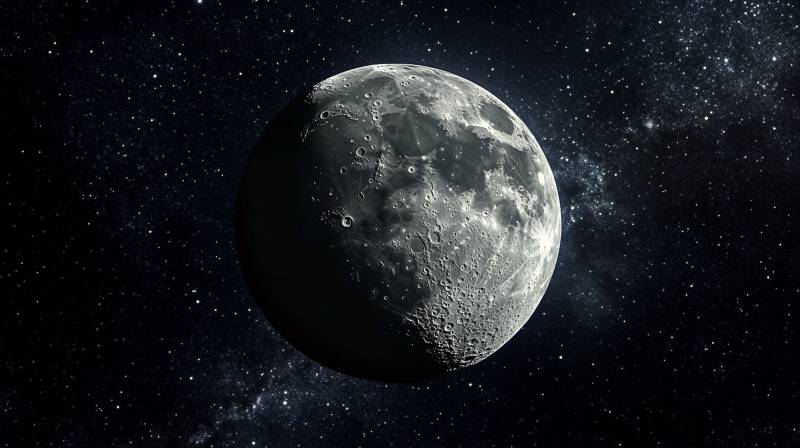
Astronomers use moon’s quiet side to study cosmic ‘Dark Ages’
As our ‘Final Frontier’ continues to fill us with wonderment, astronomers are looking to unlock the secrets of the cosmic ‘Dark Ages’ – right after the Big Bang, when the universe was still largely dark and empty before the first stars and galaxies appeared.
Ad
Indeed, astronomers plan to study the ‘Cosmic Dawn’ by sending a miniature spacecraft to the far side of the moon, from where it would listen out for an ‘ancient whisper,’ per a proposal that Dr. Eloy de Lera Acedo is presenting on July 9 at the Royal Astronomical Society’s National Astronomy Meeting in Durham.
Studying the cosmic ‘Dark Ages’
As it happens, the main problem in studying the cosmic ‘Dark Ages’ lies in the fact that it requires silence, and Earth is rather noisy for the optimal deployment of radio signals due to the interference from our atmosphere and electronics. As Dr. Acedo explained:
“It’s like trying to hear that whisper while a loud concert is playing next door. (…) This makes it really hard to pick up those faint signals from billions of years ago. To detect a special radio signal that comes from hydrogen – the first, most basic, and most abundant chemical element – in the early universe, we need it to be quiet.”
To address this key issue, his team is proposing to send “a small satellite to orbit the moon and detect a signal which could hold clues about how everything began and how structures like galaxies eventually formed.” This effort is dubbed the CosmoCube mission.
Ad
As part of the project, the machine would observe from the far side of the moon, which behaves as an enormous shield, blocking out all the radio noise from Earth, and creating a clear, quiet spot to “listen” for an “ancient whisper” and find out more about the universe’s largely unexplored Dark Ages and Cosmic Dawn periods.
Specifically, CosmoCube will include a precision-calibrated, low-power radiometer working from a low-cost satellite platform in lunar orbit. It would operate at low frequencies (10-100 MHz), designed to detect extremely faint signals in the midst of a sea of noise.
In Dr. Acedo’s words, CosmoCube’s main goal would be to bring a better understanding of how the universe changed from a “simple, dark state to the complex, light-filled cosmos we see today, with all its stars and galaxies.” Additionally, it could deliver some insights into the “mysterious dark matter and its role in shaping these cosmic structures.”
Elsewhere, Chinese scientists have managed to develop a groundbreaking 3D printing system that could allow them to create habitats on the moon using nothing other than on-site sourced lunar soil, making it a major breakthrough for future space exploration.
How do you rate this article?
Subscribe to our YouTube channel for crypto market insights and educational videos.






Join our Socials
Briefly, clearly and without noise – get the most important crypto news and market insights first.
Most Read Today
1
Samsung crushes Apple with over 700 million more smartphones shipped in a decade
2Peter Schiff Warns of a U.S. Dollar Collapse Far Worse Than 2008
3Dubai Insurance Launches Crypto Wallet for Premium Payments & Claims
4XRP Whales Buy The Dip While Price Goes Nowhere
5Luxury Meets Hash Power: This $40K Watch Actually Mines Bitcoin
Latest






8
Also read
Similar stories you might like.

Industry
Google Searches for “How to Buy Gold” Explode Globally, Hitting a Two-Decade High
Rokas | 2026-01-26

Industry
Businesses now use crypto as operational capital, CoinGate data reveals a structural shift
Rokas | 2026-01-21

Bitcoin
$455 Billion in Bitcoin Exposed to Quantum Attack Risk via Address Reuse, Up 16% Since 2020
Jastra | 2026-01-20

Altcoins
Iran’s Crypto Activity Surges During Protests; Here’s Why
Ana | 2026-01-16

Industry
Stablecoin Market Share Hits an All-Time High of 10.19%
Jastra | 2026-01-14
No image

Bitcoin
Only Three Governments Increased Bitcoin Holdings in 2025 – U.S. Leads Following 130,000 BTC Seizure
Jastra | 2026-01-05

Industry
Solana Tokens Lose $157B in 2025, The Largest Dollar-Value Drop in the Chain’s History
Jastra | 2025-12-30

Artificial Intelligence
New Epstein Disclosures Collide With an AI Project Built Months Earlier
Ana | 2025-12-22

Science
Scientists Reconstruct Skull of 1.6-Million-Year-Old Ethiopian Homo Erectus
Shedrach | 2025-12-19