













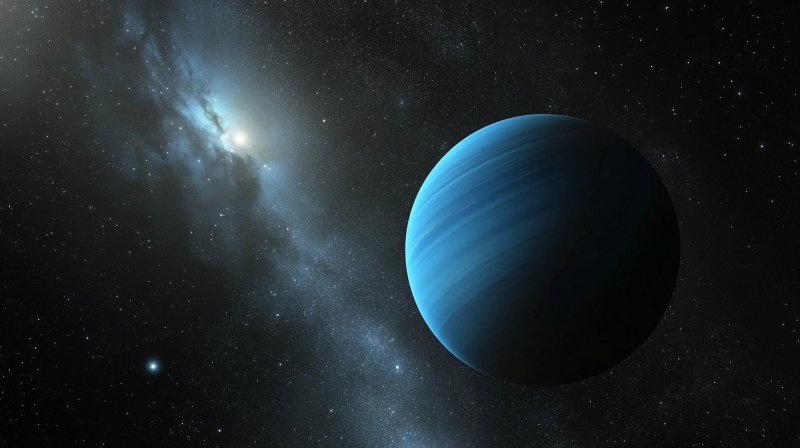
Astronomers discover mysterious object moving in sync with Neptune
As the universe continues to be a never-ending source of new and shocking discoveries, astronomers have just observed a mysterious object moving in near-perfect sync with Neptune – a planet near the icy frontier of our own solar system.
Ad
Specifically, the scientists have discovered a tiny world, called ‘2020 VN40,’ which circles the Sun once for every ten laps completed by Neptune, making it the first confirmed 10:1 partnership ever observed, according to a report published by Earth.com on July 25.
How the mysterious object fits in
Notably, Neptune requires about 165 Earth years to circle the Sun, which means that 2020 VN40 takes close to 1,650 years to complete its orbit, but the two realign in space in a way that prevents close encounters, giving some insight into how giant planets once migrated through the early Kuiper Belt.
Furthermore, computer simulations indicate that Neptune’s strongest outer resonances are an ideal location for objects that roam outward and become captured in a process called ‘scattering sticking.’
Ad
In theory, up to 40% of scattered bodies between 30-100 astronomical units (AUs – the average distance between the Earth and the Sun) are briefly caught before wandering away again.
As it happens, the locking of the orbit happens when Neptune’s repeated tugs fall at the same point in an object’s path and form resonances, and over thousands of cycles, these gentle tugs build up.
Meanwhile, this team of astronomers has made this discovery during the Large inclination Distant Objects, or LiDO, survey, which uses the 3.6-meter Canada-France-Hawaii Telescope (CFHT) on the island of Mauna Kea to analyze patches of sky well above the ecliptic.
Elsewhere, astronomers have recently spotted a collision between fast-spinning, so-called ‘forbidden’ black holes that challenge the established rules of physics and expand scientists’ understanding of how such bodies grow in the universe.
Another cosmic first involved the observation of a newborn alien solar system and even baby planets forming in the gas around the star called HOPS-315 that gave researchers a front-row seat on the earliest stages of the planetary formation process.
How do you rate this article?
Subscribe to our YouTube channel for crypto market insights and educational videos.






Join our Socials
Briefly, clearly and without noise – get the most important crypto news and market insights first.
Most Read Today
1
Samsung crushes Apple with over 700 million more smartphones shipped in a decade
2Peter Schiff Warns of a U.S. Dollar Collapse Far Worse Than 2008
3Dubai Insurance Launches Crypto Wallet for Premium Payments & Claims
4XRP Whales Buy The Dip While Price Goes Nowhere
5Luxury Meets Hash Power: This $40K Watch Actually Mines Bitcoin
Latest





8
Also read
Similar stories you might like.

Industry
Google Searches for “How to Buy Gold” Explode Globally, Hitting a Two-Decade High
Rokas | 2026-01-26

Industry
Businesses now use crypto as operational capital, CoinGate data reveals a structural shift
Rokas | 2026-01-21

Bitcoin
$455 Billion in Bitcoin Exposed to Quantum Attack Risk via Address Reuse, Up 16% Since 2020
Jastra | 2026-01-20

Altcoins
Iran’s Crypto Activity Surges During Protests; Here’s Why
Ana | 2026-01-16

Industry
Stablecoin Market Share Hits an All-Time High of 10.19%
Jastra | 2026-01-14
No image

Bitcoin
Only Three Governments Increased Bitcoin Holdings in 2025 – U.S. Leads Following 130,000 BTC Seizure
Jastra | 2026-01-05
Industry
Solana Tokens Lose $157B in 2025, The Largest Dollar-Value Drop in the Chain’s History
Jastra | 2025-12-30

Artificial Intelligence
New Epstein Disclosures Collide With an AI Project Built Months Earlier
Ana | 2025-12-22

Science
Scientists Reconstruct Skull of 1.6-Million-Year-Old Ethiopian Homo Erectus
Shedrach | 2025-12-19