












Alien Comet Leaks Nickel Gas, Baffling NASA Scientists
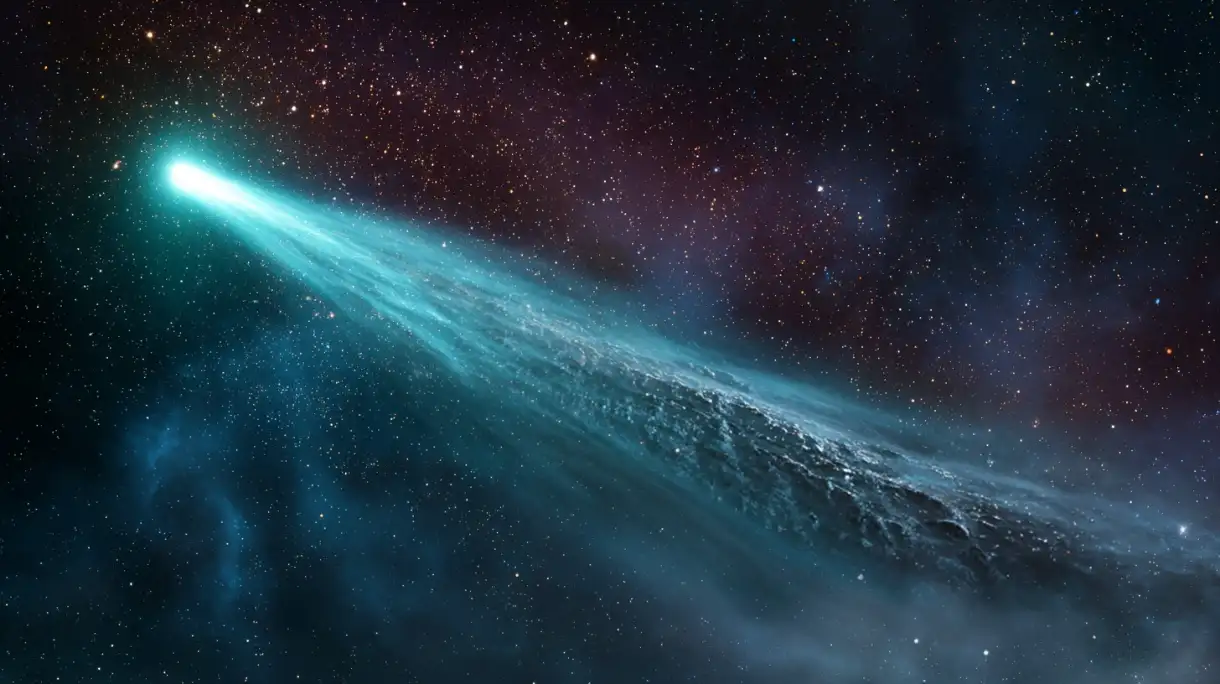
3I/ATLAS Leaks Nickel Gas Far From the Sun – NASA Can’t Explain It
In Brief
- • An interstellar comet is unexpectedly releasing nickel gas far from the Sun.
- • The discovery suggests unusual low-temperature metal-release chemistry.
- • Telescope data reveals an unusually CO₂-rich composition in the comet.
In one of the strangest interstellar findings yet, astronomers have detected nickel gas streaming from the comet 3I/ATLAS, long before sunlight should be strong enough to release metals. The signal, captured by the European Southern Observatory’s Very Large Telescope in Chile, shows multiple nickel emission lines even while the comet was still extremely cold and far from the Sun. Combined with new results from NASA’s James Webb Space Telescope, the object appears to contain a CO₂-rich chemistry unlike anything typically seen in our solar system.
Ad
Specifically, using the European Southern Observatory’s Very Large Telescope (VLT) in Chile, researchers spotted multiple nickel emission lines while the object was still far from the Sun, which is long before typical cometary activity begins, according to the report from November 17.
This early detection, coupled with a set of surprising results from NASA’s James Webb Space Telescope, suggests 3I/ATLAS contains an unusually CO2-rich composition and may host exotic chemical pathways capable of releasing metals under extremely cold conditions.
Cold Comet Shouldn’t Release Nickel – Yet It Does
Led by doctoral researcher Rohan Rahatgaonkar of Pontificia Universidad Católica de Chile, the team set out to analyze the chemical makeup of 3I/ATLAS as it entered the inner solar system.
Ad
Traditionally, nickel atoms remain locked inside hard minerals that require high temperatures to vaporize, which are conditions commonly found much closer to the Sun. But 3I/ATLAS was nearly four astronomical units away, too cold for any normal metal sublimation. That contradiction forced researchers to consider alternative mechanisms.
One explanation involves photodissociation, where sunlight breaks apart fragile molecular structures, freeing nickel atoms early in the comet’s inbound journey. Another possibility is the presence of metal carbonyls – extremely volatile compounds such as nickel tetracarbonyl – that release metals with minimal warming.
Webb Confirms Unusual Chemistry
At the same time, Webb’s Near Infrared Spectrograph detected an extraordinary CO2-to-H2O ratio of about 8 to 1 in the comet’s gas cloud. Scientists rarely see uch a carbon-dioxide-rich profile far from the Sun and it suggests 3I/ATLAS formed in or migrated through regions where CO2 ice is abundant and stable.
The combination of early nickel release, absent iron, and CO2-heavy ices paints a picture of exotic, low-temperature chemistry, much of it unlike what’s typically seen in the solar system.
All things considered, interstellar comets offer rare chemical samples from other planetary nurseries. Observing nickel without iron hints that alternative metal-release mechanisms may be widespread in young star systems. It may also reshape how scientists think about dust grain evolution, metal transport, and early chemical processing during planet formation.
More Must-Reads:
How do you rate this article?
Subscribe to our YouTube channel for crypto market insights and educational videos.






Join our Socials
Briefly, clearly and without noise – get the most important crypto news and market insights first.
Most Read Today
1
Peter Schiff Warns of a U.S. Dollar Collapse Far Worse Than 2008
2Samsung crushes Apple with over 700 million more smartphones shipped in a decade
3Dubai Insurance Launches Crypto Wallet for Premium Payments & Claims
4XRP Whales Buy The Dip While Price Goes Nowhere
5Luxury Meets Hash Power: This $40K Watch Actually Mines Bitcoin
Latest





8
Also read
Similar stories you might like.
Industry
Google Searches for “How to Buy Gold” Explode Globally, Hitting a Two-Decade High
Rokas | 2026-01-26
Industry
Businesses now use crypto as operational capital, CoinGate data reveals a structural shift
Rokas | 2026-01-21

Bitcoin
$455 Billion in Bitcoin Exposed to Quantum Attack Risk via Address Reuse, Up 16% Since 2020
Jastra | 2026-01-20

Altcoins
Iran’s Crypto Activity Surges During Protests; Here’s Why
Ana | 2026-01-16
Industry
Stablecoin Market Share Hits an All-Time High of 10.19%
Jastra | 2026-01-14
No image

Bitcoin
Only Three Governments Increased Bitcoin Holdings in 2025 – U.S. Leads Following 130,000 BTC Seizure
Jastra | 2026-01-05
Industry
Solana Tokens Lose $157B in 2025, The Largest Dollar-Value Drop in the Chain’s History
Jastra | 2025-12-30
Artificial Intelligence
New Epstein Disclosures Collide With an AI Project Built Months Earlier
Ana | 2025-12-22

Science
Scientists Reconstruct Skull of 1.6-Million-Year-Old Ethiopian Homo Erectus
Shedrach | 2025-12-19