














This BTC chart hints at an ‘epic fall’ and altseason 2025
A Healthy Pullback Or Something More — What Drove Crypto Markets This Week
In Brief
- • The crypto market pulled back over the past week, with most major assets declining after a recent rally.
- • Broader macro pressures, geopolitical tensions, and weakening institutional flows weighed on prices and sentiment.
- • Despite short-term weakness, the correction is viewed as a normal phase that may support future market stability.
Ad
This snapshot article gives readers a crypto market weekly recap, covering crypto prices, market sentiment, ETF flows, current and expected trends, as well as macroeconomic, geopolitical, or regulatory events that affected bitcoin, ethereum, and altcoins in the past seven days.
After a couple of green weeks, the crypto market has turned red over the past seven days. The large majority of the top 100 coins posted decreases, and Bitcoin fell below the $68,000 level. Notably, the pullback is not concerning, as all rallies are typically followed by necessary corrections. The shift was boosted by the U.S.-Israel-Iran war escalation, with contradictory statements coming from the US and Israel, and no end in sight, while the global impact worsens by the day. Besides geopolitical tensions, drivers included negative institutional flows, a regulatory lull, and global risk-off across markets.
TL;DR
- Crypto market cap decreased by 5.5% in a week;
- Bitcoin is down 2.4% over the past 7 days, trading at $71,367;
- Ethereum fell 3.9%, now standing at $2,175;
- The fall is a natural post-rally market correction;
- Dominant drivers include the US-Israel-Iran war escalation, lack of regulatory clarity in the US, and global risk-off sentiment;
- The market sentiment plunged back into the fear zone;
- Both BTC and ETH spot ETFs posted outflows last week;
- Goldman Sachs is quietly accumulating XRP ETFs;
- US stocks ended a fourth consecutive week lower.
Market performance this week
The global cryptocurrency market cap fell by 5.5% over the past 7 days. At the time of writing on Monday morning (UTC), the total cap stands at $2.53 trillion. This marked a return into the red, which is dominating the first quarter.
Notably, the market capitalization saw a rise over the past 24 hours of 3.4%, potentially signaling a recovery, even if a brief one. Zooming out, we also find it green in the 2-week and 1-month timeframes.
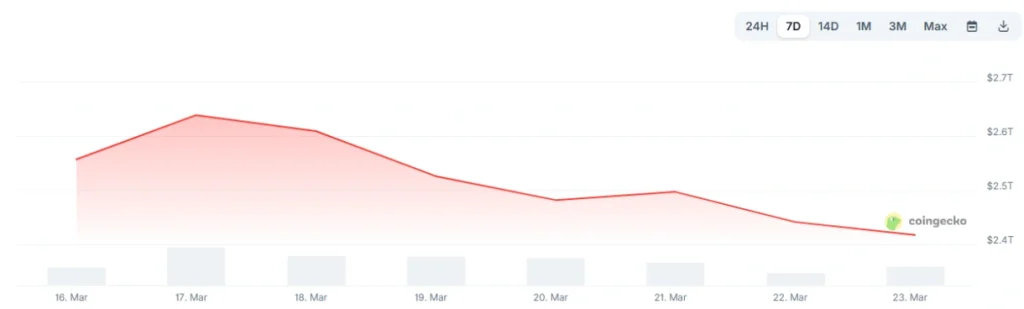
7-day market cap. Source: CoinGecko
The large majority of the top 10 coins per market cap saw their prices decrease over the past week, as did 90 of the top 100 coins. Tron (TRX) is the only green coin, making it the top 10’s default winner. The situation turned opposite over the past day, with most coins turning green.
Bitcoin price movements
Bitcoin’s price fell 2.4% over the past 7 days, dropping below the $70,000 level and towards $68,000. At the time of writing, however, it has reclaimed the $70,000 mark, trading at $71,367.
Meanwhile, BTC has appreciated over the past month, rising 4.3%. This is not a particularly large increase for Bitcoin, but if we take into consideration the fact that it’s been mostly down since the year’s beginning, the move is notable, showcasing the coin’s resilience.
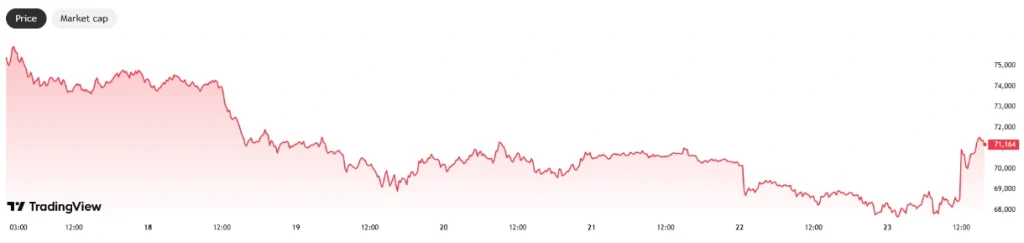
Bitcoin price chart. Source: TradingView
The week began at $75,632, dropping to the $71,300 level by Wednesday, then gradually decreasing to the intraweek low of $67,813.
The market participants are now awaiting further signals that would indicate which direction the coin and the market overall will take in the short- to medium-term. Further increases would lead BTC back into the $75,000 zone, followed by $77,700 and $79,000. This would bring it to the doorstep of the $80,000 mark. Conversely, drops could take it towards $65,000 and possibly even lower towards $50,000.
Ethereum price movements
Ethereum fell 3.9% in the past week, which is the category’s second-highest loss. It’s currently changing hands at $2,175.
Moreover, the coin is up 4.9% in a day, 8.2% in 14 days, and 10.3% in a month. It’s currently down just below 56% from the August all-time high of $4,946.
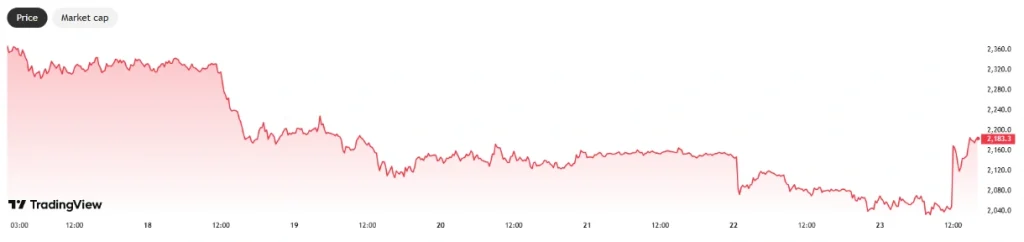
ETH price chart. Source: TradingView
ETH recorded a 7-day range between $2,035 and $2,361. It saw the intraweek high last Monday before it plunged to $2,178 and then decreased relatively gradually to the intraweek low. Notably, it kept above $2,000, not pulling back below this level as it had during the previous decrease.
Like BTC, the ETH increase over the past day suggests a potential near-term appreciation. ETH is generally quite resilient and often outperforms other coins in both the top 10 and top 100 categories. Investors are now looking to see if the price will move above $2,200 and $2,300. Additional increases would take it to $2,450. On the other hand, another fall could take the price back below the $2,000 mark.
Altcoin price movements
Altcoins have posted price decreases in all categories in the 7-day timeframe. In this period, seven coins in the top 10 coins per market cap saw their prices drop, and only one is up (not taking the stablecoins into account). Tron stands as the winner, having increased by 3.8% to the price of $0.3091. At the same time, the highest fall is Dogecoin (DOGE)’s 6.4% to $0.09426. Hyperliquid (HYPE)’s 0.24% is the category’s smallest decrease.
If we zoom in to observe the 24-hour movements, we find the completely opposite picture. Tron is the only red coin here, with a 1.6% drop in its price. Tron often goes against other coins’ performances. Solana (SOL) is the day’s highest gainer: 4.6% to $91.45. It’s followed by ETH’s 4.5% as the second-highest increase in the category.
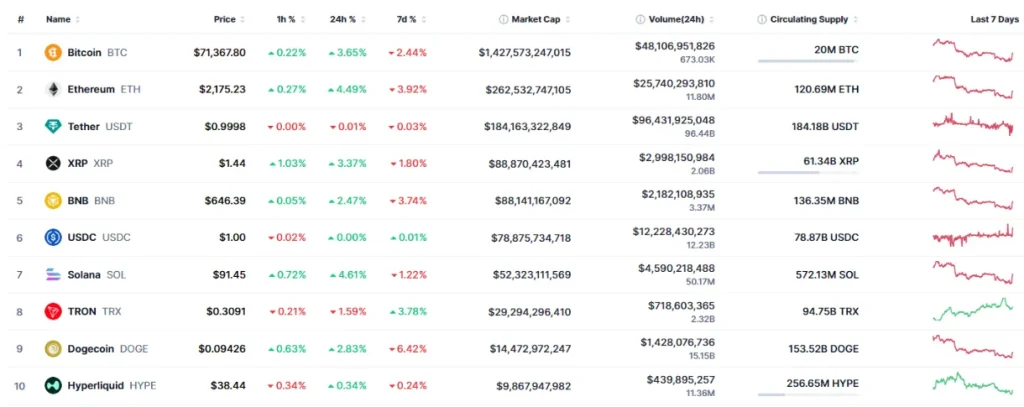
Source: coinmarketcap.com
Now, let’s turn our attention to the top 100 coins per market cap in the 7-day period. 90 of them are down at the time of writing, and 14 of these posted double-digit drops. Ethena (ENA) and Worldcoin (WLD) sit at the top with pullbacks of 19.2% and 16.8% to $0.094 and $0.31, respectively.
Two coins rose by more than 10%. Siren (SIREN) appreciated $273% to $2.33, while Just (JST) was up 10.5% to the price of $0.061.
In the 24-hour timeframe, Midnight (NIGHT) saw the only double-digit increase of 12% to $0.04776, while River (RIVER) fell the most, with a 4.7% decrease to $25.92.
Why did the crypto market drop this week?
The shift in the market came as a typical and healthy pullback that commonly follows rallies. It was boosted by negative institutional flows, macro and geopolitical concerns, and a lack of regulatory advancements.
Classic post-rally correction
This is a key factor, though an often overlooked one. It’s not only natural following surges, but also necessary, because it shakes out weak hands and consolidates gains. After prices rise, they hit a psychological or technical resistance level but can fail to sustain it, leading to a pullback. The consolidation establishes a base for future price increases.
In the case of the last two weeks, bitcoin rallied to $75,600 from the February low of $62,800. Following the rally, it pulled back below the $70,000 mark, with traders taking profit.
Renewed escalation in the U.S.–Israel–Iran war
In addition to the typical post-rally fall, the weak macro and geopolitical news hit the market at the same time and intensified the drop. Traders reacted to the renewed threats and attacks, pushing the sentiment down and turning the market red across the board.
War escalation typically leads to uncertainty among the market participants, resulting in liquidity withdrawal. Investors will rotate out of risk assets and into safer assets, with gold being a common winner. And yes, during active conflicts with a global impact, crypto behaves like a risk asset, rather than a hedge.
The US president claimed that the US and Iran talked today and agreed they both wanted to “make a deal”, with markets reacting positively, but Iran denied that any “productive” talks took place. Additionally, Israel and the US have launched a new wave of extensive attacks across Iran today.
Global risk-off across markets
Crypto wasn’t the only market to drop last week. Traditional markets have seen major drops as well, operating under increasing pressure. You’ll find more details in the ‘stocks’ section below. This is exacerbated by oil-related volatility and war fears that are boosting inflation expectations.
Higher rates and inflation fears can lead to lowered liquidity in the crypto market, and when investors de-risk, they often sell their crypto first.
Regulatory disappointment in the U.S.
After a surge in crypto regulatory efforts and related enthusiasm in the US, this area has turned pretty quiet. Earlier rallies were boosted by a combination of ETF flows, regulatory advancements, and institutional narratives. But when the market lacks regulatory clarity, capital inflow may drop.
However, last week saw the Clarity Act finally move within the political circles, even if slightly, as the US senators reportedly reached a deal on the stablecoin yield language. This has marked “a potential major breakthrough” and “could clear the way for a landmark crypto regulatory bill to advance in the coming weeks,” Politico reported.

What to watch next?
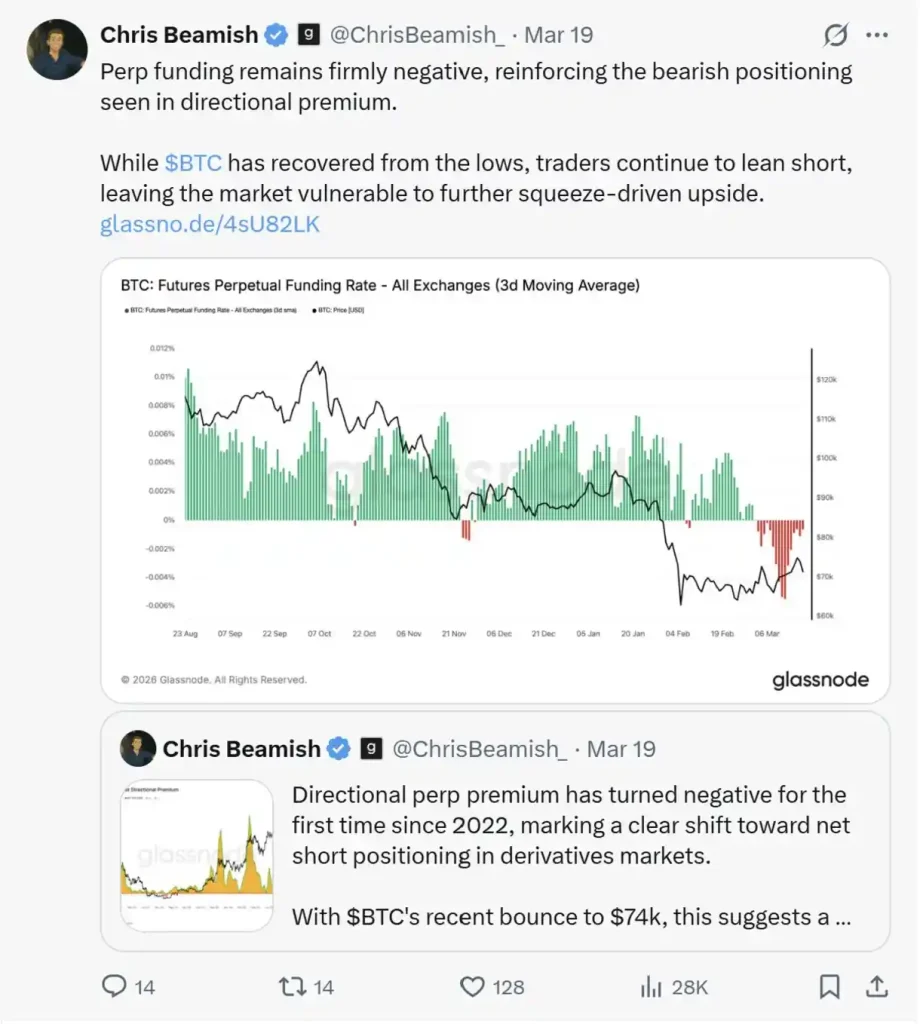
Analyst Chris Beamish commented that perpetual funding turned negative last week for the first time since 2022. As of Thursday, it stood firmly negative, “reinforcing the bearish positioning seen in directional premium.”
Bitcoin saw an uptick recently, Beamish said, but traders leaned short, “leaving the market vulnerable to further squeeze-driven upside.” This is something for investors and traders to keep an eye on.
But there are more key factors to observe in order to search for signals that will decide the market’s direction. One is to see if bitcoin will hold the $65,000-$67,000 support and stay above $70,000. Next is to watch the ETF flows to see if institutions are currently still buying. Last week posted outflows, but this week could see ETFs turn the tide.
The largest driver is still the developments in the Middle East. We’ve seen the escalation of the war impact the market negatively, as well as positive geopolitical developments influencing it positively. However, we can’t predict these events, especially given the contradictory information coming from the US.
And speaking of the US, incoming regulatory and macro events in that country are also expected to possibly reflect on the crypto market. On Tuesday, the Securities and Exchange Commission (SEC) Chairman Paul Atkins will speak at the Digital Asset Summit in New York, and investors will wait to hear any relevant remarks.
Also, keep an eye on the rate expectations and inflation data in major markets, such as today’s data from Japan.
On Friday, $14.39B in bitcoin options expire at a maximum pain price of $75,000, Ledn noted.

Market sentiment plunges
Contrary to the previous week’s performance, the crypto market sentiment has dropped significantly since last Monday. The crypto fear and greed index now stands at 25, compared to 41 recorded seven days ago.
The recovery that had led the metric into the neutral zone didn’t last long. This latest move has led the market sentiment right back into the fear zone. There is still room for it to fall further, given that the low in the past month stands at 11. Moreover, the metric hit the lowest recorded point of 5 just this February.
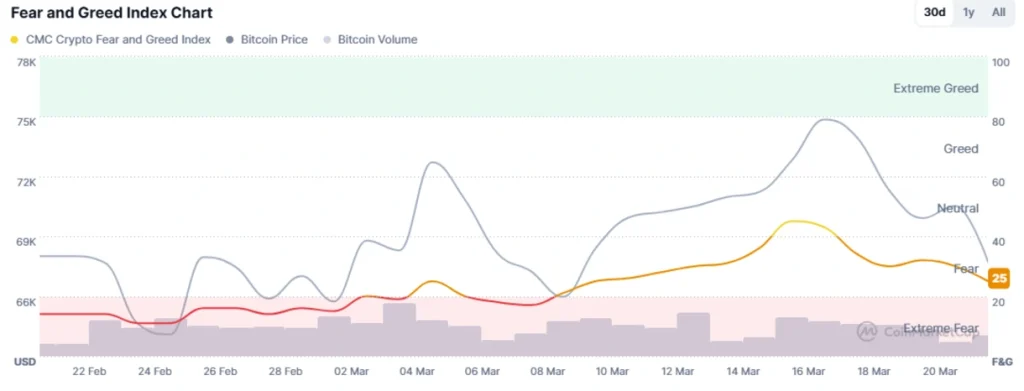
Source: CoinMarketCap
Notably, the return to the fear region is far from surprising. The market has had very little to no room to breathe, being bombarded with shock after shock, be it geopolitical or macroeconomic, as market pressure builds. When the sentiment falls so severely, traders stop buying dips, and short-term players typically exit. Volatility spikes, accelerating downside. This is not to say that the sentiment has no chances for recovery. On the contrary, the market has proven its resilience time and time again, and this is one of the key bases for near-term sentiment jumps.
Institutional flows: Bitcoin and Ethereum ETFs
Over the past week, the US BTC spot exchange-traded funds (ETFs) saw the cumulative total net inflow rise from $56.14 billion to $56.23 billion. While the week began with two green days, marked by decent inflows, the rest of the week turned red, yet not enough to pull the total net inflow down. Monday and Tuesday posted around $200 million each, followed by negative flows for the next three days between $52 million and $164 million.
Friday saw only VanEck posting positive flows, and only of $2.96 million. At the same time, BlackRock let go of $45.94 million, and Fidelity said goodbye to $9.13 million.
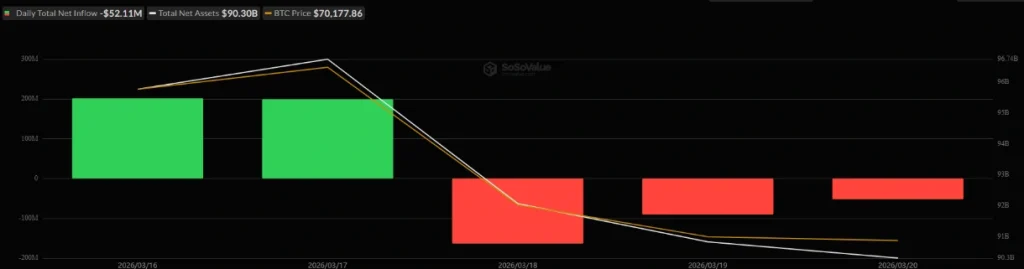
Source: SoSoValue
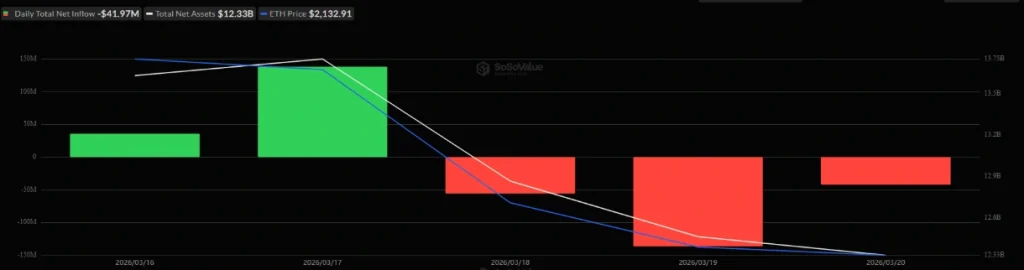
Looking at the ETH spot ETFs, we find that the total net inflow fell this past week to the current $11.79 billion compared to $11.73 billion the week before. Just like their BTC counterparts, ETH ETFs opened the week with inflows and closed with outflows. Monday and Tuesday posted $35 million and $139 million, respectively. The highest flow amount was $136.41 million on Thursday, while Wednesday and Friday recorded similar levels between $40 million and $55 million.
Zooming into Friday’s close, we find BlackRock’s ETHB as the day’s winner by default, given that it was the only green one on the list. It took in $5.47 million. On the other hand, BlackRock’s ETHA recorded the highest negative flow of $31.45 million, followed by Fidelity’s $12.18 million.
Source: SoSoValue
Meanwhile, Goldman Sachs has been quietly hard at work accumulating XRP ETFs. Starting in November 2025 and by the end of the year, the bank built a $153.8 million position across four spot XRP ETFs: $40 million in Bitwise, $38.5 million in Franklin Templeton, $38 million in Grayscale, and $36 million in 21Shares. This is approximately 73% of all disclosed institutional XRP ETF holdings.

Overall, XRP spot ETFs posted two days of positive and one of negative flows last week, with no flows on the remaining two days. The total net inflow now stands at $1.21 billion.
US stocks plunge for four straight weeks
The US stock market closed Friday starkly lower, marking a fourth consecutive week of losses. By the end of trading on 20 March, the S&P 500 was down 1.5%, the Nasdaq-100 decreased by 2%, and the Dow Jones Industrial Average fell by 1%.
The plunge was largely the result of a push by technology shares, while oil, a key inflation driver, keeps rising, as do the oil futures. The market has also shown vulnerability to the increasing 10-year Treasury note yields.
Editor’s notes
This wasn’t a crypto-specific crash, as markets across the board posted decreases, driven by macro and geopolitical factors. But the main conclusion is that this is a typical and healthy post-rally pullback for the crypto market, which will enable it to consolidate and form a basis for further increase. The chances are that the prices will continue rising mid-term, with BTC moving over $75,000 and ETH towards $2,500. However, some analysts discuss the possibility of BTC dropping further and hitting a bottom of $50,000. Though this would be quite a crash, it would also be an excellent buying opportunity.
How do you rate this article?
Subscribe to our YouTube channel for crypto market insights and educational videos.






Join our Socials
Briefly, clearly and without noise – get the most important crypto news and market insights first.
Most Read Today
1
Crypto Trading Volume Collapse: March on Track for Worst Month Since 2020
2Cardano’s $10 Million Question: Will Bulls Survive the Liquidity Sweep?
3Goldman Sachs Is XRP’s Biggest ETF Buyer — What the Pros See That Retail Might Be Missing
4$3B in RWA TVL and Counting: Can BNB Flip Solana’s Crown?
5The Real Bitcoin Story Isn’t Just the Fed — A 2012 Whale Reshuffled $146M: What It Means
Latest






8
Also read
Similar stories you might like.

Bitcoin
Bitcoin Supply Shift Raises New Questions Across Market
Ana | 2026-03-23
Market
Crypto Trading Volume Collapse: March on Track for Worst Month Since 2020
Jastra | 2026-03-23

Industry
U.S. Crypto Regulation Breakthrough Pushes Clarity Act Closer to Reality
Ana | 2026-03-23

Bitcoin
Bitcoin Crash Fears Return as Market Pressure Builds
Ana | 2026-03-23
Industry
New Threat to Prediction Markets as U.S. Crackdown Expands
Rokas | 2026-03-23

Defi
SEC Move Opens New Phase For Bitcoin And Ethereum ETFs
Rokas | 2026-03-23

Altcoins
$3B in RWA TVL and Counting: Can BNB Flip Solana’s Crown?
Azeez | 2026-03-22

Altcoins
Goldman Sachs Is XRP’s Biggest ETF Buyer — What the Pros See That Retail Might Be Missing
Azeez | 2026-03-22

Altcoins
Cardano’s $10 Million Question: Will Bulls Survive the Liquidity Sweep?
Azeez | 2026-03-22

Altcoins
The Real Bitcoin Story Isn’t Just the Fed — A 2012 Whale Reshuffled $146M: What It Means
Azeez | 2026-03-22