













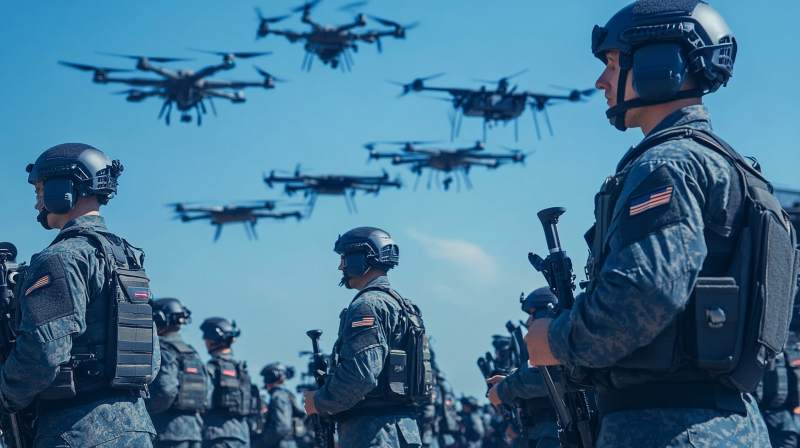
Military parade in modern era: How AR transformed traditional spectacles
Military parade in modern era: How AR transformed traditional spectacles
With a military parade, such as the one that is about to take place in Washington DC on June 14 in the face of the looming immigration protests in Los Angeles, holding a special place for a country’s tradition, many things have changed with the arrival of the digital age.
Ad
As it happens, these national displays of military prowess are now embracing augmented reality (AR) and other cutting-edge technologies to captivate global audiences and project power in new ways. Indeed, South Korea’s Seoul Defense Exhibition in 2019 already offered a glimpse into this future.
A modern military parade
Specifically, the country’s military incorporated AR overlays to provide real-time data about weapon systems and troop formations, and viewers watching remotely could access interactive feeds showing everything from missile specifications to the historical context of particular units.
Similarly, China’s annual military parade in Tiananmen Square has adopted state-of-the-art digital enhancements in recent years, combining traditional elements with AR and advanced graphics to amplify the parade’s diplomatic impact and engage international observers.
Ad
The United States, too, has experimented with digital adaptations, starting in the COVID-19 pandemic. Interestingly, the 2020 Independence Day parade replaced physical crowds with virtual live broadcasts and drone footage to reach a global audience and maintain public engagement despite restrictions.
Meanwhile, modern technology continues to shape armed forces’ weaponry, including for the US military, which is set to receive a batch of unmanned airborne solutions, spanning from one-way attack drones to F-16 aircraft, based on artificial intelligence (AI), courtesy of technology companies Booz Allen Hamilton and Shield AI.
Earlier, defense technology company QinetiQ started working alongside the US Army to develop a next-generation AI-powered long-range sensor system called the Future Advanced Long-Range Common Optical/Netted-Fires Sensor (FALCONS), which can detect and identify targets from distances farther than ever before, even in poor weather conditions.
How do you rate this article?
Subscribe to our YouTube channel for crypto market insights and educational videos.






Join our Socials
Briefly, clearly and without noise – get the most important crypto news and market insights first.
Most Read Today
1
Peter Schiff Warns of a U.S. Dollar Collapse Far Worse Than 2008
2Samsung crushes Apple with over 700 million more smartphones shipped in a decade
3Dubai Insurance Launches Crypto Wallet for Premium Payments & Claims
4XRP Whales Buy The Dip While Price Goes Nowhere
5Luxury Meets Hash Power: This $40K Watch Actually Mines Bitcoin
Latest






8
Also read
Similar stories you might like.

Artificial Intelligence
Robert Kiyosaki Warns AI Bubble May Be Bigger Than Dot-Com
Ana | 2025-12-24

Artificial Intelligence
New Epstein Disclosures Collide With an AI Project Built Months Earlier
Ana | 2025-12-22

Artificial Intelligence
Gemini Can Now Detect AI-Generated Files
Shedrach | 2025-12-19

Artificial Intelligence
Fetch.ai Launches Autonomous AI-to-AI USDC Settlement
Shedrach | 2025-12-19

Artificial Intelligence
Tesla Semi Tease Hints At Big Changes Under The Hood
Ana | 2025-12-19

Artificial Intelligence
Scientists Use AI to Crack Nature’s Hidden Laws
Ana | 2025-12-18

Artificial Intelligence
Can AI Ever Be Proven Conscious? A Philosopher Says No
Ana | 2025-12-18

Artificial Intelligence
Researchers Uncover Hidden Bias in Cancer Diagnosis AI
Ana | 2025-12-17

Artificial Intelligence
AI Learns Math Better by Arguing With Itself
Ana | 2025-12-15

Artificial Intelligence
Breakthrough AI Enables Seamless Control of Prosthetic Hands
Shedrach | 2025-12-12