














Bitcoin city overlay. Source: TechGaged / Shutterstock
Bernstein Maintains Bitcoin $150K Target Amid Institutional Growth
In Brief
- • Bernstein keeps a $150K Bitcoin target amid institutional growth.
- • Market structure is shifting away from retail-driven cycles.
- • Strong holder base and ETF flows support the outlook.
Ad
Bitcoin (BTC) may have already formed a bottom near current levels, with Bernstein maintaining a $150,000 target as institutional demand continues to grow. The asset is trading around $70,000 after a more than 50% drawdown, yet without the cascading liquidations seen in prior cycles. The shift suggests Bitcoin’s market structure is changing.
What Bernstein’s thesis is based on
The core argument is simple. Bitcoin is no longer driven primarily by retail speculation.
According to a Bloomberg report on March 24, Bernstein has pointed to the growing role of exchange-traded funds, corporate treasuries, and structured capital markets as key drivers of demand. These participants tend to operate on longer time horizons, which changes how the market reacts during downturns.
Recent price action supports that view. Specifically, BTC was at press time trading at $71,551.58, indicating a 0.5% gain on the day, a decline of 3.4% across the week, an advance of 8.9% over the last month, but an accumulated drop of 17.5% across the past year.
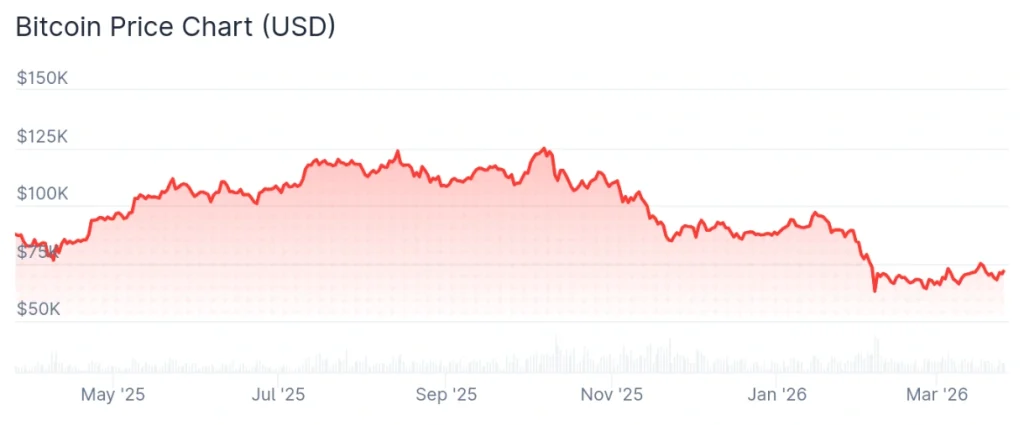
Despite a sharp correction, Bitcoin avoided the kind of forced selling and liquidation spirals that defined earlier cycles.
ETF flows have remained relatively stable, even reversing earlier outflows. At the same time, companies like Strategy have continued accumulating Bitcoin, absorbing a meaningful share of new supply.
Ownership data reinforces the trend. Around 60% of Bitcoin supply has not moved in over a year, indicating a large base of long-term holders less sensitive to short-term volatility.
Why this is important for the next cycle
The shift toward institutional ownership is changing how Bitcoin behaves.
A market anchored by exchange-traded funds (ETFs) and corporate balance sheets tends to be more stable during drawdowns, but also more dependent on capital markets. That introduces a different type of risk tied to liquidity conditions and financing.
There is also a supply dynamic at play. With ETFs holding roughly 6% of Bitcoin supply and corporate buyers continuing to accumulate, available liquidity can tighten over time.
Bernstein argues this combination could extend the current cycle rather than end it, pushing potential upside toward $150,000 by 2026 and even higher beyond.
Still, the model depends on continued access to capital and sustained institutional interest.
All things considered, Bitcoin is evolving into a different kind of market, and that shift is reshaping both risk and upside.
How do you rate this article?
Subscribe to our YouTube channel for crypto market insights and educational videos.






Join our Socials
Briefly, clearly and without noise – get the most important crypto news and market insights first.
Most Read Today
1
Exclusive: AI Finance Is Now “Institutional Grade”, Says True Trading Co-Founder Igor Stadnyk
2SEC Opens Door for Tokenized Stocks on Nasdaq – A Major Shift for Wall Street
3Crypto Trading Volume Collapse: March on Track for Worst Month Since 2020
4XRP Ownership Patterns Are Changing — And It May Signal Something Bigger
5Ethereum Supply Concentration Is Rising — A Quiet Shift Is Underway
Latest








8
Also read
Similar stories you might like.
Defi
New CFTC Task Force Puts Crypto Rules Back In Focus
Ana | 2026-03-25

Altcoins
Morgan Stanley: Wall Street’s Crypto Shift Was Years in the Making
Rokas | 2026-03-25

Altcoins
Cardano Traders Are Capitulating — A Turning Point or Warning Sign?
Ana | 2026-03-24

Altcoins
XRP May Be Entering a Key Phase as Market Stress Signals Are Building
Ana | 2026-03-24

Bitcoin
Wall Street Behavior Suggests a Turning Point for Bitcoin Strategy Firms
Rokas | 2026-03-24

Altcoins
Ethereum Supply Concentration Is Rising — A Quiet Shift Is Underway
Rokas | 2026-03-24

Market
A Healthy Pullback Or Something More — What Drove Crypto Markets This Week
Sead | 2026-03-23

Bitcoin
Bitcoin Supply Shift Raises New Questions Across Market
Ana | 2026-03-23
Market
Crypto Trading Volume Collapse: March on Track for Worst Month Since 2020
Jastra | 2026-03-23

Industry
U.S. Crypto Regulation Breakthrough Pushes Clarity Act Closer to Reality
Ana | 2026-03-23