












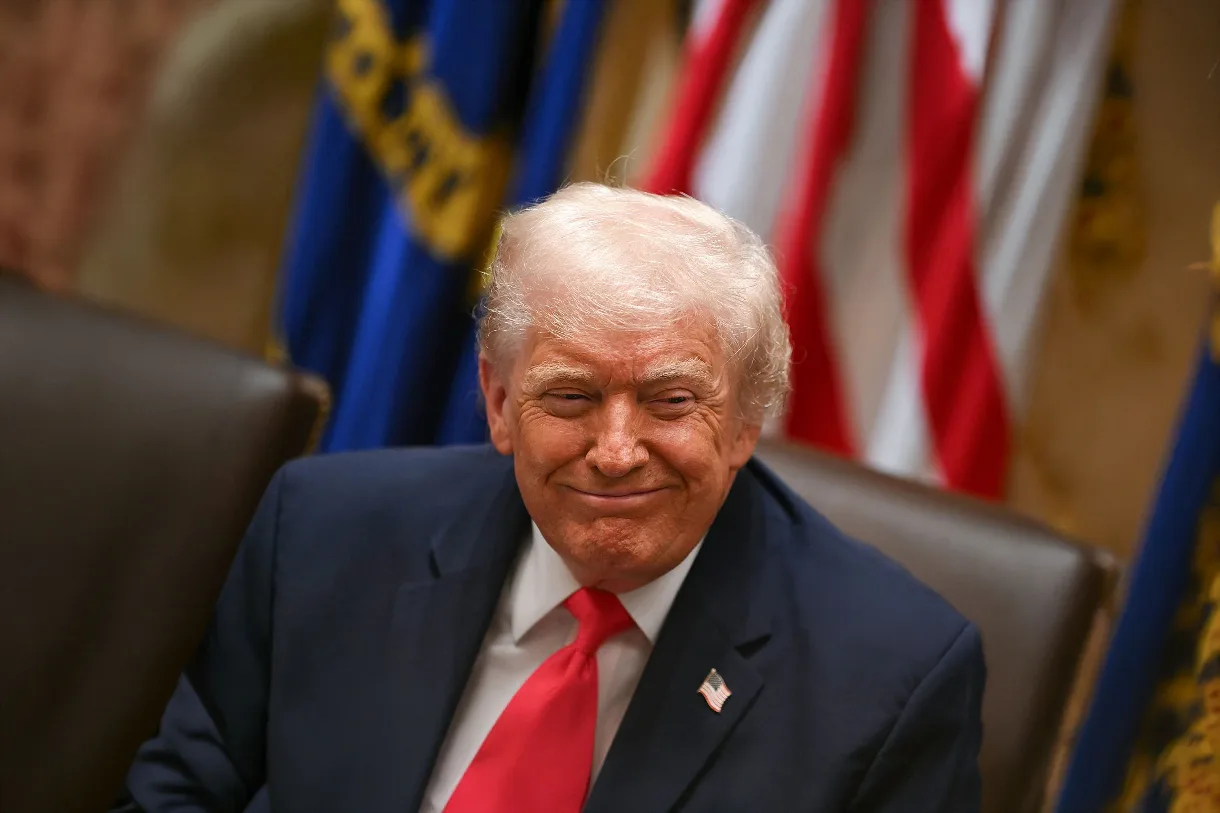
President Donald Trump. Source: TechGaged / Shutterstock
Trump’s Tariffs Just Collapsed – and Crypto Could Be Next
In Brief
- • The Supreme Court ruled Trump-era tariffs illegal in a 6–3 decision.
- • The U.S. now faces over $150B in potential tariff refunds.
- • Shifting liquidity and policy risk could spill into crypto markets.
In a 6–3 decision, the Supreme Court of the United States ruled that tariffs imposed during the Trump administration violated federal law.
Specifically, the Court found that the executive branch exceeded its authority when it imposed broad trade duties under emergency statutes.
As a result, the United States now faces more than $150 billion in potential tariff refunds.
At the center of the case stood Donald Trump and the scope of presidential trade power. The majority opinion drew a clear boundary.
Congress controls taxation and trade unless it explicitly delegates authority. Therefore, urgency alone cannot justify sweeping economic actions.
This ruling does not evaluate trade policy outcomes. Instead, it enforces constitutional structure.
Importantly, markets care less about legal theory and more about consequences. This decision rewrites expectations around liquidity, fiscal flows, and political risk. Those factors matter directly to crypto.
What $150B in Refunds Means for Liquidity and Risk Assets
First, refunds reintroduce liquidity into the system. Importers who recover capital regain balance-sheet flexibility. Consequently, some of that capital will seek reinvestment.
Historically, excess liquidity often flows toward higher-risk assets. Crypto tends to benefit in those conditions.
Second, legal clarity reduces uncertainty. Before the ruling, companies faced open-ended exposure tied to past tariffs.
Now, that overhang disappears. As uncertainty fades, investors recalibrate risk premiums. That recalibration often supports speculative assets, including digital assets.
Third, the fiscal mechanics matter. A $150 billion refund obligation pressures Treasury cash management. If payouts stretch over time, liquidity enters markets gradually.
If payouts accelerate, liquidity shocks increase. Either way, crypto markets respond quickly to shifts in liquidity expectations.
Meanwhile, global investors watch closely. U.S. policy reversals influence dollar demand and confidence.
When fiscal stress rises or policy credibility wavers, capital often rotates toward non-sovereign assets. Bitcoin frequently serves that role during periods of adjustment.
Why the Ruling Reinforces Crypto’s Long-Term Narrative
Beyond short-term flows, the ruling strengthens a deeper narrative. The Court reaffirmed limits on executive economic power. That reinforcement underscores institutional checks and balances.
Crypto originally emerged from distrust of concentrated authority. Therefore, moments like this resonate with its foundational thesis.
Additionally, the decision improves rule predictability. Markets allocate capital more confidently when legal boundaries remain clear.
Crypto adoption benefits from stable frameworks. Arbitrary policy shifts slow participation. Clear constraints accelerate it.
Furthermore, the ruling pressures lawmakers. If Congress wants tariffs, it must legislate directly. That process moves slower. Slower policy shifts reduce tail risk.
Reduced tail risk improves long-term portfolio modeling. Bitcoin increasingly appears in those models.
Ultimately, this decision reaches beyond trade. It reminds markets where power stops. And when boundaries harden, decentralized assets gain relevance.
More Must-Reads:
How do you rate this article?
Subscribe to our YouTube channel for crypto market insights and educational videos.






Join our Socials
Briefly, clearly and without noise – get the most important crypto news and market insights first.

Most Read Today
1
Jim Cramer Prediction Accuracy: Full Report (2000–2026)
2Exclusive: $250M Asset Manager Breaks Down Morgan Stanley’s Bitcoin ETF Impact
3Security Warning: Bitcoin Depot Hit by Cyberattack, Millions in BTC Taken
4XRP Enters Make-or-Break Phase as CLARITY Act Advances in April
5Bitcoin Miners Dump Thousands of BTC — What’s Going on?
Latest






8
Also read
Similar stories you might like.

Bitcoin
Exchange Seeks Asset Freeze as Users Refuse to Return BTC
Rokas | 2026-04-10

Altcoins
Crypto Market Loses $50B After Bitcoin Rejection
Ana | 2026-04-09

Altcoins
Massive Fartcoin Long Ends in $3M Loss, Shorts Benefit
Ana | 2026-04-09

Altcoins
Wall Street Meme Coin Push: Canary Capital Files for Spot PEPE ETF
Ana | 2026-04-09

Bitcoin
Bitcoin Pioneer Adam Back Rejects Satoshi Identity Claims
Ana | 2026-04-09
Bitcoin
Security Warning: Bitcoin Depot Hit by Cyberattack, Millions in BTC Taken
Rokas | 2026-04-09

Bitcoin
Bitcoin Miners Dump Thousands of BTC — What’s Going on?
Azeez | 2026-04-09

Bitcoin
Subversive Bitcoin SPAC Registers With SEC to Go Public
Rokas | 2026-04-09

Altcoins
XRP Enters Make-or-Break Phase as CLARITY Act Advances in April
Azeez | 2026-04-09

Blockchain
FBI Warning: Crypto Losses Hit $11B as Scams Surge
Ana | 2026-04-08