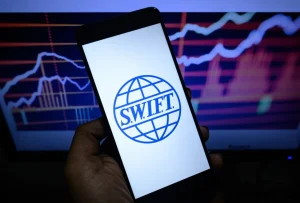











SWIFT Logo shows on a smartphone with a trading chart in the background. Source: TechGaged / Shutterstock.
Banks Are Helping SWIFT Build a Blockchain Coordination Layer
In Brief
- • SWIFT is adding a blockchain-based shared ledger to synchronize tokenized asset transfers across networks.
- • Major banks like Standard Chartered are helping design cross-border tokenized settlements.
- • The move positions SWIFT as the interoperability layer for institutional tokenized finance.
Ad
SWIFT has confirmed it’s adding a blockchain-based shared ledger component to its global infrastructure. A move designed to enable secure, synchronized transfers of value across multiple networks and asset types. The initiative aims to bridge tokenized assets, traditional banking rails, and cross-border settlement into a unified environment.
This move is being developed with major financial institutions including Standard Chartered. However, SWIFT’s aim isn’t to replace existing payment systems.
Indeed, SWIFT is positioning blockchain as an interoperability layer that allows institutions to move tokenized money and securities across platforms without fragmentation.
This shift signals how deeply tokenization is moving into core financial plumbing.
SWIFT Integrates Blockchain Into Global Financial Messaging
According to how SWIFT frames it, the organization is introducing a blockchain-based shared ledger. Designed to synchronize transactions across different networks while preserving its role as the central coordination layer for global finance.
Moreover, the ledger is intended to support a multi-asset environment. Therefore, it will enable tokenized money, securities, and other digital representations of value to move across borders with the same reliability as traditional payments.
A key objective is interoperability. Currently, financial institutions are experimenting with tokenized deposits, digital bonds, and on-chain settlement systems.
However, these initiatives often exist in isolated ecosystems. SWIFT’s approach aims to connect these fragmented environments through a common coordination layer rather than forcing institutions onto a single blockchain.
Standard Chartered’s involvement reflects the banking sector’s push toward tokenized finance infrastructure. Indeed, the bank is contributing design expertise around cross-border settlement and institutional workflows.
As a result, this aligns with their broader strategy to integrate digital assets into transaction banking. This model effectively suggests blockchain is being absorbed into existing financial architecture instead of replacing it.
The Next Phase of Tokenized Finance
The initiative highlights that tokenization is moving from experimentation toward integration with core banking rails.
Additionally, institutions have spent several years piloting tokenized assets and blockchain settlement. However, scaling these systems requires connectivity across banks, custodians, and markets.
This is exactly the coordination layer SWIFT can provide.
By embedding blockchain synchronization into its network, SWIFT is effectively positioning itself as the interoperability backbone for tokenized finance.
Instead of competing with blockchain networks, it connects them, enabling multi-rail settlement across traditional and digital assets.
As a result, this reduces fragmentation risk while preserving regulatory oversight. A critical requirement for institutional adoption.
The involvement of major banks suggests tokenization is transitioning from isolated projects into production-grade infrastructure.
Furthermore, as more assets move on-chain, institutions will need standardized mechanisms to coordinate transactions across multiple ledgers and jurisdictions.
SWIFT’s model addresses this gap by anchoring blockchain activity within the existing global financial messaging system.
In practical terms, the move accelerates the convergence between traditional banking and digital asset infrastructure.
More Must-Reads:
How do you rate this article?
Subscribe to our YouTube channel for crypto market insights and educational videos.






Join our Socials
Briefly, clearly and without noise – get the most important crypto news and market insights first.

Most Read Today
1
AI Tokens Split from Crypto; Up 6% While the Market Drops 21% in Q1
2How Accurate Are Robert Kiyosaki’s Predictions?
3Quantum Breakthrough Sparks Fresh Fear for Bitcoin Security
4Trump Backs Bitcoin, Stablecoins In New Pro-Crypto Push
5Robert Kiyosaki Reveals 4 Assets He’s Buying Amid Geopolitical Carnage
Latest






8
Also read
Similar stories you might like.
Blockchain
Swift Tests Blockchain System For Global Payments
Ana | 2026-03-31

Bitcoin
New U.S. Bill Backs Domestic Bitcoin Mining Industry
Ana | 2026-03-31

Industry
AI Tokens Split from Crypto; Up 6% While the Market Drops 21% in Q1
Jastra | 2026-03-31

Bitcoin
Quantum Breakthrough Sparks Fresh Fear for Bitcoin Security
Ana | 2026-03-31

Altcoins
Ripple CEO Says U.S. Can’t Survive “Gensler 2.0”
Rokas | 2026-03-31

Blockchain
Crypto Apps Exposed to Risk After Malicious Axios Versions Go Live
Rokas | 2026-03-31

Research
How Accurate Are Robert Kiyosaki’s Predictions?
Sead | 2026-03-31

Industry
Trump Backs Bitcoin, Stablecoins In New Pro-Crypto Push
Ana | 2026-03-30

Industry
Canada Proposes Ban on Crypto Political Donations
Ana | 2026-03-30

Altcoins
Ethereum Foundation Makes Record ETH Staking Move
Ana | 2026-03-30