











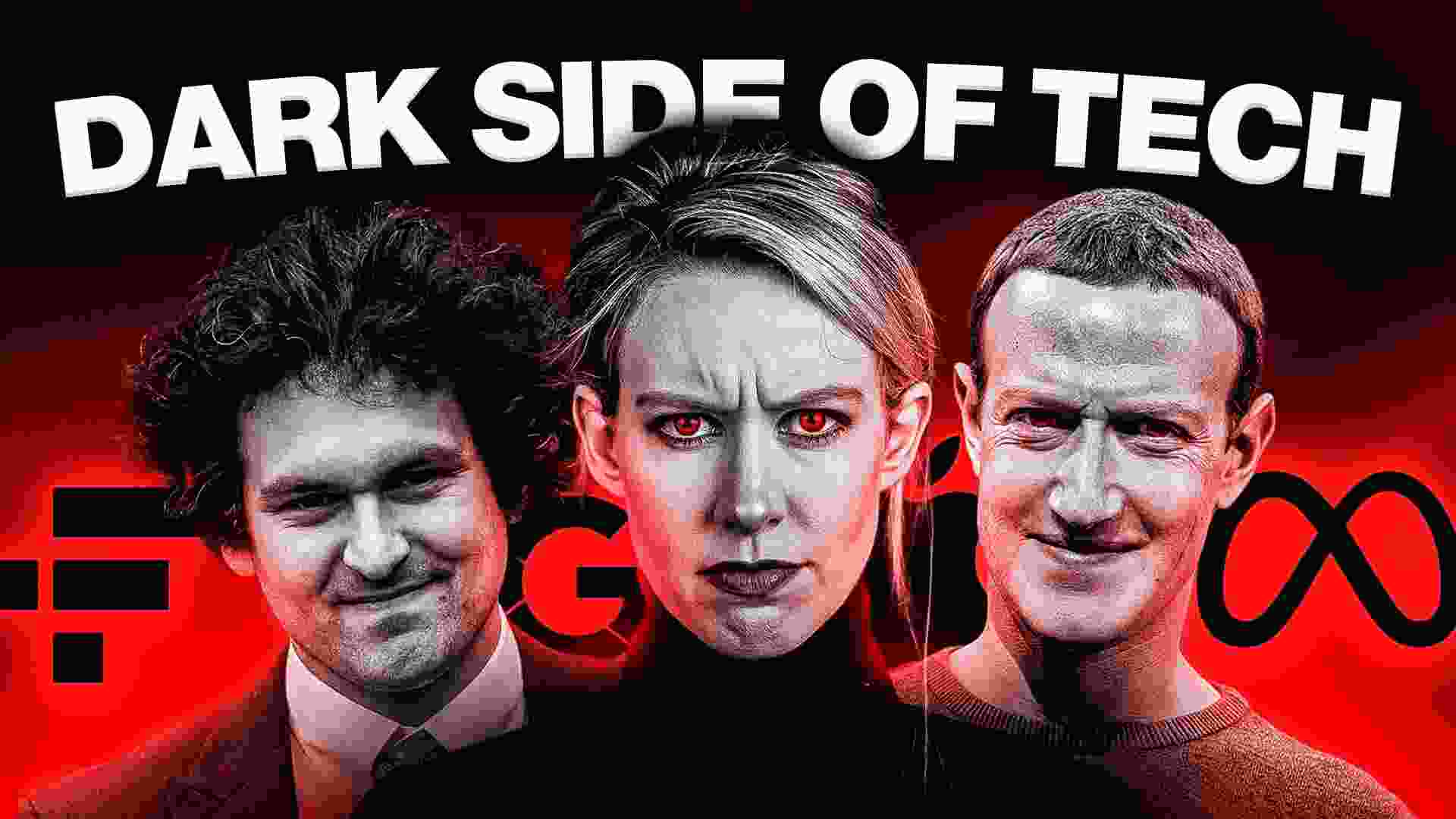
SBF, Elizabeth Holmes, and Mark Zuckerberg
6 greatest scandals in big tech: Fraud, lies, and billions lost
A single lie cost investors over 900 million dollars. A software update betrayed half a billion iPhone users. And a crypto exchange vanished with 8 billion dollars overnight.
Ad
This is the story of the tech world — an industry that sells us dreams of progress and a better future. But behind every sleek product launch and inspiring keynote lies a trail of fraud, manipulation, and criminal cover-ups.
Today, we’re pulling back the curtain on the six greatest scandals that expose the real cost of Big Tech’s success.
Watch our full video of the 6 biggest tech scandals.
Ad
The ‘fake it ’til you make it’ nightmare – The Theranos story
No story better captures the danger of the “fake it ’til you make it” mantra than Theranos. Founded in 2003 by Elizabeth Holmes, the company promised to revolutionize healthcare.
Its miracle device could supposedly run hundreds of tests from a single drop of blood. Decked out in her signature black turtleneck,
Holmes was hailed as the next Steve Jobs. Investors, swept up in the hype, poured over $700 million into her vision, rocketing Theranos to a staggering $9 billion valuation.
There was just one catastrophic problem: the technology was a complete and utter fraud. The miracle machines never actually worked. To hide the truth, the company faked product demos, doctored lab reports, and secretly used commercially available equipment to run patient tests.
The entire house of cards began to collapse in 2015 after a bombshell investigation by The Wall Street Journal. By 2022, the lie had run its course.
Holmes was found guilty of fraud and sentenced to over 11 years in prison, while her partner-in-crime, Sunny Balwani, received a sentence of nearly 13 years.
Apple’s betrayal – ‘Batterygate’ and planned obsolescence
The Theranos scam was built on a lie about a product that never existed. But deception in tech can be far more subtle, hiding inside the products that millions of us already own and love.
Apple, for instance, built its global empire on a promise of perfection and a flawless user experience. But in 2017, millions of its most loyal users felt a sharp sense of betrayal.
It was discovered that Apple had been deliberately slowing down older iPhones without telling anyone. The scandal, nicknamed “Batterygate,” erupted after users noticed their older devices becoming agonizingly slow immediately after software updates.
What many had dismissed as a conspiracy theory was suddenly confirmed to be true.
Apple’s defense was that it was throttling performance to prevent aging batteries from causing unexpected shutdowns. But the company did it in secret, leaving customers in the dark.
This sparked widespread outrage and accusations of “planned obsolescence” – the cynical idea that Apple was intentionally crippling older phones to force customers into buying expensive new ones.
The backlash was immense, leading to class-action lawsuits that resulted in Apple paying hundreds of millions in settlements worldwide. It was a brutal blow to the company’s pristine reputation, exposing a calculated deception from a brand that prided itself on customer trust.
Google’s all-seeing eye – data, dominance, and deception
Like Apple, Google also betrayed its users’ trust. But while Apple was secretly slowing down your phone, Google was secretly tracking your entire life. The company’s unofficial motto was once famously “Don’t Be Evil,” but a long string of scandals has revealed a much darker side.
The company’s dominance has drawn massive antitrust lawsuits from the Department of Justice, accusing it of running illegal monopolies. In August 2024, a judge ruled that Google did, in fact, maintain a monopoly over online search advertising.
But the problems go far beyond market control. In April 2024, Google agreed to destroy billions of data records to settle a lawsuit claiming it secretly tracked users even when they were in Chrome’s “Incognito” mode.
Users believed they were browsing privately, but Google’s tools allegedly kept right on collecting information.
The deception ran so deep that in September 2025, a federal jury ordered Google to pay over $425 million for collecting data on millions of people who had explicitly turned off location tracking features.
Adding to the privacy fears, a program called “Project Nightingale,” a partnership with the healthcare system Ascension, gave Google access to the personal health records of tens of millions of Americans – including names, birth dates, and full medical histories – often without patients’ knowledge or consent.
When disruption turns dangerous – harassment, abuse, and murder
Abusing data and market dominance is one thing. But tech’s high-pressure, win-at-all-costs culture can also turn toxic, spilling from corporate deception into real-world harm.
In 2021, a lawsuit exposed a “pervasive frat boy culture” at Activision Blizzard, detailing horrifying allegations of constant sexual harassment.
The scandal led to an $18 million fund to compensate victims and a separate settlement of around $54 million with the state of California for alleged discrimination against women.
At eBay, corporate obsession became a real-life terror campaign. In 2019, after an executive texted “Take her down,” top security staff criminally harassed a couple who ran a critical newsletter.
They sent the couple a funeral wreath, live insects, and even flew across the country to surveil them. The plot led to guilty pleas from former employees and a $3 million corporate fine.
The darkness can even turn deadly. In 2023, Bob Lee, the celebrated creator of Cash App, was murdered by fellow tech consultant Nima Momeni. The case unravelled a grim story of personal disputes among the city’s tech elite.
Prosecutors argued Momeni was angry with Lee over his relationship with Momeni’s sister and their involvement in the city’s drug scene, which ended in a fatal confrontation on a secluded San Francisco street.
The new frontier of fraud – FTX and crypto
But the damage wasn’t just physical; financial fraud was simply getting a digital-age update. After the world grappled with the lessons of Theranos, a new poster boy for tech genius emerged: Sam Bankman-Fried, the so-called “King of Crypto.”
His exchange, FTX, was valued at an astronomical $32 billion, and he was hailed as a modern-day visionary.
But in late 2022, the entire empire came crashing down, revealing what prosecutors would later call “one of the biggest financial frauds in American history.”
It turned out that Bankman-Fried had been secretly funneling billions of dollars in customer money from FTX to his other company, Alameda Research, using it as his own “personal piggy bank.” The stolen funds were spent on risky ventures, lavish real estate, and massive political donations.
When a liquidity crisis hit, FTX couldn’t honor customer withdrawals, and the whole scheme imploded with stunning speed, wiping out the life savings of countless people.
In November 2023, Bankman-Fried was convicted on all seven counts of fraud and conspiracy. He was ultimately sentenced to 25 years in prison, with the judge ordering him to pay $11 billion in forfeiture.
FTX was exposed as nothing more than an “irresponsible sham,” proving that tech hype had found a dangerous new frontier in the unregulated world of crypto.
Meta’s ultimate betrayal – the Cambridge Analytica scandal
Sam Bankman-Fried stole billions of dollars, but the next scandal revealed that tech companies could steal something far more personal – our private data, weaponized to manipulate society itself.
No disaster shook the world quite like Meta’s Cambridge Analytica scandal. In 2018, it was revealed that the political consulting firm Cambridge Analytica had harvested the personal data of up to 87 million Facebook users without their consent.
This wasn’t a hack; the data was collected through a seemingly harmless personality quiz app called This Is Your Digital Life. The app didn’t just scrape the data of people who used it – it also scraped the data of their entire friends list.
This data was used to build psychological profiles of voters, which then allowed for targeted political advertising designed to influence major events like the 2016 U.S. Presidential election.
The revelation sparked a global uproar, revealing how Facebook’s entire platform could be exploited to manipulate public opinion and democratic processes.
The fallout was severe: a record-breaking $5 billion fine from the FTC and a separate $725 million settlement from a class-action lawsuit. The scandal permanently damaged public trust, revealing a business model in which users’ private lives were treated as a commodity for sale.
Watch our full video on the 6 biggest tech scandals.
Conclusion
From the outright fraud of Theranos and FTX, to the calculated betrayals by Apple and Google, and the weaponization of data by Meta, these scandals aren’t just a few bad apples.
They are the predictable results of a culture that worships disruption at any cost and values explosive growth over basic ethics. For every promise to change the world for the better, there is a hidden, human cost.
The dark side of tech is a legacy still being written, and it’s one we can’t afford to ignore.
How do you rate this article?
Subscribe to our YouTube channel for crypto market insights and educational videos.






Join our Socials
Briefly, clearly and without noise – get the most important crypto news and market insights first.

Most Read Today
1
Peter Schiff Warns of a U.S. Dollar Collapse Far Worse Than 2008
2Samsung crushes Apple with over 700 million more smartphones shipped in a decade
3Dubai Insurance Launches Crypto Wallet for Premium Payments & Claims
4XRP Whales Buy The Dip While Price Goes Nowhere
5Luxury Meets Hash Power: This $40K Watch Actually Mines Bitcoin
Latest





Most Read Today

MOST ENGAGING
8
Also read
Similar stories you might like.
Blockchain
FTX Insider Caroline Ellison Gets Released
Ana | 2026-01-22
Business &Amp; Technology
Apple Makes Key Changes to iOS Apps in Japan – What’s New?
Shedrach | 2025-12-18

Business &Amp; Technology
Someone Is Hijacking Apple Podcasts – And It’s Really Weird
Ana | 2025-11-28
Industry
Analyst Warns Market is Entering ‘FTX-Level Pain’ – With a Twist
Shedrach | 2025-11-24
Artificial Intelligence
Elon Musk Hints Grok Could Replace Siri’s “Painfully Dumb” AI – Users Want It
Ana | 2025-11-19

Business &Amp; Technology
EU to get Apple’s Live Translation on Airpods Next Month
Shedrach | 2025-11-05

Business &Amp; Technology
Apple Launches Web Version of App Store with a Big Catch
Shedrach | 2025-11-04
Business &Amp; Technology
‘Not worth it: Users kick as Apple greenlights ads in Maps app
Shedrach | 2025-10-28
Business &Amp; Technology
Bitcoin outpaces Apple in daily trading volume by 59% in last 30 days
Rokas | 2025-09-23
Smartphones &Amp; Iot
iPhone 17 is great and all, but here’s a big catch that has Apple fans talking
Shedrach | 2025-09-10