












Market makers are the unseen force keeping crypto markets liquid.
How Crypto Market Makers Really Operate in 2026
In Brief
- • Crypto market makers don’t predict or control price. They manage risk by providing liquidity, adjusting spreads, and hedging inventory as market conditions change.
- • Liquidity is conditional, not guaranteed. Market makers provide depth only while risk remains measurable, which is why liquidity can disappear suddenly during volatility.
- • Market makers are infrastructure, not actors in a narrative. They enable markets to function across exchanges, OTC desks, and DeFi without dictating direction.
Ad
Most people interact with crypto markets through price charts. They see candles form, volume bars rise and fall, and spreads widen or tighten without questioning why.
Behind those visible mechanics sits a group of actors whose decisions quietly determine how smoothly markets function. Those actors are crypto market makers.
Market makers rarely attract attention unless something goes wrong. When spreads widen suddenly or liquidity vanishes during volatility, their absence becomes obvious.
In normal conditions, however, their presence fades into the background. Trades execute, prices update, and markets feel liquid without revealing who made that possible.
In 2026, market making has become one of the most misunderstood components of crypto market structure. Many assume market makers manipulate prices or operate with privileged insight.
In reality, they operate within strict constraints defined by risk, capital efficiency, and market design.
This guide explains how crypto market makers really operate today, why their role evolved, and how they influence liquidity without controlling price direction.
Rather than focusing on accusations or folklore, we’ll examine mechanics. Understanding those mechanics offers clarity into how modern crypto markets actually work.
What a Crypto Market Maker Actually Is
A crypto market maker is an entity that continuously provides buy and sell quotes for an asset, aiming to facilitate trading by ensuring liquidity is available on both sides of the market.
Their function centers on presence, not prediction. They don’t exist to forecast where prices will go, but to ensure trades can happen efficiently.
Market makers quote bids and offers simultaneously. By doing so, they reduce friction between buyers and sellers.
The difference between those quotes, known as the spread, compensates them for the risks they take while holding inventory.
In crypto, market makers operate across spot markets, derivatives, and increasingly across multiple venues at once. They may act independently or in partnership with exchanges, protocols, or OTC desks.
Regardless of structure, their core task is to absorb short-term imbalances between supply and demand.
Understanding this role helps dispel a common misconception. Market makers don’t set prices. They respond to them.
Crypto Markets Need Market Makers
Crypto markets differ from traditional financial markets in several structural ways. They operate continuously, span jurisdictions, and fragment liquidity across dozens of venues.
Without market makers, these characteristics would create chronic inefficiency.
Retail and institutional traders rarely arrive at the same time with perfectly matched orders. Market makers bridge that gap.
They stand ready to transact even when natural counterparties don’t exist at that moment.
In the absence of market makers, order books thin out quickly. Slippage increases. Volatility spikes. Execution quality degrades.
Market makers reduce these effects by maintaining depth, even when conditions fluctuate.
Their importance becomes most visible during stress. When uncertainty rises, natural liquidity retreats. Market makers decide whether to stay active or step back.
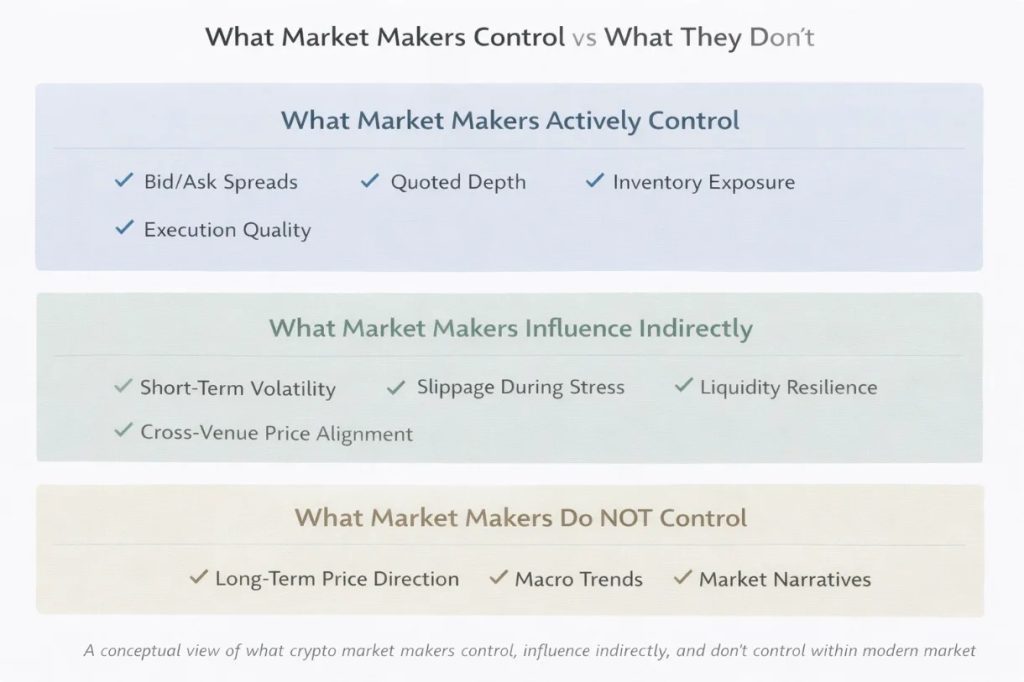
Market Makers Provide Liquidity Without Predicting Price
A persistent myth suggests market makers must know where price is headed to operate profitably. In reality, market making focuses on managing risk, not forecasting direction.
Market makers profit primarily from spreads, not directional bets. They quote prices close to the prevailing market while adjusting those quotes dynamically based on volatility, inventory, and flow.
If buy pressure dominates, their inventory shifts. They respond by adjusting prices or hedging exposure elsewhere.
If sell pressure increases, the same logic applies. At no point does this require knowing where price will end up.
This approach explains why market makers can remain profitable even in sideways or volatile markets. Their edge comes from execution discipline, not prediction.
Inventory Management: The Core of Market Making
Inventory represents the assets a market maker holds while providing liquidity. Managing that inventory sits at the heart of their operation.
Holding too much inventory exposes market makers to directional risk. Holding too little reduces their ability to quote competitively. Balancing this tradeoff requires constant adjustment.
Market makers monitor inventory in real time. When positions drift beyond predefined limits, they respond by adjusting spreads, skewing quotes, or hedging exposure.
These actions happen continuously and often invisibly to the end user.
In crypto, inventory risk intensifies due to volatility and fragmented liquidity. Market makers must manage exposure across multiple assets, venues, and time zones simultaneously.
How Market Makers Hedge Risk Across Markets
Hedging allows market makers to neutralize directional exposure while continuing to provide liquidity. In crypto, hedging rarely occurs on a single venue.
A market maker may quote liquidity on a spot exchange while hedging exposure through derivatives, perpetuals, or OTC positions. They may also hedge across correlated assets, adjusting exposure dynamically.
This cross-venue hedging explains why activity in one market often influences liquidity elsewhere. A sudden move in derivatives can affect spot liquidity as market makers rebalance risk.
Hedging doesn’t eliminate risk entirely. It transforms it into manageable components. Therefore, the effectiveness of that transformation determines whether a market maker stays active or withdraws during stress.
Why Liquidity Can Vanish Suddenly
When markets feel liquid, it’s tempting to assume that liquidity always exists. In reality, liquidity is conditional. Market makers provide it as long as risk remains measurable and manageable.
When volatility spikes, correlations increase, or uncertainty rises, risk models break down. Under those conditions, market makers widen spreads or reduce size. If uncertainty persists, they may step back entirely.
This behavior often gets misinterpreted as manipulation. In practice, it reflects risk control. Market makers don’t owe liquidity to the market regardless of conditions. They provide it when doing so remains viable.
Understanding this dynamic explains why liquidity often disappears precisely when traders expect it most.
The Relationship Between Market Makers and Exchanges
Exchanges rely heavily on market makers to function efficiently. Without them, order books thin out, spreads widen, and user experience degrades.
In return, exchanges offer incentives. These may include fee rebates, preferred access, or infrastructure support. The relationship isn’t collusive; it’s symbiotic. Exchanges need liquidity. Market makers need venues with consistent flow.
In 2026, this relationship has grown more structured. Many exchanges integrate market makers directly into launch strategies, liquidity programs, and risk frameworks.
Despite this integration, market makers remain independent actors. They adjust activity based on profitability, not loyalty.
Market Makers in DeFi vs Centralized Markets
Market making in decentralized finance differs significantly from centralized markets. Automated market makers rely on algorithms rather than active quoting, shifting risk from professionals to liquidity providers.
Professional market makers still participate in DeFi, often by arbitraging between pools and centralized venues. They supply liquidity where pricing diverges and withdraw when risk increases.
This interaction explains why DeFi liquidity often mirrors centralized conditions. Market makers act as connective tissue between systems, enforcing price consistency.
However, DeFi introduces unique constraints. Smart contract risk, gas costs, and composability affect how market makers deploy capital.
How Market Makers Interact With OTC Desks
Market makers and OTC desks operate closely, especially during large trades. OTC desks often rely on market makers to hedge exposure or source liquidity.
When an OTC desk internalizes a large trade, market makers help manage the resulting inventory risk. This collaboration distributes impact over time rather than concentrating it.
This interaction explains why OTC activity influences public markets indirectly. Market makers absorb and redistribute risk through their quoting and hedging behavior.
Understanding this link completes the picture of how large trades move markets quietly.
Regulation and Its Impact on Market Making
Regulation shapes market making indirectly by affecting capital requirements, compliance costs, and counterparty access. In crypto, regulatory clarity varies by jurisdiction, creating uneven conditions.
Market makers adjust accordingly. They allocate capital where regulatory friction remains manageable and withdraw from markets where constraints outweigh opportunity.
This dynamic influences where liquidity concentrates globally. Regulation doesn’t eliminate market making. It redirects it.
As frameworks mature, market makers adapt. Those with strong infrastructure and compliance capacity gain advantage.
What Market Makers Signal About Market Health
Market maker behavior offers insight into market conditions. Tight spreads, consistent depth, and stable quoting suggest confidence. Widening spreads and reduced size signal caution.
However, market makers don’t predict direction. Their behavior reflects risk tolerance, not sentiment. Reading it requires context.
Understanding these signals helps traders interpret conditions beyond price action alone.
How Crypto Market Making Has Changed by 2026
By 2026, crypto market making has become more sophisticated and more constrained. Capital efficiency matters more. Risk management has grown stricter. Margins have compressed.
At the same time, integration across markets has improved. Market makers operate seamlessly across spot, derivatives, OTC, and DeFi.
The role remains essential, but less visible. Market makers don’t dominate markets. They enable them.
Where It’s Headed Next
Looking forward, market making will continue evolving alongside market structure. Fragmentation, regulation, and institutional participation will shape how liquidity gets provided.
Automation may improve execution, but human risk management remains central. Market making will remain a business of judgment, not prediction.
As long as crypto markets exist, they’ll require entities willing to stand between buyers and sellers.
Seeing Market Makers for What They Really Are
Crypto market makers don’t control prices. They manage risk. They don’t dictate direction. They facilitate movement.
Understanding how they operate removes much of the mystery surrounding liquidity, volatility, and execution. It reframes markets as systems rather than battlefields.
Seeing market makers clearly means seeing crypto markets as they truly function, not as they appear on a chart.
Frequently Asked Questions:
What does a crypto market maker do?
A crypto market maker provides continuous buy and sell quotes to ensure liquidity and smooth trading.
Do market makers manipulate crypto prices?
Market makers respond to price and flow; they don’t control long-term price direction.
Why do market makers pull liquidity during volatility?
Because risk becomes harder to manage, not because of intent to manipulate markets.
Are market makers necessary for crypto markets?
Yes. Without them, execution quality and market stability degrade significantly.
How do market makers make money?
Primarily through spreads and efficient risk management, not price prediction.
How do you rate this article?
Subscribe to our YouTube channel for crypto market insights and educational videos.




Join our Socials
Briefly, clearly and without noise – get the most important crypto news and market insights first.





8
Also read
Similar stories you might like.
Crypto Guides
Crypto Market Cycles: What Actually Changes Between Each Phase
Rokas | 2026-02-06
Defi
How Stablecoin Liquidity Works & Why It Quietly Drives Crypto Markets
Rokas | 2026-02-06
Bitcoin
Bitcoin’s Cycle Is Breaking the Pattern – Raising New Questions
Patrick | 2026-02-04

Crypto News
Here’s What Drove the Crypto Crash, According to Raoul Pal
Patrick | 2026-02-02
Bitcoin
Bitcoin’s Fall Below $78k Wasn’t Just a Dip – But a Leverage Flush
Rokas | 2026-02-01
Altcoins
Solana Holds Critical Support as Activity Cools
Patrick | 2026-01-31

Altcoins
Ethereum Trades Sideways as Market Watches for Directional Break
Patrick | 2026-01-27
Bitcoin
Crypto Market Shows Early Stabilization Signals in January
Patrick | 2026-01-24
Crypto News
White House Signals Path for Banks to Go All-In on Crypto
Patrick | 2026-01-21
Bitcoin
Bitcoin Whales Keep Buying as Institutional Demand Holds Firm
Patrick | 2026-01-20