











Mt Gox logo and Bitcoin coin. Source: TechGaged / Shutterstock
Former Mt Gox CEO Proposes Bitcoin Hard Fork to Recover $5B — Developers Push Back
In Brief
- • Mark Karpeles proposed a Bitcoin hard fork to recover 79,956 BTC stolen in 2011.
- • The change would alter Bitcoin’s consensus rules, but developers quickly rejected it.
- • Critics warn the move would undermine Bitcoin’s neutrality and immutability.
Ad
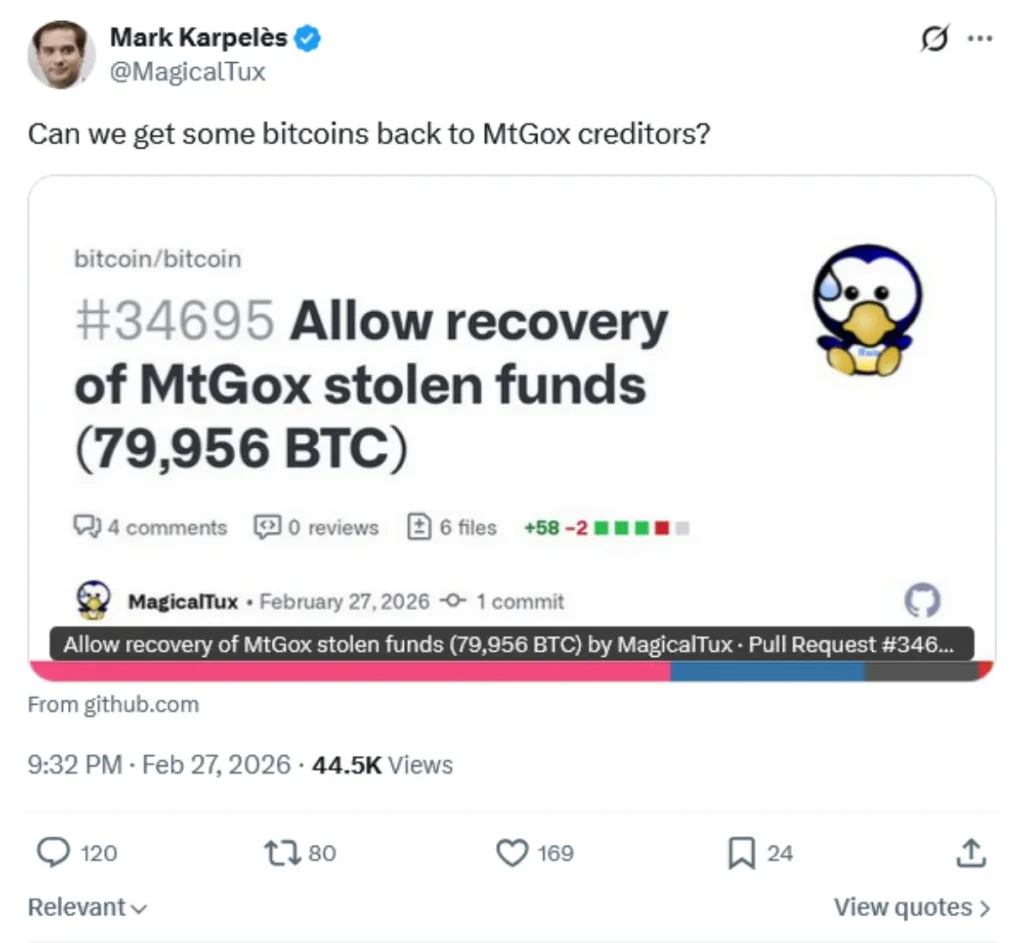
Mark Karpeles, the former CEO of defunct Bitcoin exchange Mt Gox, has sparked debate across the Bitcoin community after submitting a pull request on GitHub to the Bitcoin Core repository proposing a one-time hard fork to recover roughly 79,956 BTC stolen from the platform in 2011.
According to Karpeles’ February 27 post on X, the coins — now worth approximately $5 billion at current prices — remain untouched at a known address.
Karpeles’ proposal would modify Bitcoin’s consensus rules at a future block height, allowing the funds to be reassigned to a designated recovery address. The recovered assets would then be distributed through Mt Gox’s ongoing court-supervised rehabilitation process to creditors.
What the Proposal Would Do
Technically, the pull request would make a previously invalid transaction valid by introducing a special rule that permits spending from the specific address tied to the 2011 theft. All nodes would need to upgrade in order for the change to take effect.
Karpeles acknowledged in his submission that the change requires a hard fork — meaning it would alter Bitcoin’s consensus rules and demand coordinated adoption from miners and node operators.
The proposal was closed and locked within hours of being posted.
Swift Rejection From Developers
Bitcoin developers and long-time contributors responded quickly, dismissing the proposal as incompatible with Bitcoin’s foundational principles of neutrality and censorship resistance.
Pieter Wuille, a prominent Bitcoin Core contributor, redirected any discussion of consensus changes to the project’s formal mailing list. Other community members were more direct. Several commentators argued that rewriting Bitcoin’s rules to recover funds from a custodial exchange failure would undermine trust in the protocol’s rule-based design.
The central concern is that if Bitcoin’s ledger can be altered to compensate specific victims, it undermines the guarantee that transactions are immutable and politically neutral.
Historical Context: Mt Gox and the 2011 Theft
Mt Gox began in 2010 as a trading platform for Magic: The Gathering cards before pivoting into Bitcoin exchange services. Founded by Jed McCaleb — who later co-founded Ripple and Stellar — the platform was sold to Karpeles in 2011.
At its peak in 2013, Mt Gox handled an estimated 70–80% of global Bitcoin trading volume. However, persistent technical and operational issues culminated in its collapse in early 2014. The bankruptcy raised existential concerns about Bitcoin’s survival at the time.
The specific 2011 theft referenced in Karpeles’ proposal involved hackers using stolen credentials to move funds to a single address that still holds the coins today. While the private keys associated with that address remain unknown, the funds have never been spent.
An ETH Zurich study published in 2014 later showed that transaction malleability — initially cited as a major cause of Mt Gox’s losses — accounted for only 386 BTC.
Comparisons to Ethereum and Binance
Karpeles referenced Ethereum’s 2016 hard fork following the DAO exploit as precedent, noting on X that “Ethereum showed us doing the right thing can work.”
That fork led to the recovery of stolen funds but also resulted in a permanent chain split, creating Ethereum Classic.
Bitcoin, however, has historically resisted similar actions. In 2019, Binance CEO Changpeng Zhao floated the idea of coordinating a chain reorganization after losing 7,000 BTC in a hack. The suggestion was quickly abandoned following strong opposition from developers and users.
The Economic Barrier
While nothing in Bitcoin’s code technically prevents a hard fork if sufficient adoption occurs, the real constraint lies in incentives.
Bitcoin’s value proposition is rooted in its predictable, rule-based system that treats all participants equally. Altering the protocol to favor one group of victims — even in the case of a high-profile collapse like Mt Gox — would signal that consensus rules are subject to revision under pressure.
Such a shift could undermine confidence in Bitcoin’s neutrality and, by extension, its long-term economic integrity.
For now, the community response suggests that the proposal is unlikely to gain traction.
The pull request remains closed.
How do you rate this article?
Subscribe to our YouTube channel for crypto market insights and educational videos.






Join our Socials
Briefly, clearly and without noise – get the most important crypto news and market insights first.






8
Also read
Similar stories you might like.

Altcoins
Crypto Whale Transfers Spike Ahead of Clarity Act Decision; Here’s Why
Ana | 2026-02-27

Bitcoin
Bitcoin Bear Market Nearing End, But $30K Still Possible
Ana | 2026-02-27

Bitcoin
Bitcoin Rights Bill Clears Indiana Legislature; Here’s What It Means
Ana | 2026-02-26

Bitcoin
Bitcoin Spot Demand Turns Positive Again, Breaks Multi-Month Downtrend
Ana | 2026-02-26

Bitcoin
‘How To Buy Bitcoin’ Searches Spike To 5-Year High As Interest Returns
Ana | 2026-02-26

Bitcoin
The “Jane Street 10 AM” Narrative Meets a $68,000 Bitcoin Rally
Patrick | 2026-02-25

Bitcoin
Traders Are More Afraid Now Than During Past Crashes, Here’s Why
Patrick | 2026-02-25

Bitcoin
TD Cowen Analyst Makes Bullish Bitcoin Case: ‘Stronger, Cheaper Than Ever’
Ana | 2026-02-25

Bitcoin
Rare Solo Bitcoin Mining Win Happens Again: $200K on $75 Equipment
Ana | 2026-02-25

Altcoins
U.S. Midterms Could Drive Crypto Cycle, Analyst Says
Ana | 2026-02-25