














Crypto volatility surges beyond Great Depression-era extremes, analyst warns.
Crypto Volatility Exceeds Great Depression Extremes, Bloomberg Analyst Warns
In Brief
- • A Bloomberg analyst warns crypto volatility rivals Great Depression extremes.
- • Bitcoin is acting as a high-beta liquidity asset.
- • Market resilience is being tested.
Ad
The recent behavior of Bitcoin (BTC) and the rest of the cryptocurrency market is prompting unusually stark historical comparisons, including those by Bloomberg Intelligence strategist Mike McGlone.
Specifically, according to McGlone, crypto market swings in 2025-26 are rivaling, and in some cases exceeding, the volatility seen during the 1929-30 U.S. stock market collapse, as he observed in the analysis shared in an X post on February 3.
What The Comparison Is Showing
McGlone highlights normalized charts comparing the Bloomberg Galaxy Crypto Index with the Dow Jones Industrial Average during 1929-30. On a relative basis, crypto industry drawdowns and rebounds appear sharper and faster than those seen during the early stages of the Great Depression.
The takeaway is that risk compression and release in crypto is happening at a scale rarely seen in traditional markets. Crypto’s 24/7 structure, leverage, and reflexive speculation amplify moves that once took years into months.
McGlone also points to bond-market dynamics. In a separate chart, he suggests that falling Bitcoin prices have historically aligned with declining long-term Treasury yields, reinforcing crypto’s role as a high-beta liquidity indicator rather than a defensive hedge.
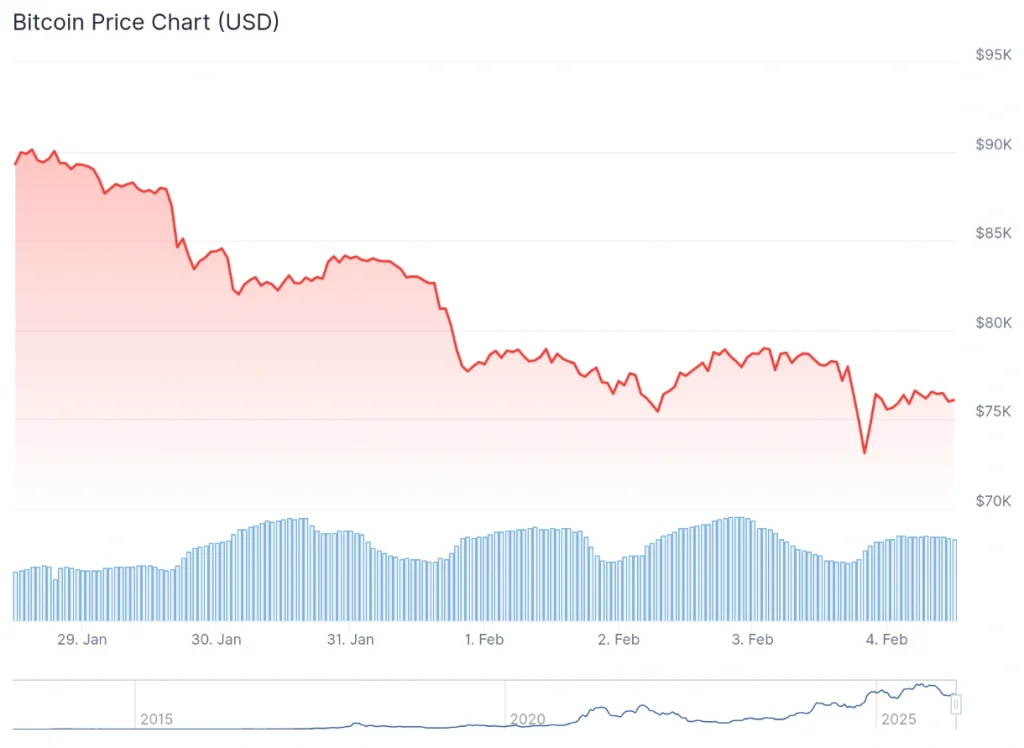
Meanwhile, BTC was at press time trading at the price of $76,069, down 2.6% on the day, losing 14.8% across the week, and dipping 18.3% over the past month, according to the most recent chart information.
Why McGlone Sees Bitcoin At A Crossroads
McGlone frames 2025 as a potential apex for risk-asset-driven inflation, with Bitcoin acting as a pressure valve. He argues Bitcoin may need to “prove strength” by holding above psychologically important levels rather than relying on perpetual inflows from exchange-traded funds (ETFs) and speculative demand.
He also notes a structural shift. Bitcoin was once the “first-born” digital asset with limited competition. Today, millions of tokens exist, ETFs have pulled in retail at scale, and speculative access is easier than ever, which are the conditions that historically appear near market peaks.
That raises the bar for what resilience looks like for Bitcoin in this phase of the cycle. Whether this period marks a generational reset or simply another violent transition remains open. What’s clear is that crypto volatility is no longer being measured against its own past, but financial history’s most extreme moments.
Bitcoin Price Today
More Must-Reads:
How do you rate this article?
Subscribe to our YouTube channel for crypto market insights and educational videos.






Join our Socials
Briefly, clearly and without noise – get the most important crypto news and market insights first.
Most Read Today
1
Crypto Trading Volume Collapse: March on Track for Worst Month Since 2020
2SEC Move Opens New Phase For Bitcoin And Ethereum ETFs
3Bitcoin Crash Fears Return as Market Pressure Builds
4New Threat to Prediction Markets as U.S. Crackdown Expands
5SEC Opens Door for Tokenized Stocks on Nasdaq – A Major Shift for Wall Street
Latest






8
Also read
Similar stories you might like.

Altcoins
Ethereum Supply Concentration Is Rising — A Quiet Shift Is Underway
Rokas | 2026-03-24

Market
A Healthy Pullback Or Something More — What Drove Crypto Markets This Week
Sead | 2026-03-23

Bitcoin
Bitcoin Supply Shift Raises New Questions Across Market
Ana | 2026-03-23
Market
Crypto Trading Volume Collapse: March on Track for Worst Month Since 2020
Jastra | 2026-03-23

Industry
U.S. Crypto Regulation Breakthrough Pushes Clarity Act Closer to Reality
Ana | 2026-03-23

Bitcoin
Bitcoin Crash Fears Return as Market Pressure Builds
Ana | 2026-03-23
Industry
New Threat to Prediction Markets as U.S. Crackdown Expands
Rokas | 2026-03-23

Defi
SEC Move Opens New Phase For Bitcoin And Ethereum ETFs
Rokas | 2026-03-23

Altcoins
$3B in RWA TVL and Counting: Can BNB Flip Solana’s Crown?
Azeez | 2026-03-22

Altcoins
Goldman Sachs Is XRP’s Biggest ETF Buyer — What the Pros See That Retail Might Be Missing
Azeez | 2026-03-22